
Introduction
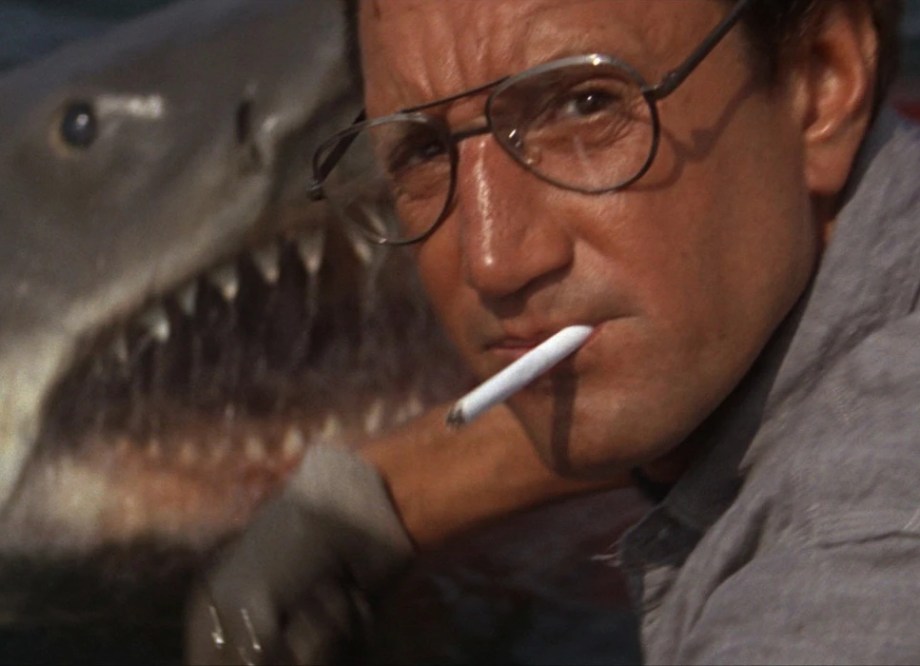
Though people often expect me to name something more arcane or highbrow, my favourite film of all time is Jaws (1975). Along with King Kong (1933), it is at film that has fascinated me since childhood and continues to enthral me as an adult to the point of credulity. More than just blockbuster or creature-feature, I love Jaws because it possesses a remarkable intelligence in rhythm and pacing, tonal discipline, emotional architecture, and narrative control. For its 50th birthday, I want to write an appreciation of a film I consider a production masterpiece.
The Production
The triumph of Jaws comes from constraint rather than scale. Its unpolished aesthetic is derived from the fraught and improvised production process where each technical obstacle invited formal invention. Coherence and intensity come through a dialectical relationship between failure and breakdown on the one hand, and perseverance and ingenuity on the other. Take the persistent mechanical breakdown of Bruce the shark. In the absence of a reliable spectacle, implication was substituted for depiction, and structure for shock; with the narrative and sensory world shaped by suggestion, spatial displacement, and negative presence.
This reconfiguration of production failure into cinematic poetry was not accidental. But drew upon the collaborative instincts of the filmmakers, particularly Steven Spielberg, editor Verna Fields, cinematographer Bill Butler, and composer John Williams, whose combined interventions recalibrated the relationship between the narrative plot and audience perception. The delays, cost overruns, and improvisational set-pieces all contrived to precipitate the film’s form. Thus, a production tarrying around a malfunctioning robotic shark was transformed into a study in atmospheric tension, rhythmic pacing, and psychological projection. In this way, the structure of film can be said to arise from a negotiation between intention and accident. It is not the expression of a pre-formed vision, but the discovery of structure in response to real-world material constraints.
Each component of Jaws operates not as isolated craftsmanship, but as an integrated contribution to a total system of tension. Butler’s cinematography, forced to improvise around the limitations of sea shooting, provides a varied selection of immersion and restriction; with the submerged perspectives, horizonless vistas, and voyeuristic tracking shots locating the viewer inside the logic of dread. Williams’s minimalist and binary, da-dum score give the shark presence when its physical appearance is absent. And Fields’s editing of raw footage provides a structure that suspends terror through an oscillation between revelation and delay.
The Editing
The tightly modulated editing of Jaws can be seen as a literal recovery of coherence and form from the teeth of contingency. That is, from technical breakdowns, delayed schedules, and logistical excess.
From the wreckage, Verna Fields’ was able to construct a regime of visibility and concealment, pacing and delay, that transformed the shark from a malfunctioning prop into a metaphysical presence. Her work exemplifies temporal regulation not imposed externally but arising organically from the interplay of shot-duration, narrative structure, and audience expectation.
Throughout Jaws, editing becomes a mechanism of affective control. Suspense is not generated by the shark’s appearance, but by its delay. The frequent recourse to reaction shots, environmental cues, and spatial ambiguity generates anticipation. These techniques do not simply heighten tension but structure how knowledge is distributed to the viewer. The film withholds, teases, and fragments, producing a dire epistemology where the viewer learns to expect harm without seeing its cause. In this way, Fields’ editing reconfigures horror not as shock, but as pacing and the orchestration of time around an absent referent.
Paradoxically, it is the shark’s mechanical failure which enhances the film’s power. Unable to rely on direct depiction, Spielberg and Fields were forced to apply and utilize ellipses as intentional omissions or narrative gaps. But these ellipses were not based on lack. Rather, the shark emerges as a structuring absence as opposed to an object, with its menace amplified by the negative space it occupies. Each cut, each delay, each omission creates junctures of meaning and significance.
There is a threefold dialectic at work here.
- First, the failure of technology produced the necessity of concealment.
- Second, that concealment became the basis for suspense.
- Third, suspense itself became a narrative driver, reorienting the film’s structure away from monster spectacle and toward character, atmosphere, and thematic resonance.
This makes the movie unfold like a chamber piece, with a privileging of sequence over sensation. The shark is rarely seen but always felt – call it the cinematics of delay.
Fields’ approaches also invites a reconsideration of authorship. While Spielberg’s directorial instincts are evident, the film’s pacing, its modulation of impending doom and dread, and its epistemic structure owe as much to the editing suite as to the camera. The auteur theory of a director as the primary creative force behind a production is inadequate to explain the film’s coherence. What emerges instead is a collaborative aesthetic, in which performance, sound, and montage all coalesce into a system greater than its parts.
The Music
The score of Jaws is not merely an accompaniment but a principal structuring device, one that recasts the status of the unseen. John Williams’s composition, deceptively simple in its architecture, operates through a logic of recurrence and escalation. Its primary motif, with a minor-second ostinato alternating between two notes, functions not as mere theme but as sonic presence, standing in for the shark itself.
This transmutation of score into narrative force reflects a deeper formal strategy as Williams’s motif generates an effect of proximity: the closer the sound, the closer the threat, regardless of visual confirmation. This decouples suspense from visibility and recasts sound as the actualizer of affective knowledge. What cannot be seen is nonetheless known, not through narrative exposition but through auditory compulsion.
In formal terms, Williams’s score operates as a kind of auditory montage. It provides a temporal rhythm, shapes expectation, and sutures otherwise discontinuous sequences into a coherent structure of direness and dread. The music’s metonymic function, with a two-note motif signifying the presence of the shark, allowed Spielberg and editor Verna Fields to construct sequences in which the threat was perceptible long before it was visible. In this way, Williams’s score enabled the film’s minimalism. The absence of the shark was no longer a liability becasue the score provided a sense of presence.
But the score is not singular. Williams employed a bifurcated system of musical language: the shark motif and a secondary, often overlooked idiom of thalassic adventure and emotional shading. The shark motif dominates the first two acts, establishing an aura of foreboding. Yet in the final act aboard the Orca, a different tonality emerges – one evoking camaraderie, risk, and masculine heroism. This dualism is not contradictory but dialectical. The primal, atonal force of the shark theme collides with the Romantic idiom of the adventure score, producing a sonic battleground that mirrors the narrative arc. The confrontation with the shark is not only physical but aesthetic: a contest between order and chaos, between melody and dissonance.
Williams’s approach in Jaws features classical orchestration reminiscent of Debussy and Mendelssohn but also has a modernist sensibility that draws upon Stravinsky and Herrmann. Yet, it strips away complexity in favour of elemental repetition where the classical idiom becomes a narrative agent as opposed to a lush accompaniment.
The epistemological function of the score should not be underestimated. In a film where knowledge is partial and misdirection is frequent (beaches closed and re-opened, narrow escapes fishing with holidays roasts, kids playing pranks with fake shark fins) – the score becomes the only reliable narrator. Its presence communicates certainty in a universe of contingency. When the motif plays, the audience knows what the characters do not. This asymmetry of knowledge creates dramatic irony but also situates the viewer in a privileged epistemic position. The score does not simply induce fear but grants foresight. It replaces the visual with the auditory as the privileged site of cinematic alethia.
The Cinematography
The cinematography of Jaws, under the direction of Bill Butler, is defined less by innovation than by adaptation. Yet it is precisely in these limitations that the film discovers its visual structure: a poetics of withholding, of occlusion, of partial knowledge. The decision to delay the shark’s full appearance (born more of mechanical failure than aesthetic deliberation) generates not a deficit but a surplus of affect as absence becomes presence.
The ocean, through Butler’s scopes and lenses, is not a neutral background but a dynamic field of tension. Horizon lines are carefully modulated, often low in the frame, generating a subtle imbalance – an instability of space that mirrors the instability of knowledge. The floating camera, especially in Brody’s beach scenes, operates as a surrogate for the unseen predator. It glides, watches, and then cuts. The now-iconic dolly zoom on Brody (tracking in while zooming out) marks the collapse of perceptual coherence. The camera does not record the event, but the psychic rupture in his subjectivity.
In underwater sequences, the visual structure shifts. The lens becomes murky, particulate, constrained. Visibility is reduced, the water itself a distorting medium. This is not the crystalline blue of adventure cinema but the oppressive, greenish density of really-existing oceans. The shark’s point of view (low-angle, tracking shots) invokes subjectivity but denies psychology. The creature is not a character; it is a force of Nature, red in Hobbesian tooth and claw. The cinematography thus constructs a visual ontology in which threat is non-anthropomorphic. Something that can only be registered as a Landian anti-human pure outsideness.
The land-based sequences obey a different logic. There, the camera is observational, often distant, architectural. On Amity Island, social relationships are framed through groupings: crowds on the beach, officials in the town hall, families clustered in domestic spaces. These compositions emphasize containment, order, and habit. When this order is punctured, the film does not use frenetic camerawork. Instead, it lingers. Slow pans, held reactions, a studied stillness that allows grief or doubt to settle. The restraint in these choices heightens their power.
The film’s spatial structure changes aboard the Orca. Here, the camera becomes intimate but never claustrophobic. Interiors are rendered through narrow lenses, hand-held movement, and oblique angles that emphasize both confinement and exposure. The sea is always visible, often framed by windows or portholes as a constant reminder of exterior threat. The cinematography enacts a visual dialectic between enclosure and openness, inside and outside. This structural opposition (land versus sea, safety versus exposure) finds its visual correlate in the film’s alternating compositional structure.
Jaws avoids the excesses of horror, with no gratuitous gore or aestheticization of violence. When the shark attacks, it does so with brute force. But even then, the camera holds back. Consider Quint’s death: the scene is horrifying not because it is stylized, but because it is framed with cold clarity. The camera does not flinch, nor does it revel – but records. The horror is in the duration, the sound, the inevitability. This ethic of restraint is what gives the cinematography its moral as well as aesthetic force.
Rhythm and Pacing
The editing of Jaws, shaped primarily by Verna Fields, operates as an intelligence beneath the surface as an unseen yet decisive force governing the film’s affective tempo, perceptual structure, and emotional modulation. Fields’ work in Jaws cultivated a rhythmic intelligence, attuned not simply to narrative pacing but to deep cadences of tension, release, and recurrence. It anticipates dread, accelerates panic, and returns the audience to a fragile equilibrium before the next disruption.
This rhythm is clearest in the alternation between stillness and rupture. Long, observational takes (such as the static beach scenes that build toward the Chrissie Watkins attack) are interrupted not by flashy montages but by the strategic intrusion of sudden violence. The attack on Alex Kintner, for instance, is preceded by a carefully choreographed series of false alarms: Pipit the dog’s disappearance, Larry with his ugly black bathing cap, and Brody being hassled as he tries to relax. Each of these is cut rhythmically, not arbitrarily. The editing layers anticipation, frustrates it, and then releases it with the briefest flash of fin, tooth, and blood. But even that violence is not lingered upon as the cut pulls back, with the camera almost unable to bear the horror.
The film’s structure, divided between Amity’s land-bound civics and the Orca’s maritime odyssey, reveals another of Fields’ strategies: the use of editing to stage a tonal change and migration. The first half of the film is constructed through elliptical rhythms, where the shark’s threat is dispersed across various plains, such political denial, local gossip, scientific warning. The editing in this phase favours digression and juxtaposition, generating a sense of social texture. By contrast, the second half tightens. Onboard the Orca, scenes unfold in real time, with minimal cutting. The rhythm slows, but tension deepens. Fields resists the temptation to quicken pace in moments of action, instead trusting duration to generate intensity.
This temporal confidence extends even to scenes of dialogue. The epic exchange between Quint and Hooper regarding the USS Indianapolis is edited with a refusal of flourish. No cross-cutting, no reaction shots to heighten pathos – just the slow, inexorable build of Quint’s monologue. The editing here respects both the performance and burden of time. Fields’ editorial choices let the scene speak and allow the viewer to feel without manipulating beyond what is necessary with minimal ethical intervention.
Elsewhere, Fields is more active but never gratuitous. Consider the quick cross-cutting during Brody’s final confrontation with the shark. The rhythm accelerates, but the logic remains grounded in intelligibility. Each cut serves a perceptual function: to track the shark’s location, Brody’s responses, and the sinking boat with dispersing flotsam. Nothing is ornamental. Even the climactic explosion, which in lesser hands might have dissolved into indulgent spectacle, is tightly framed, quickly resolved, and followed by silence. Fields uses the cut not to announce victory but to return the film to stillness of a relieved Brody clinging to the Orca’s mast.
Perhaps most distinctive is how Fields’ editing functions as a mode of unseen emotional architecture. The film never tells the viewer how to feel but orchestrates conditions in which feeling emerges. This is achieved not through overt manipulation, but through the precise calibration of temporal intervals, of what is shown and withheld, and for how long. The editing guides attention and calibrates fear without ever declaring itself.
The Shark
The shark in Jaws is not merely an animal, nor simply a monster, but an ontological rupture – an entity that exists at the limit of comprehension, resisting symbolic containment and destabilizing human categories of threat, agency, and meaning. Its status within the film oscillates between the biological and the mythic, the empirically visible and the metaphysically opaque. Spielberg’s genius, reinforced by the production constraints of the malfunctioning mechanical shark, is to withhold the creature from view for much of the film, thereby preserving its ontological indeterminacy. The shark becomes as kind of fearful finned signifier capable of absorbing ecological, political, and metaphysical meanings without ever resolving into a single, coherent referent.
From the perspective of cinematic ontology, the shark functions as an absent presence. It exerts force, produces effects, generates panic while remaining unseen for extended durations. This displacement, far from diminishing the creature’s power, intensifies it. What is feared cannot be fully known; what is not seen cannot be assimilated into the rational grid of human order. The shark’s attacks are filmed not as expressions of animal behaviour, but as eruptions from beneath: from under the sea, from beneath the social order, from within the unconscious. It is this underworld resonance that gives the creature its metaphysical potency.
Such potency is reinforced by the aesthetic structure of the film. John Williams’ score renders the shark’s presence into pattern. But the minimalist motif of two alternating notes discloses not the shark’s psychology (which is non-existent), but its pure instinctive drive. The music signifies not intention, but inevitability. The shark is not evil; it is indifferent (amoral as opposed to immoral as Nietzsche would have it). It cannot be reasoned with because it lacks interiority. The mechanical failure of the shark prop, far from hindering the film, permitted Spielberg and editor Verna Fields to withhold its visual presence, thereby enhancing its metaphysical one. The shark becomes a kind of philosophical abyss – an embodiment of blind appetite, of the non-human Real.
Yet the shark is not merely an abstract symbol. It is also embedded in a network of social, ecological, and historical references. The film emerged in the wake of the Watergate scandal, the 1973 oil crises, and the Vietnam War – amid a growing sense of institutional failure and economic downturn, and ecological precarity. You could even call Jaws a leitmotif for the Ford presidency.
The shark, indifferent to human hierarchies, disrupts the complacency of Amity’s civic order. Its arrival exposes the fragility of governance, the inadequacy of expertise, and the limits of technocratic rationality. Brody, the chief of police, cannot prevent the deaths. Hooper, the marine biologist, cannot predict the shark’s behaviour. Quint, the grizzled hunter, cannot subjugate it with wit and guile. Each fails in their own way, revealing that the threat lies not merely in the shark, but in the human desire and hubris to master unconquerable Nature like Xerxes lashing the sea.
In this sense, the shark functions not only as a non-human threat, but as a rebuke to anthropocentrism. It is not a villain in the narrative sense, but it a disruption of narrative itself. Its attacks are not plot points, but irruptions. Spielberg frames the shark not as a character, but as a force, a pressure, a rupture.
To interpret the shark as a mere symbol is to reduce its ontological strangeness. Its power lies in its refusal to symbolize fully. It resists allegory and persists as excess. The brilliance of Jaws is that it allows the shark to remain alien by existing on a different plane from the human characters. The film stages an encounter not with otherness-as-difference, but with otherness-as-indifference. All it does is swim, eat, and make little sharks.
The final confrontation on the Orca thus becomes a confrontation with that which cannot be assimilated. The shark is defeated but not comprehended. As the blasted and ruined body slowly sinks in bloody spirals to the ocean floor, this defiance is signalled through the release of a primal engine-like roar. Over this, Williams’s score offers a delicate, almost melancholic motif, like falling snow – an aural gesture of elegy rather than triumph. It evokes a fleeting sense of pity for a creature of Nature that failed to be understood. Beyond a Hegelian part of no part, like Bataille’s base matter, the shark is obscene, excessive, and radically indifferent to human meaning and intention.
The Characters
The second half of Jaws, confined largely to the spatial enclosure of the Orca, shifts the film’s from public panic to private drama. Within this maritime chamber piece, the interpersonal dynamics between Brody, Quint, and Hooper develop into a layered dialectic – one that both enacts and unsettles archetypes of class, authority, and knowledge. The boat becomes a stage upon which competing masculinities, ideologies, and forms of expertise are tested, compromised, and reconfigured in the face of the shark’s implacable threat. The Bakhtinian concepts of dialogism, heteroglossia, the carnivalesque, and polyphony can all be mobilised to perform analysis here.
Each character is initially defined by an operative epistemology. Brody, the police chief and outsider, represents civic duty, procedural order, and moral instinct. His authority is jurisdictional but fragile; he is afraid of water, uncertain in crisis, and newly arrived on the island. Hooper, the oceanographer, stands for technocratic expertise, scientific rationalism, and privileged urbanity. He is wealthy, educated, and confident in his instruments. Quint, the shark hunter, is uncouth, instinctual, and mythic. His authority is earned, embodied, and traumatic. He is a besotted Melvillean Ahab, animated by resentment, and haunted by war.
These three men are not symbols but social types in friction. Spielberg and screenwriter Carl Gottlieb permit their conflicts to emerge gradually, building tension through gesture, interruption, silence, and contempt. Dialogue is deployed not merely for exposition, but as performance, with each character asserting dominance or retreating into ambiguity depending on the dramatic structure of the scene. The tone alternates between banter and aggression, humour and hostility. What emerges is not a hierarchy but a triangulated dynamic, shifting with each encounter.
Nowhere is this more evident than in the famous USS Indianapolis monologue, delivered by Quint in low light, the three men half-drunk and briefly suspended in mutual recognition. The scene operates as a narrative and tonal pivot, transforming the film from a creature-feature into a meditation on trauma, memory, and mortality. Quint’s story does not merely explain his hatred for sharks; it reorients the film’s emotional centre. His authority is no longer performative but becomes experiential. The monologue, written in part by John Milius and improvised by late and great Robert Shaw, opens a fissure in the film’s structure, allowing a moment of historical horror to bleed into the fictional world.
What follows is a brief solidarity, a moment of masculine bonding through scars, songs, and broken-hearts, through alcohol and vulnerability. But the harmony is short-lived. The shark returns, battering the hull and the fragile truce with it. From here, each man is pushed to his limit: Hooper is nearly eviscerated in a shark cage; Quint, the salty seadog is devoured; and Brody, alone and afraid, improvises a solution (perhaps taking cues from the books he read earlier, one which features a shark devouring a scuba tank?). His victory is as much comic as heroic, underscoring the film’s refusal to affirm any one epistemology.
In this way, Jaws deconstructs character expectations. The expert fails, the warrior dies, the bureaucrat survives. But all experience personal growth and change. Spielberg’s direction sustains this intimacy through close framing, shallow focus, and unpolished rhythm. The editing allows for interruption, silence, and the unspoken. Characters do not always answer one another; they interrupt, defer, or stare.
Bound in the mutual sharing of an ordeal, the Orca becomes an allegorical space – not of redemption, but of reckoning. Each character faces the limit of his identity and the breakdown of his role. The shark does not merely threaten their lives; it forces them into confrontation with themselves and each other. This is the deeper logic of the film: not human versus Nature, but humanity exposed by the presence of what cannot be negotiated.
Thinking of the opening lines from Homer’s Iliad, the word agon (strife) can be interpreted as a bringing together in contest, which implies an original distance or separation. On the Orca, Brody, Hooper, and Quint (along with their personalities, backgrounds, ideals, etc.) are all brought into contest by strife as a structural form by the shark which is the form of strife itself.
Conclusion
Fifty years on, Jaws remains more than a benchmark of popular cinema; it is a masterclass in formal precision, tonal control, and narrative economy; with its enduring power derived from a meticulous interplay of sound, image, and performance. We spend barely two-hours with Brody, Hooper, and Quint yet we learn more about them as people in this time than most TV drama series can manage over entire seasons.
 The Beginning of Terror