
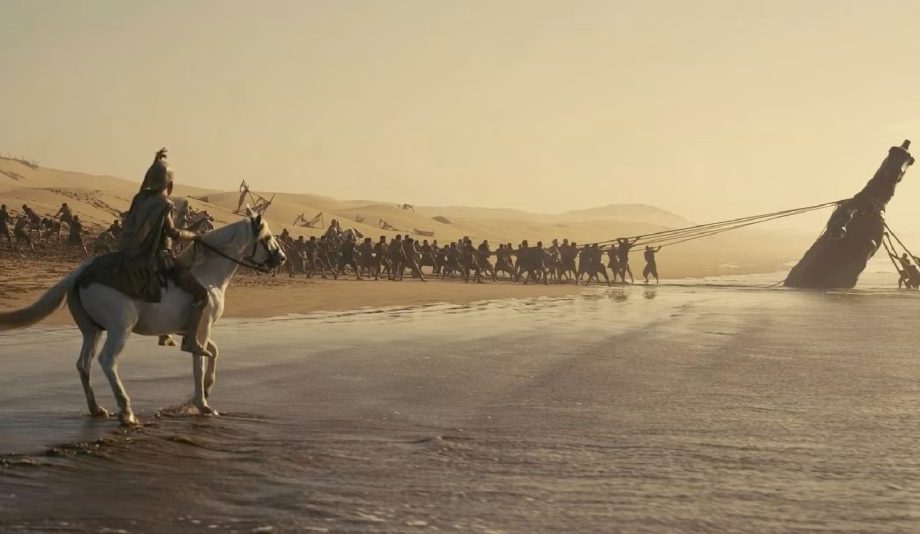
The Odyssey (Universal Pictures, 2026), directed by Christopher Nolan.
In 2007, aged nineteen, I travelled around Greece with the faintly ridiculous expectation that I might find people wearing togas and discussing the meaning of being. What I found instead was a modern European country and the Eastern Orthodox Christianity to which I would later convert. The classical Greece I had made for myself out of books was nowhere to be found.
Nolan gave me back something of it: the rosy-fingered Dawn and the wine-dark sea I had carried around in my head since adolescence, with all its elemental density – sea, stone, sunlight, timber, and wind. Several times during the film I found myself with a lump in my throat, and once or twice with tears in my eyes, at images that were hardly doing anything in narrative terms but conveyed some of that old Burkean sublimity where beauty crosses over into something frightening because the world has suddenly become much larger than you are. Much like when you stand on the beach at Calgary Bay on Mull and realise that nature doesn’t give a flying fuck about you.
Hoyte van Hoytema’s cinematography has a combination of what I will call Spielbergian in-boatedness and a Tony Scottian up-in-the-airness. By in-boatedness, I mean the camera gets down among the wet timber, ropes, sails, and armoured bodies, close enough to the waterline that the sea keeps getting in the way of what you are trying to see. The boat is at once a sanctuary and a prison. Beyond it is apparently empty water, but its emptiness is exactly what makes it threatening. You cannot see what is beneath it or what lies beyond the horizon.
Then Nolan and van Hoytema start throwing that horizon around. Sunlight flashes off skin and metal; faces, rigging, and open sky are cut together. By up-in-the-airness, I am referring to that understanding by Tony Scott of how to make movement itself exhilarating. At times Nolan’s ships appear to have been tossed into a great zibaldone of water, wind, and sky. The camera pitches with them rather than looking on from somewhere stable. Anyone prone to motion sickness should probably take precautions.
That physical quality runs through the whole film. Shooting entirely on IMAX gives Nolan the scale he wants, but, as in Oppenheimer, he is just as interested in what the format does to a face. The same image that can make a ship look tiny beneath an enormous sky can, a moment later, fill the screen with the smallest change in expression. Damon and Hathaway are particularly well matched because both are actors who can do a great deal with small facial gestures: Damon’s crooked smirks and half-smiles suit a man forever calculating his next move, while Hathaway’s rabbit-quick shifts of eye, lip, and nose give Penelope an equally active inner life without requiring her to say what she is thinking. Tom Holland, too, can shift through the gears of emotion almost entirely through his large eyes and the tightening or slackening of his mouth. Homer called Odysseus polytropos, the man of many turns, and Damon makes those turns visible. He survives because he can become whatever a situation demands of him, and IMAX gives equal weight to the vast world through which he moves and to the tiny betrayals of expression that suggest what twenty years of such adaptation have done to the man himself.
That is also why Nolan’s usual fondness for non-linear storytelling works here better than it often does. Homer never tells the story in a straight line either. The Odyssey begins when the journey is already nearly over, moves back and forth between Ithaca and Odysseus abroad, and lets Odysseus himself tell much of what happened earlier.
Some things are inevitably lost. The gods have less independent life than they do in Homer, some of the poem’s moral ambiguities are tidied up, and the long process by which Odysseus is recognised and becomes himself again has to happen faster. Nolan recovers some of that richness through the intensity of the acting and rawness of the cinematography. Oddly enough, the film is at its most spectacular when nothing very spectacular is happening.
This is the danger inherent in historical fiction. John Julius Norwich, introducing Robert Graves’s Count Belisarius, called it perhaps the most dangerous literary form because it has to combine historical explanation and interpretation with constructive imagination. The same is true of historical cinema. The temptation is to make the past intelligible by making it morally familiar: to give ancient people our assumptions, our sympathies, and our arguments, until history becomes little more than a contemporary moral allegory in period dress. Imagination ought to do the opposite. It should make another way of seeing the world imaginable without first requiring that it agree with our own.
Homer himself was already dealing with a version of this problem. The Greece of the Odyssey was already partly an act of imagination. Nolan is therefore adapting not a historical record but one civilisation’s memory of an earlier one.
That helped me past my usual objections to colour-blind casting. My problem with it has never simply been that people of a particular appearance may not have been present in a particular place. The larger danger is that historical difference gets rubbed away and the past begins to resemble the present with different scenery. Here, though, the casting feels closer to what we accept without difficulty in a Shakespeare adaptation. Helen, Penelope, Odysseus, and Telemachus stopped belonging exclusively to historical Greece a very long time ago. Like Macbeth or Julius Caesar, they have been retold so often that they now belong as much to literature and performance as to history. What is of interest is how they portray these characters. Without giving too much way, I had to restrain from applauding when Lupita Nyong’o’s Helen turned the other cheek. It was as if Nolan had anticipated the “go woke, go broke” backlash from grass-fed-beef-gnashing teeth.
Nolan does make an interesting use of xenia to explore a contemporary political reality. The Trojan Horse becomes a corruption of the bond between guest and host: the Greeks win by learning how to turn trust into a weapon. By the time Odysseus returns to Ithaca, the same breach has come home with him, where the suitors have entered as guests and settled in as occupiers.
There is something almost Scottish Enlightenment about that idea. By this, I mean that civilisation is built less upon the rule of law than upon the customs, expectations, courtesies, and restraints people observe without anyone having to enforce them. These habits are fragile precisely because they work best when nobody is thinking very hard about them. Nolan’s Odyssey understands that civilisation does not collapse only when barbarians arrive from somewhere outside it. Civilised people can manage the job perfectly well themselves once they begin to take their customs and obligations for granted, or to believe that some people are above them.
Perhaps something worthwhile can emerge from that destruction. Nietzsche’s ancient Greece was a culture of agon: competition, rivalry, ambition, and the desire to excel, with greatness produced not by the absence of conflict but by giving conflict forms in which it could become creative. Perhaps an exhausted liberal order will give way to new forms of courage, excellence, and cultural creation.
The film is too long, and the sword fights are overdone. But this seems to be the way of things now, with large-scale cinema increasingly expected to justify itself through duration and spectacle more than genuine storytelling. We have a plague of bigness upon our cinema houses, too often mistaken for epicness: films made longer, louder, and more expensive in the belief that sheer magnitude will supply what the form itself has failed to provide.But what Nolan has managed to produce an epic in the Tolkienian sub-creative sense of a secondary world that possess an inner consistency of reality where all the parts seem to belong to the same imaginative order.
 The Beginning of Terror