
Introduction.
Through a comparative study of J.R.R. Tolkien and William James — the purpose of this essay is twofold.
1. To demonstrate the enactive potency of imagination in lived experience. This is to say that human volitional action is motivated by a fidelity to ideal notions with a tangible and visceral quality as real as the empirical world in which they are enacted.
2. That imagination and fantasy perform a function in alerting and preparing subjectivity to the possibilities for enacting endeavours of betterment and melioration with the world.
Tolkien on Imagination and Fantasy.
In a letter to Amy Ronald, dated 15th December 1956, Tolkien wrote that:
“I am a Christian, and indeed a Roman Catholic, so that I do not expect ‘history’ to be anything but a long a ‘long defeat’ — though it contains (and in a legend maybe contain more clearly and movingly) some samples or glimpses of final victory.” (L195, p255, LT)
Here is a recognition of human fallenness and an acknowledgement that history, in contrast to eternity, is nothing but a linear series of defeats, failures, and disappointments running down from Eden.
Elsewhere, in his lecture Beowulf: The Monsters and the Critics, he writes:
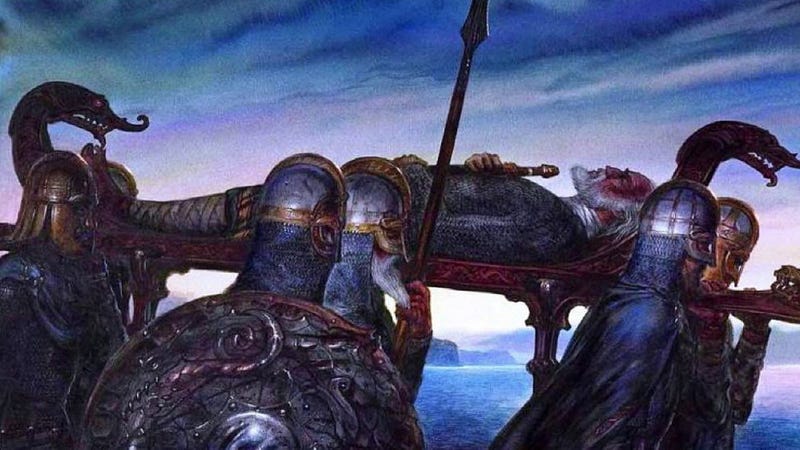
When we have read this poem, as a poem, rather than a collection of episodes, we perceive that haelel under heofenum may have meant in dictionary terms “heroes under heaven,” or “mighty men upon the earth,” but he and his hearers were thinking of the eormengrund, the great earth ringed with garsecg, the shoreless sea, beneath the sky’s inaccessible roof; whereon, as in a little circle of light about their halls, men with courage as their stay went forward to that battle with the hostile world and the offspring of the dark which ends for all, even the kings and champions, in defeat. (MC, P18)
Furthermore, in On Fairy-Stories, he observes:
The consolation of fairy-stories, the joy of the happy ending: or more correctly of the good catastrophe, the sudden joyous ‘turn.’ … does not deny the existence of dyscatastophe, of sorrow and failure: the possibility of these is necessary to the joy of deliverance; it denies (in the face of much evidence, if you will) universal final defeat and in so far is evangelium, giving a fleeting glimpse of Joy, Joy beyond the walls of the world, poignant as grief. (MC, p153)
We need not retell Tolkien’s travails during the Great War here, though it is worth acknowledging how he produced works of such profound and solemn beauty from the absolute depths of tragedy and despair. In the Beowulf lecture, the narrative movement is from light to darkness, while On Fairy-Stories it is the inverse. But both recognise the complimentary relationship of positive and negative potencies: of joy and sorrow, love and loss, fallenness and redemption, light and darkness, etc.
The argument of the Beowulf lecture, couched in allegory, is that the fantastical poem has a value in itself as a work of art, not merely as a historical document; and that it proposes the existence of a supermundane reality beyond the shoreless sea and vault of heaven. On Fairy-Stories expands from this point and develops a more methodological expostulation.
For Tolkien, fairy-stories satisfy the human spirit in four ways: Fantasy, Recovery, Escape, and Consolation. Fantasy is primary, the other categories are derivative, originating as experiential responses to the former. He then takes issue with the thinking of Samuel Taylor Coleridge, of whom the fellow Inkling, Owen Barfield — wrote a treatise. Inspired by German idealism, Coleridge parsed the human imagination into three categories: Primary, Secondary, and Fancy. The first species is a manifestation of the divine Logos in the human mind; the logoi, so to speak — the little ideas deriving from the one big idea. The secondary aspect is these little ideas infused with conscious human volition — the inaction of an idea through individual will. The third variety is a mode of remembrance with no active potency.
Tolkien takes issue with the demeaning of the fantastical. For him, imagination is “the power of giving to ideal creations the inner consistency of reality…the perception of the image, the grasp of its implications, and the control, which are necessary to a successful expression, may vary in vividness and strength: but this is a difference of degree in Imagination, not a difference in kind” (MC, p138–139). Fantasy, or fancy, is “the making or glimpsing of Other-worlds” (MC, p135), providing a “freedom from the domination of observed fact” (MC, p139). Fantasy, then, is the execution and enactment of the human imagination in a deliberate and disciplined manner.
Regarding Tolkien’s derivative movements of the human spirit: Recovery, Escape, and Consolation, the following can be said. Recovery is reclamation of a worldview undimmed and unsullied by over-familiarity and repetition — childlike wonder. Escape and Consolation are mutually implicated and arise from the same root, the need for diversion and distraction from a world that is nasty, brutish, short, and in modernity — ugly. While the need for escape and consolation in the face of harsh reality is regularly mocked and derided, seen as weak and effete, Tolkien defends it as a valid human need. When he speaks of Escape and Consolation as a desire “as ancient as the Fall” (MC, p152), Tolkien is motioning beyond mere misty-eyed nostalgia or trite sentimentality towards the agonising longing all human beings feel for their childhood: “a sense that it was a severance; a strange fate and guilt lies on us” (Ibid). The use of the words severance and guilt is crucial. Severance denotes not merely an estrangement or gradual drift from origins but a harsh cutting-off from the past. Then there is the guilt that such circumstances were permitted to happen, a responsibility lying with the individual self. In Christian terms, there a the falling from God, from nature, from others, and from the self.
What the contemptible happily-ever-after of fantasy provides is metanoia: a change of mind, a reorientation, a fundamental transformation of outlook — towards the world, self, others, and God. In short, an opportunity for repentance and redemption. For Tolkien, the joy experienced in fantasy has “the very taste of primary truth. (Otherwise its name would not be joy!” (MC, p156). This is to say that fantasy engenders a disposition of readiness to envision and enact the providential intentions of God for the cosmos. For Tolkien as Christian, the incarnation, death, and resurrection of Christ is the ultimate original (and true) story from which all other fantasy stories derive — they are the secondary manifestations (logoi) of the singular Logos.
William James on Imagination and the Will to Believe.
In The Varieties of Religious Experience, William James stated the following:
The further limits of our being plunge, it seems to me, into an altogether dimension of existence from the sensible and merely “understandable” world. Name it the mystical region, or the supernatural region, whichever you choose. So far as our ideal impulses originate in this region (and most of them do originate in it, for we find them possessing us in a way for which we cannot articulately account), we belong to it in a more intimate sense than that in which we belong to the visible world, for we belong in the most intimate sense wherever our ideals belong. Yet the unseen region in question is not merely ideal, for it produces effects in this world. When we commune with it, work is actually done upon our finite personality, for we are turned into new men, and consequences in the way of conduct follow in the natural world upon our regenerative change. But that which produces effects within another reality must be termed a reality itself, so I feel as if we had no philosophic excuse for calling the unseen or mystical world unreal. (VRE, p515–516)
For James, like Tolkien, imagination has an enactive potency. The belief in a reality beyond the walls of the world is essential for structuring and contextualising ideals, as well as informing moral life. Although ethical and religious experiences are of different orders, the religious possesses an ethical dimension owing to the inherent superiority of imagined realms over empirical world. This is to say that mystical regions are typically not just other than the world but also better — and as such, this provides a foundation, justification, or authority for ethical action.
In The Will to Believe (p41–52/p111–145), James presented a reflex action model of the self, composed of three departments: perception, conception, and volition. The function of the former is to encounter the lived environment and glean impressions for the conceptual department which is responsible for theorising ideas that are passed onto the volitional department for enaction. Conception occupies a mediative place between perception and volition. It is dependent upon perceptual impressions for content and its prescriptions are not complete unless they manifest as volitional discharges capable of real and substantial effects within the lived environment in which the self is embedded.
Consciousness for James arises from an interaction of mind, body, and world — with subjectivity being fundamentally embodied and implicated in a lifeworld. Thus, imagination is irrevocably dependent upon sensory perception for its content. Motivated by personal interest and concern, the perceptual faculty discriminatingly selects impressions from the singular and seamless stream of consciousness of experience which are then worked-over by the conceptual faculty — comparing, associating, refining, etc.
In the second volume of The Principles of Psychology, James states that:
Fantasy, or Imagination, are the names given to the faculty of reproducing copies of originals once felt. The imagination is called ‘reproductive’ when the copies are literal; productive’ when elements from different originals are recombined so as to make new wholes. (PP2, p44)
Here James distinguishes between reproductive and productive imagination. The former generates literal copies of impressions, while the latter cuts and pastes them to form new images. Thus, even the wildest fantasies are a recombination of images with a sense-based origin. Productive imagination can function in the positive activity of Tolkien’s recovery, escape, and consolation, or in the negative dynamics of dysfunctional cognition, emotional instability, and clinical insanity. But regardless of whether it is realistic or fantastical, reproductive or productive, diversionary or clinical — imagination is rooted in the empirical lived environment.
What is interesting about James’ thinking regarding Tolkien is that he was reluctant to impose sharp a priori distinctions between reality and fantasy. This is because the cosmos for James was not a static and complete entity with nothing new under the Sun, but a variable and evolving process. To relate one analogy — the world is not a fishtank with all things contained and presentable but a decorative adornment with various disparate parts forging a coherent mosaic whole. It is very much a relational universe where all parts are interconnected, even if perilously vague and tenuous.
Given that consciousness is the product of an embodied subjectivity embedded in a lifeworld, in peaking of what he termed religious genius, James identified that certain individuals are naturally gifted with an inherent sensitivity and sentimentality permitting them to detect resonances within the lived environment that may not necessarily be open to the majority with their lesser receptivity and discernment — these are the artists, sages, and fools.
Imagination is a cognitive faculty which can provide genuine, deep, and abiding insights into the nature of reality. Whether religiously inspired or manically conjured, the distinction between these experiences is less important than the effect they have on the lived experience. As a pragmatist, James held that imaginative and fantastical experiences should be considered real to the extent that they have concrete impacts and effects upon embodied conscious action, regardless of rational explanation and objective verification.
He was opposed to a naïve realism which posits perception as a direct and unmediated reflection of the given world. Perception is not a receptive process but a constructive one — with a recondite history influenced by personal scruples, current interest, future prospects, inherited values, previous experience, etc. The individual feeling of reality is contingent upon the efficacy of conceptual and ideal notions to produce real world outcomes when volitionally enacted. Anxiety, unease, and disjunction arise when conceptual enaction fails and ideals cannot be realised or reflected in the empirical world. But inversely, successful conceptions can create the circumstances by which the non-empirical reality can appear or feel more real that the spatial-temporal cosmos. What is important with the Jamesian notion of the will to believe is that there is a conception to willingly believe in — there must be visceral and tangible content which volition can subscribe to and want to enact in fidelity.
In Eastern Patristic theology, the immanent Incarnation of Christ is referred to as a thickening of a transcendentally thin God. As such, it could be said that believable and enactable imaginative content has a palpable thickness. Even with the Incarnation, Jesus Himself observes in John 20:29 that although the Apostles were gifted a vision and presence of the Risen Christ, and in Thomas’ case — to prod and probe, there are others who were blessed because they had not seen Him and yet believe because the event had such visceral imaginative potency.
Willam James and Tolkien on the Melioristic Endevour.
Like Tolkien with his notion of the long defeat, James also felt a “genuine sense for the tragic” (ECR, p18), where the hope of meliorisation was founded in a “Rembrandtesque moral chiaroscuro” (WB, p59) — that is, a world defined by the contrast of light and darkness, love and loss, good and evil, happiness and sadness, etc.
Writing in The Varieties of Religious Experience, James finds melancholy sourced in the recognition of the “evil facts” which constitute “a genuine portion of reality” (VRE, p163). In drawing the distinction between a sick soul and the healthy-minded, the former will avow the existence of evil while the latter averts “one’s attention from evil” and “breaks down impotently as soon as melancholy comes” (Ibid). Meanwhile, the reality of evil is a “grisly blood-freezing heart palsying sensation” (VRE, p162) for the melancholic sick soul. This is not an intellectual experience but a somatic one, registered intimately and intensely by the embodied subject. It should be noted here that James considered emotions and feelings as perceptions of physiological alternations. For him, the sensitivity of a sick soul to the actuality of sorrow, suffering, and death provided sounded religious grounds than those proposed by the healthy-minded — as James states: “The completest religions would therefore seem to be those in which the pessimistic elements are best developed” (VRE, p165).
Speaking of twice-born souls — those who have discovered a new way of living and relating to their own existence from a place of sorrow and despair, James writes:
They had drunk too deeply of the cup of bitterness ever to forget its taste, and their redemption is into a universe two stories deep. Each of them realized a good which broke the effective edge of his sadness; yet the sadness was preserved as a minor ingredient in the heart of the faith by which it was overcome. (VRE, p187)
A twice-born soul is two stories deep to the extent that they preserve evil as a “minor ingredient” (Ibid) in their revised and renewed lebenschauung.
In The Will to Believe and Other Essays (more specifically — The Moral Philosopher and the Moral Life), James laments that:
The actually possible in this world is vastly narrower than all that is demanded; and there is always a pinch between the ideal and the actual which can only be got through by leaving part of the ideal behind. (WB, p73, his emphasis)
He describes the moral universe as a “howling mob of desires” (WB, p71) which require “butchering” if they are to be compatible, realizable, and assignable within the nasty, brutish, and short medium of empirical reality. Moral life is a constant process of negotiating and compromising between a plurality of empirical obligations arising from cornucopia of divergent and contesting ideals. As James observes: “See everywhere the struggle and the squeeze; and everlastingly the problem of how to make them less” (WB, p72–73)
While optimists consider redemption and salvation inevitable, pessimists deem it impossible. Meliorism differs from these by treating the question as possible — there are Tolkienesque glimpses of victory. Or, as James puts it: “as a possibility, which becomes more and more of a probability the more numerous the actual conditions of salvation become” (P, p125).
Four central tenants of meliorism can be defined:
1. It accepts that the creation of a better world entails and involves risk.
2. It encourages dedication and action.
3. It is social, involving collective volition and effort.
4. It is pluralistic and piecemeal in nature, not monistic or totalizing.
The meliorist can be described as a character two-stories deep to the extent that they accept the possibility of loss and setbacks within their project of betterment. Indeed, as James states: “When the cup is poured off, the dregs are left behind forever, but the possibility of what is poured off is sweet enough to accept.” (P, p129). Thus, the meliorist is “willing that there should be real losses and real losers, and no total preservation of all that is” (Ibid).
Writing in The Dilemma of Determinism (featured in The Will to Believe and Other Essays), James argues that meliorism, while orientated towards the future, is infused with a sense of immediacy:
Now, it is entirely immaterial, in this scheme, whether the creator leave the absolute chance-possibilities to be decided by himself, each when its proper moment arrives, or whether, on the contrary, he alienate this power from himself, and leave the decision out and out to finite creatures such as we men are. The great point is that the possibilities are really here. Whether it be we who solve them, or he working through us, at those soul-trying moments when fate’s scales seem to quiver, and good snatches the victory from evil or shrinks nerveless from the fight, is of small account, so long as we admit that the issue is decided nowhere else than here and now. That is what gives the palpitating reality to our moral life and makes it tingle. (WB, p69)
This realization of the possibilities latent within the here and now is exactly the function Tolkien identified for fantasy — to alert and prepare subjectivity for the chance and opportunity to enact an ideal or initiate change within the given world.
In contrast to the mere faith and hope characterising optimism, as well as the fatalism and nihilism of pessimism — the immediacy of meliorism entails courage. It this same courage that Tolkien speaks of in his Beowulf lecture — those mighty men upon the earth, like James’ finite creatures such as we men are — who leave the light to battle with darkness and all its embodiments. As Tolkien notes: “It glimpses the cosmic and moves with the thought of all men concerning the fate of human life and efforts” (MC, p33). What is more, the fight is not merely against other men but monsters embodying darkness, and as such, the inhumanity of the foes renders the story of Beowulf’s death through valour more profound and significant. He is the proxy for humanity in general, and the heroes among it — of “man fallen and not yet saved, disgraced but not dethroned” (MC, p23).
In the footnotes to the lecture, Tolkien also draws attention to the fact that monstrosity in the poem is psychological, not allegorical. This is to say that the “foe is always within and without; the fortress must fall through treachery as well as assault…Thus Grendel has a perverted human shape…For it is true of man, maker of myths, that Grendel and the Dragon, in their lust, greed, and malice, have a part in him” (MC, ft23, p46). If the Dragon is the darkness outside of humanity — the strife, suffering, and death found in the world; then Grendel is the darkness inside — the depths and depravity of the soul.
Thus, using the potency of their imaginative faculties to conjure and conceive melioristic ideals, humanity must also have the readiness and courage to implement them — striving for both personal and social change and improvement. That is, within the fortress of their being, and without.
Sources and References.
~ (LT) The Letters of J.R.R. Tolkien (HarperCollins, 2006).
~ (MC) The Monsters and the Critics and Other Essays by J.R.R. Tolkien (HarperCollins, 2006).
~ (VRE) The Varieties of Religious Experience by William James (Penguin Classics, 1982).
~(PP2) The Principles of Psychology: Volume Two by William James (Dover, 2000).
~ (ECR) Essays, Comments, and reviews by William James (HUP, 1987).
~ (WB) The Will to Believe and Other Essays by William James (CreateSpace, 2014).
~ (P) Pragmatism and Other Writings by William James (Penguin, 2000).
 The Beginning of Terror