
Introduction
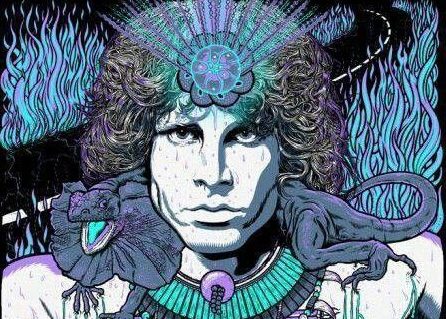
The two chords of my sonic America are Johnny Cash and Jim Morrison.
The former is the music of prisoners, murderers, drifters, and condemned men. But even at its bleakest, Cash’s spare boom-chicka-boom rhythm encloses their alienation, guilt, and despair with a moral order where the long penitential arc bends towards salvation. It is like a train under steam from the poverty and hardship of the Slough of Despond in the Delta Blacklands to Bunyan’s Celestial City.
Morrison, meanwhile, like Cormac McCarthy, understood that American modernity had not abolished the old frontiers and wilderness, so much as striped them with freeways, silenced then with chattering television sets, and illuminated them with neon lights. By the late 1960s, the Truman–Eisenhower dream of mass affluence had begun to corrode like the cooling elements of a mass-produced refrigerator, as the confidence it had produced was being booby-trapped in the jungle by the Vietcong, tear-gassed and water-cannoned across the South, and clubbed in the streets outside the Democratic Convention in Chicago. Where Cash took the railroad towards redemption, Morrison followed killer-stalked highways into the American night. His work returns repeatedly to the violence, appetite and mortality that this confident public order had managed rather than overcome, testing whether the breakdown of its forms could become the beginning of something genuinely new. He wanted to know what remained when the respectable surfaces of postwar life were stripped away, and whether anything new could be made from what was found underneath.
His poetry collection, The Lords and the New Creatures, juxtaposes two modes of existence:
- The Lords govern by fixing the habits through which reality is interpreted, until people become spectators of images and meanings prepared in advance.
- The New Creatures begin where those habits fail: where neglected relations return, experience resists the meanings imposed upon it, and perception must be remade in response. Destruction is therefore only the beginning. What has been broken open must be gathered into new forms capable of further life.
As such, Morrison’s breakthrough is not an escape from mediation, embodiment, history, or mortality. Rather, it is the reconstruction of experience from within: the passage from dead images to living symbols, from inherited perception to renewed encounter, and from chaotic revolt to a second creation.
A Ring of Death with Sex at its Centre
Morrison begins The Lords and the New Creatures with an imperative: “Look where we worship” (LN, p. 3). The command makes vision the first field of conflict. Before a person judges the city, the city has already taught him what deserves attention: where wealth appears respectable, where desire may be discharged, what forms of danger are tolerated, and whose lives remain visible. When Morrison writes that “The city forms—often physically, but inevitably psychically—a circle” (LN, p. 3), urban geography becomes a structure of consciousness. The commercial centre and the diseased hotel, the cinema and the brothel, the respectable street and the pawnshop are not separate moral worlds. They belong to the same order, which distributes appetite and degradation to recognised places while concealing their relation to the centre.
Hence the city is “a ring of death with sex at its center” (LN, p. 3). Sex and death are not marginal obscenities but the two facts modern life cannot abolish: generation and extinction, bodily contact and irreversible separation. The city manages both by converting them into images. Sex circulates as advertising, fantasy and cinematic possession; death returns through news, war, celebrity and the endlessly reproducible faces of the dead. The Lords govern through this arrangement of appearances. A commodity can be detached from the labour that produced it, celebrity from the machinery that manufactured celebrity, sexuality from reciprocity, and political authority from the violence and historical contingency beneath its symbols. Nothing has to be wholly hidden. It is enough that certain relations disappear until their absence no longer feels like an absence.
“Our lives are lived for us” (LN, p. 32) describes a dispossession deeper than obvious coercion. The individual may enjoy wide freedom of movement and still inhabit meanings prepared elsewhere. Work, success, beauty, rebellion and respectability arrive already furnished with recognisable forms; repeated associations eventually settle into perception as common sense. The Lords therefore “appease us with images” through “books, concerts, galleries, shows, cinemas,” until art “adorns our prison walls” and keeps the captive “silent and diverted and indifferent” (LN, p. 32). Morrison’s prison is close to Plato’s cave, except that its captives suffer from an excess of images rather than a scarcity. They can consume courage, eroticism, danger, revolt, and catastrophe without assuming the consequences of any of them.
Morrison accordingly calls “the cleavage of men into actors and spectators” “the central fact of our time” (LN, p. 9). Cinema perfects the division. The viewer enters darkness and becomes “a pair of eyes staring in the dark” (LN, p. 9), receiving bodies already framed, sequenced and enlarged. They cannot return his gaze. Violence can be endured without bodily danger, erotic presence possessed without reciprocity, and death felt without burial or obligation. “Film spectators are quiet vampires” (LN, p. 17) because they feed upon represented lives without entering their conditions. Film mechanically animates dead pictures while living viewers grow dependent upon those pictures for intensity.
The imagined “Weather Theatres,” where people might gather to remember “the sensation of rain” (LN, p. 22), carry the logic further. Rain ceases to be cold water against skin, soaked clothes, obscured sight and changed ground; it becomes a controlled effect. Representation no longer preserves experience but replaces the capacity to undergo it. Yet Morrison does not condemn every image. “Imagery is born of loss” (LN, p. 15): memory begins where direct possession ends. The dead, the absent lover, and the vanished place survive through images because they are absent. A living image preserves that wound, while spectacle sutures it. Alain Ronay’s final photographs of Morrison, bloated and bearded beside Pamela Courson, preserve a changing and mortal man. Joel Brodsky’s Young Lion portraits can instead fix him as eternally youthful rebellion. One image returns us to loss, while the other offers an icon in place of the person.
The Doors of Perception
The poetry of William Blake supplies Morrison with the principle of release: “If the doors of perception were cleansed every thing would appear to man as it is, infinite” (MHH, pl. 14). Infinity is not another world behind the material one. It is the excess of things over the narrow uses, names, and associations through which habit confines them. Morrison translates Blake’s cleansing of perception into an almost technical account of how habitual meaning is broken apart: “Metamorphose. An object is cut off from its name, habits, associations. Detached, it becomes only the thing, in and of itself. When this disintegration into pure existence is at last achieved, the object is free to become endlessly anything” (LN, pp. 27–28). He is not against language per se. Adam names the creatures before the Fall, so naming belongs to humanity’s original relation with the world. The corruption begins when the name ceases to answer to the thing and instead claims mastery over it. A worker becomes a machine cog, a woman an erotic image, a soldier a patriotic symbol, and the poet a rebel. Morrison’s objection is not that such descriptions are always false, but that they become tyrannical when they leave nothing beyond themselves.
Perception is cleansed when the thing recovers the power to correct its description. Touch matters for this reason. Sight can preserve distance; a photographed or filmed body can be summoned, enlarged and repeated without resistance. But touch places bodies within consequence, with warmth, pressure, movement, refusal, and withdrawal making the other person more than material for private experience. Morrison defines connection as the moment when “2 motions, thought / to be infinite & mutually / exclusive, meet” (W-TW, p. 120). Neither is absorbed by the other. Connection interrupts the fantasy of self-sufficiency because the perceiver becomes perceptible and the actor becomes vulnerable to response.
Psychedelic experience therefore cannot count as liberation merely because sensation becomes strange. Colour may intensify, time dilate and remote associations suddenly appear connected while the subject remains as passive before the altered state as the spectator before a screen. To break on through must mean returning to ordinary life with habits altered by what has been encountered. If conduct, desire, work, and relationships remain untouched, the other side has become an inward cinema.
Morrison knew that the counterculture could fail in exactly this fashion. Long hair, army jackets, beads, psychedelic argot, and drugs quickly became a recognisable style, and therefore something that could be copied, sold, and consumed. Rebellion risked becoming another image. The song “Five to One” consequently refused to flatter youth as a revolutionary class simply because it was young. Its sneer at the flower child asked whether the counterculture possessed a will beyond its clothes, rituals, and rebellious pose. A person could abandon church, school, suburban respectability, and conventional work only to submit just as completely to a guru, commune, or prescribed form of awakening. The Manson Family and Synanon showed, in very different ways, how readily the language of communal freedom, altered consciousness, and liberation could harden around charismatic authority. In an almost Huxleyan fashion, domination had become most effective when it ceased to feel like domination at all, arriving instead as pleasure, liberation, and the promise of expanded consciousness.
The contrast between “The Unknown Soldier” at the Hollywood Bowl in July 1968 and Miami in March 1969 showed Morrison confronting the problem through performance. At the Bowl, military commands, the snare-roll execution, simulated gunfire, Morrison’s staged collapse, and the whispered ‘Make a grave for the unknown soldier’ turned the song into a ritual enactment of command, execution, burial, and release carry the audience through something close to the ritual logic of Euripides’ The Bacchae. Morrison is at once Dionysus, directing the crowd towards collective release, and Pentheus, the body through whose symbolic destruction that release is achieved. At Miami, Morrison arrived intoxicated, interrupted songs, denounced the audience as slaves and idiots, urged them to strip and caused the concert to collapse around his own behaviour. The first performance used form to turn spectatorship against itself; the second made Morrison the spectacle. The shaman who wished to abolish the division between actor and audience had become its most consuming object.
A Primeval Disaster Region
Morrison described transformation in 1967 as a descent through “disorder, chaos, returning to a primeval disaster region,” followed by purification, “a new seed of life,” transformation and finally the marriage of “all those dualisms and opposites” (INT, p. 143). Chaos is necessary because inherited forms have become the medium of dead experience, but chaos is not the goal. “Original Temptation” states the sequence brutally: “To participate in the creation. / To screw things up. To bring Things / into being” (AN, p. 157). Disruption earns its value only from what it allows to exist afterwards.
The primeval disaster region is not an intact paradise hidden beneath civilisation. Morrison descends below exhausted arrangements so that their elements can enter combinations not previously permitted. Morrison turns to the wilderness because it strips away the protections that make mastery seem effortless. Here, darkness limits vision, weather assaults the body, unfamiliar ground interrupts habitual movement, and animal life decentres the human ego. His American Night is not pastoral. Instead, deserts, motels, highways, ruins, erotic danger, and violence form the underside of postwar prosperity, where civilisation encounters the older bodily conditions it has never abolished.
A car can pass through this darkness at speed while preserving the city inside itself.Behind the glass, the traveller remains sheltered from the weather while the landscape is reduced to visual succession and distance becomes something measured in miles rather than experienced through contact. The hitchhiker occupies the same road through exposure, fatigue, chance, and dependence upon strangers. He exists outside and beyond the sanitised environment of the assembly-line desire machine.
The wilderness does not guarantee truth, but it does restore resistance – and so does ritual. Dionysian dance, shamanic possession, amplified sound, intoxication, and Artaudian theatre interest Morrison because they can break ordinary personality within a shared event rather than represent transformation before a passive audience. Yet the shaman always risks becoming another Lord. Whoever controls the rhythm, symbols, and thresholds of surrender can turn obedience into an experience of liberation.
Blake’s “Without Contraries is no progression” gives Morrison the discipline that chaos alone cannot provide (MHH, pl. 3). Reason severed from energy hardens into control, while energy denied form exhausts itself in destruction. The marriage of opposites does not split the difference. Rather, it solicits reason to become receptive to bodily intensity without surrendering judgement, and energy to acquire form without becoming obedient. Morrison’s own failures sharpen the point: intensity alone does not make an experience liberating. The release of desire, instinct, and imagination becomes creative only when it can survive resistance and enter a durable form of life.
Reinvent the Gods, All the Myths
“Let me tell you about / heartache & the loss / of God” (AN, p. 127) is not a cheerful Nietzschean obituary for religion. The loss of God leaves mortality, suffering, desire, and obligation without a shared symbolic centre, but myth does not disappear with belief- it migrates. Celebrity, national destiny, technological progress, political activism, and erotic fulfilment inherit powers once attached to sacred forms. Richard Burton and Elizabeth Taylor could be immortalised as Mark Antony and Cleopatra, Che Guevara venerated as a socialist saint, and Virginia Slims could offer more feminine mystique than Betty Friedan. Just as in Marx, all that is solid melts into air, and all that is sacred becomes profaned.
Morrison answers with the injunction to “reinvent the gods, all the myths / of the ages” (AN, p. 3). He does not propose pretending that the ancient gods still command belief. Myth must be remade from powers that remain active in experience: birth, death, desire, sacrifice, exile, violence, and transcendence. Los Angeles becomes a labyrinth: the highway becomes trajectories of pilgrimage and flight, cinema grants repeated death and resurrection, and the desert becomes an ordeal.
The unborn “blind cave fish” (LN, p. 6) gives Morrison a figure for existence before the self imagines itself complete. In the womb, nourishment, pressure, movement, and heartbeat form one sustaining environment. Birth creates distance, language, and separate persons, but it also breaks that continuity. The New Creature is a second birth only if it recovers the truth of dependence without regressing into enclosure. The image of “soft arms around / the head & the neck / a mouth to connect” (LN, p. 17) makes relation bodily before it becomes theoretical. Sex stands at the centre of the city because it promises to overcome isolation, but genuine contact preserves the other person’s ability to answer, refuse, or leave. When lover, muse, disciple or audience is valued chiefly for the transformation they produce in the visionary, the other person ceases to be encountered in their own right and becomes an instrument of self-creation. Thus, liberation then reproduces the structure of possession it claimed to overcome.
I Am a Guide to the Labyrinth
Death exposes the fraudulence of the image more completely than anything else, but the represented person cannot change, answer or enter another relation. Celebrity turns this fixity into counterfeit immortality. The coy flirtatiousness of Marilyn Monroe, the hard-boiled cynicism of Humphrey Bogart, the haunting croon of Ian Curtis, and the suave detachment of Sean Connery all belong to a secular iconography through which my life is lived vicariously, borrowing possible selves from lives I cannot possibly live.
The same mechanism gives political symbols their power. People attach themselves to nations, movements, and public figures partly because these appear to outlive the mortal body. Such attachments may preserve real obligations, but they become vicarious when admiration for courage substitutes for courage, or the language of freedom for a free life. Morrison returns death to the present because mortality exposes the cost of spectatorship. Time spent living through images cannot be recovered. The screen remains young while the viewer ages. Finitude gives choice its seriousness, because time cannot be reclaimed and possibilities disappear as they are refused. Mortality therefore forces participation: to live at all is to commit oneself to actions, relations, and losses that no image can undergo on one’s behalf.
Morrison’s attempt to pass beyond conventional good and evil becomes most dangerous here. If inherited morality can enforce obedience, it does not follow that cruelty, exploitation, and domination are unreal. Intensity offers no criterion by which to distinguish liberation from domination – an experience does not become liberating merely because it is ecstatic, violent, or overwhelming. His Nietzscheanism sometimes approaches the Stavroginism Dostoevsky anatomised in Demons: a sovereign personality proving its freedom by crossing limits because nothing beyond itself is permitted to bind it. Transgression then produces no higher form of life. It merely confirms the exceptional status of the transgressor. Morrison nears this condition whenever erotic danger, intoxication, and charismatic authority cease to serve transformation and become proofs of spiritual privilege in themselves.
From an Orthodox Christian perspective, the weakness lies in the absence of a reality beyond the visionary self capable of judging and transfiguring it. The problem is that the visionary self repeatedly tries to become both the material and the author of its own transformation. Selfhood may be a task, but the self does not create the conditions from which that task proceeds. Morrison approaches a deeper form of self-enclosure whenever intoxication, theatrical ordeal, or imaginative force becomes a technique by which the visionary proposes to destroy and recreate himself. What appears to be transcendence may therefore remain an intensified relation of the self to itself, with every experience folded back into the drama of its own becoming.
The alternative does not abolish freedom or inward transformation. The person must still choose, suffer, and become within temporal existence, but renewal cannot be manufactured entirely from private energies. It requires a relation to something that precedes the self and remains capable of judging, resisting, and transforming it. Morrison is strongest in his hatred of passive, second-hand existence, yet weakest when he entrusts the work of resurrection to the visionary who needs resurrecting.
“I am a guide to the labyrinth” (W-TW, p. 84) finally gives Morrison a better figure than the shamanic Lord. A Lord supplies images through which others may live, while a guide returns them to their own capacities of attention, judgement, and action. The labyrinth is neither a straight road nor empty freedom. Its walls make error, repetition, correction, and discovery possible. Yet the guide remains exposed to Lordship whenever charisma makes the audience dependent upon him for access to intensity. Morrison’s life became the severest test of his own distinction. The Lizard King gave transformation a mythic figure and then hardened into an idol; intoxication broke ordinary control and eventually weakened the discipline required for creation.
His life does not refute the poetry. It reveals the danger built into it. Dissolution can destroy the very powers – attention, reciprocity, discipline, and continuity – needed to make anything from the ruins. No group becomes new automatically: youth can consume rebellion as readily as age consumes respectability, artists can serve spectacle, sexual permissiveness can reproduce possession, and hostility to authority remains reactive when the rebel receives his identity from what he opposes. The New Creature begins only when opposition ceases to determine the content of freedom.
Morrison never completed that passage. He identified with unusual clarity how experience is captured by hardened images and how revolt can itself be captured in turn. His answer was a poetics of second creation in which perception must be reopened, dead forms dissolved and released energies gathered into another mode of relation. But he never discovered a secure communal or theological form capable of sustaining the process. A culture governed by spectacle offers no uncontaminated medium from which spectacle can be attacked: the poet must use images against the image, performance against spectatorship and public visibility against celebrity.
The breakthrough therefore cannot be an escape from embodiment, history, mediation, mortality, or dependence. These are not prisons outside life but conditions through which life becomes real. A person becomes new when inherited images no longer determine perception in advance, when things and other people recover the power to resist interpretation, and when the energy released by revolt is gathered into forms capable of surviving the moment that produced them. Morrison’s radical achievement was to understand that rebellion can become another image, liberation another commodity, the shaman another Lord and the visionary another idol. Second creation begins only after that knowledge, when imagination accepts correction and the person who has broken through returns capable of living otherwise.
Sources and References, in order of quotation
~ (LN) The Lords. The New Creatures (Omnibus Press, 1985) by Jim Morrison.
~ (MHH) The Marriage of Heaven and Hell (Dover Publications, 1994) by William Blake.
~ (W-TW) Wilderness: The Lost Writings of Jim Morrison (Penguin Books, 1988) by Jim Morrison.
~ (INT) No One Here Gets Out Alive (Plexus, 1980) by Jerry Hopkins and Danny Sugerman.
~ (AN) The American Night: The Writings of Jim Morrison (Penguin Books, 1990) by Jim Morrison.
 The Beginning of Terror