
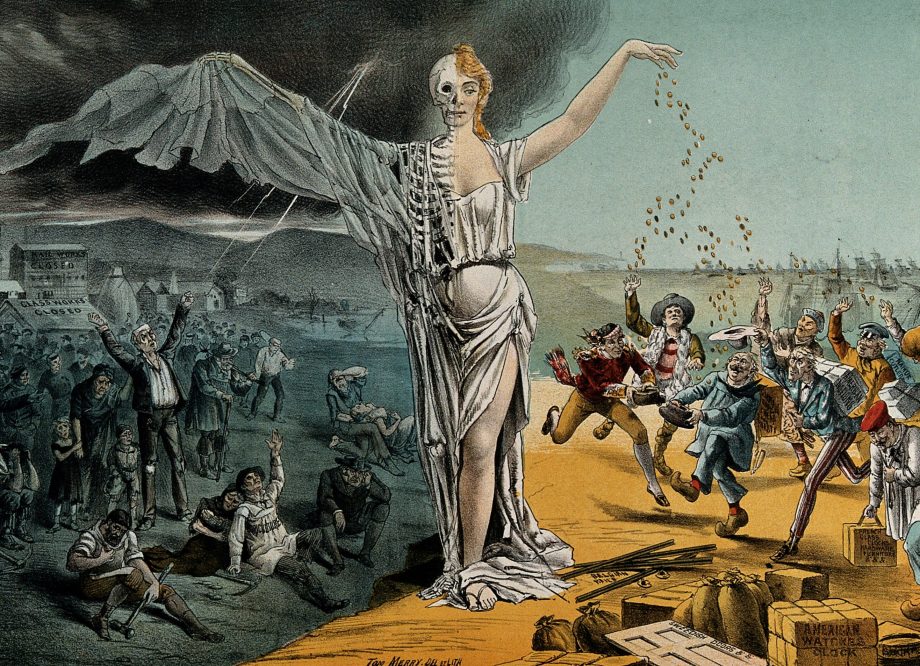
~ Pax Economica: Left-Wing Visions of a Free Trade World (Princeton University Press, 2024) by Marc-William Palen.
~ 1873: The First Great Depression and the Making of the Modern World (Penguin Press, 2026) by Liaquat Ahamed.
~ The Marginal Revolutionaries: How Austrian Economists Fought the War of Ideas (Yale University Press, 2019) by Janek Wasserman.
Marc-William Palen’s Pax Economica, Liaquat Ahamed’s 1873, and Janek Wasserman’s The Marginal Revolutionaries converge on the truth that all market anarchists hold to be self-evident but both the modern left and right seem blissfully ignorant of: markets are not identical with capitalism. Palen reconstructs the history of free trade as a radical political cause, showing how liberals, socialists, feminists, pacifists, and anti-imperialists linked commercial openness to peace, democracy, and opposition to monopoly. His argument takes us from the Anti-Corn Law League through to Marx and Engels, and beyond. Ahamed, meanwhile, recounts the crash of 1873 from the speculative property and securities boom in Vienna to the railroad-finance collapse in the United States, where Jay Cooke & Company failed after overextending itself on the Northern Pacific Railway. He then follows the crisis outward into bond defaults, deflation, the turn toward gold, and the sovereign debt problems of Egypt and the Ottoman Empire. Finally, Wasserman traces the Austrian school from Menger’s 1871 theory of subjective value and the private seminars of imperial Vienna through Mises’s socialist-calculation debate, Hayek’s business-cycle work, the Rockefeller-backed Institute for Business Cycle Research, and the exile of the Austrian economists after the collapse of interwar Austria. The story then moves to London and the United States, where Hayek, Mises, Machlup, Haberler, and Morgenstern helped turn a Viennese school of economic theory into an international intellectual and political movement.
For the discerning libertarian, Pax Economica is what Basil Fawlty would consider stating the bleeding obvious – that free trade is a radical emancipatory project. American journalist Benjamin Tucker had already described his individualist variant of anarchism as the “logical carrying out of the Manchester doctrine”, directed as much against capitalism as the state. Money, land, tariffs, and patents formed his four principal monopolies: legal privileges that restricted competition and diverted income toward bankers, landlords, and protected firms. Removing customs barriers was therefore only one part of free trade. Labour could not be meaningfully free while access to land, credit, and technology remained politically restricted. Palen recovers a political world in which the distinction between markets and privilege was still intelligible.
Richard Cobden and the Anti-Corn Law League provide the book’s centre of gravity. From them Palen follows free trade through Marxism, feminism, Christian pacifism, cooperation, and world federalism, eventually reaching Che Guevara’s attack on unequal international trading arrangements at the first UNCTAD conference in 1964. These movements agreed neither about capitalism nor about the society that should replace existing institutions. What they shared was the conviction that restrictions on exchange were rarely just economic measures. Tariffs protected particular classes and industries; those privileges created political constituencies; and those constituencies acquired an interest in military expenditure, colonial markets, and the extension of national power.
By keeping foreign grain out of Britain, the Corn Laws sustained domestic grain prices and the rents of the landed elite, tying the cost of bread directly to the political interests of landowners. Cobden’s objection was larger than the familiar argument for cheap bread, as protection tied the cost of subsistence to the political power of landowners and gave that class an interest in preserving the wider fiscal and imperial order from which it benefited. Repeal in 1846 attacked both the tariff and the social coalition behind it. Cobden then carried the same reasoning into foreign affairs by opposing the Crimean War and Britain’s renewed assault on China, and his campaign against the latter helped cost him his parliamentary seat in 1857. The Cobden-Chevalier Treaty followed three years later, cutting Anglo-French tariffs and spreading liberalisation through Europe by means of most-favoured-nation clauses. When Cobden called free trade “God’s diplomacy”, the phrase expressed a serious political proposition: commerce should remove the economic interests for which governments otherwise sent armies and fleets abroad.
In his Brussels speech of 1848, Karl Marx mocked the English manufacturers who presented repeal as a humanitarian gift to labour. Protection could perform a historically revolutionary function, he argued, where it helped create large-scale industry and destroy feudal relations. Once a capitalist class had established itself, however, the tariff ceased to be revolutionary and became one of its defences. Free trade was preferable because it widened the world market, dissolved inherited national arrangements, and exposed the antagonism between capital and labour with fewer political disguises. Where Cobden expected commercial interdependence to moderate political conflict, Marx regarded freer trade as an accelerant of capitalist development, valuable precisely because it would intensify the contradictions on which that order rested.
Palen then turns to women reformers and Christian pacifists who reached free trade by a different route. Jane Addams, the American social reformer who founded Hull House and later won the Nobel Peace Prize, linked tariffs to the everyday costs of economic nationalism. Protection raised the price of food and other necessities, while the same politics of national self-sufficiency encouraged armaments and rivalry abroad. Women’s peace organisations treated household prices and military expenditure as parts of the same problem. Christian internationalists made a parallel case from pacifism: trade created forms of dependence between nations that could reduce the appeal of conquest. None of these groups accepted Cobden’s liberal economics. Rather, they supported freer trade because they saw protection, monopoly, and militarism as mutually reinforcing.
Palen’s account becomes less convincing when he treats this free-trade tradition as mainly a history of the Left. For instance, Friedrich Hayek argued in 1939 that the free movement of people, goods, and capital could limit the economic power of nation-states by making protection and national planning harder to sustain. His mentor, Ludwig von Mises, made the connection with peace even more directly: protectionism divided the world into rival economic blocs, while an international division of labour reduced the material incentives for territorial expansion. Neither thinker belongs to Palen’s socialist or progressive tradition, but both continued the older Cobdenite argument that freer trade could restrain nationalism and war.
The German economist Friedrich List complicates this picture from the protectionist side, arguing that free trade could entrench the advantage of countries that had industrialised first. He maintained that protective tariffs, railway building, and state support could give late-industrialising countries time to develop their own productive capacity before facing competition from stronger economies. In Germany, the United States, and Japan, that programme helped strengthen states that later pursued imperial ambitions. Yet the same logic appealed to countries under foreign domination. Indian, Chinese, Irish, and Egyptian nationalists could argue that “free competition” with Britain was hardly neutral when Britain already possessed superior industry, capital, shipping, and access to colonial markets. Listian protection could therefore serve two very different purposes: it could strengthen an aspiring empire, or it could help a dependent economy build the capacity to resist one.
Britain’s own position makes the difficulty impossible to reduce to a choice between open and closed markets. By the high age of Cobdenite free trade it had already industrialised, accumulated the world’s leading merchant fleet, developed unusually deep capital markets, and secured an empire of ports and commercial routes. Its manufacturers did not encounter foreign competition from the same historical starting point as late industrialisers. More importantly, Britain retained the sovereign power to choose its commercial policy. India did not exercise equivalent control under colonial rule. China’s treaty-port system followed defeat in the Opium Wars and restricted its freedom to determine its own tariff regime. The relevant distinction is not simply between free trade and protection, but between voluntary openness and imposed openness.
A low tariff is not, by itself, evidence of free trade. Britain and France could reduce duties by reciprocal agreement; China’s tariff regime after the Opium Wars was constrained by treaties imposed after military defeat. British merchants gained access to Chinese ports, but the Qing government lost control over the terms of that access. The difference is one of sovereignty, as free exchange requires not simply fewer barriers, but the freedom of all parties to determine whether, and on what terms, they enter the exchange. Palen’s radicals were right to see tariffs, monopoly, and protected interests as sources of militarism and empire. What they were less equipped to explain was how commercial domination could persist after tariffs fell, through treaty rights, shipping power, financial leverage, and other privileges that shaped the market before any individual bargain took place.
Ahamed’s 1873 shifts the focus from tariffs and commercial policy to the financial machinery of the new world economy: railway speculation, sovereign borrowing, bond markets, and the monetary regime built around gold. It is an intensely interconnected world where railway and bond markets carried European capital into American infrastructure, Ottoman borrowing, and Egyptian development – the boom was huge. Berlin experienced hundreds of new company flotations in the early 1870s; Vienna combined property speculation with securities mania; American railway promoters capitalised expectations of settlement decades into the future. Then Vienna broke. In May 1873 its exchange lost about 45 per cent in a single day. Four months later Jay Cooke & Company, heavily committed to financing the Northern Pacific Railroad, failed in New York. About $1 billion of American railway bonds eventually went into default.
Ahamed is excellent on the material substance beneath the financial abstractions. Railways consumed iron, land, labour, and enormous amounts of capital. Governments granted land and concessions; financiers sold claims on future traffic; investors treated anticipated continental development as present wealth. Railways were not simply private market ventures. They depended heavily on land grants, state concessions, legal privileges, and public guarantees, even when the companies themselves were privately owned. A company could remain privately owned while relying on the state for its land, route, legal privileges, and guarantees.
For Ahamed, the crash of 1873 was only the beginning. His larger argument concerns the deflationary regime that followed. The move from bimetallism toward gold contracted the monetary base, prices fell, and nominal debts remained fixed. Farmers, firms, and governments therefore had to service old obligations from declining revenues, while creditors were repaid in money with greater purchasing power. Deflation shifted the burden of adjustment toward debtors and strengthened creditors.
In Egypt, heavy sovereign borrowing gradually transferred control over public revenues to foreign creditors. The government borrowed heavily to finance railways, irrigation, and the Suez Canal, then sold its 44 per cent stake in the canal to Britain in 1875 as its finances deteriorated. European creditors subsequently acquired increasing control over Egyptian revenues and fiscal administration, before British occupation followed in 1882. The Ottoman Empire moved along a similar path, with foreign bondholders gaining claims over state revenues after default.
The importance of these cases is that coercion no longer had to begin with a tariff or territorial conquest. A debt contract could remain formally private while its enforcement drew in governments, customs revenues, and fiscal control. Palen’s radicals had attacked protection because it created privileged interests behind the state. What Ahamed shows is that the same problem could reappear through finance. Removing a customs barrier does not remove political privilege if creditors can still acquire enforceable claims over the revenues of weaker states.
Wasserman’s The Marginal Revolutionaries demonstrates how the Austrian school grew out of actual institutions rather than an immaculate succession of texts libertarians recite like dogma. Menger’s Principles appeared in 1871 and soon went out of print, but his private seminar became a model later generations repeated. Eugen von Böhm-Bawerk, Friedrich von Wieser, Ludwig von Mises, Friedrich Hayek, Oskar Morgenstern, Fritz Machlup, Gottfried Haberler, and others moved through universities, ministries, discussion circles, and the Institute for Business Cycle Research before fascism and war dispersed much of the Viennese milieu.
Such institutional emphasis eventually becomes tedious, as Wasserman’s repeated attention to funding networks, seminar circles, foundations, and political affiliations begins to crowd out the intellectual development of the economics itself. Menger’s subjectivism, Böhm-Bawerk’s capital theory, Mises’s calculation argument, Hayek’s work on knowledge and business cycles, and Morgenstern’s movement towards game theory were not simply stages in the consolidation of a single political tendency. Rather, they addressed different economic problems and often pulled in different directions. In the later chapters especially, Wasserman’s attention to the American political settings in which Austrian economics was received can make those distinctions recede behind the story of its association with libertarianism and conservatism.
The real meat is in his discussion of the ideas themselves. Carl Menger’s theory of subjective value, Ludwig von Mises’s calculation argument, Friedrich Hayek’s account of dispersed knowledge, Israel Kirzner’s emphasis on entrepreneurial discovery, and Ludwig Lachmann’s treatment of capital as heterogeneous all reject the possibility that a complex economic order can be comprehended and directed from a single centre. The relevant knowledge is dispersed, local, tacit, and constantly changing; coordination therefore depends on prices, competition, entrepreneurial experiment, and the continual correction of error. Wasserman’s history is especially valuable in showing how much more radical this tradition once was than its later political reputation suggests. Before Austrian economics was absorbed into the Cold War alliance between libertarians and conservatives, its suspicion of concentrated power, monopoly, privilege, and institutional rigidity was less easily reduced to a simple defence of private enterprise against the state. The older radicalism of Austrian economics was broader than the later opposition between private enterprise and the state suggests. Its central arguments rested not on private ownership alone, but on competitive processes through which dispersed knowledge is tested, errors are exposed, and entrepreneurial discovery becomes possible. A firm protected by patents, subsidies, exclusive concessions, guarantees, or barriers to entry may therefore remain privately owned while being insulated from some of the very disciplines on which the Austrian case for markets depends. The later fusion of libertarianism with conservatism tended to narrow this critical reach by identifying market order too readily with existing private institutions. What was obscured was not an explicitly anti-corporate doctrine shared by all Austrians, but a more demanding implication of their economics: private ownership is not sufficient where political privilege protects institutions from competition, failure, and discovery.
There is, I think, a lesson here for present-day free-marketeers of all stripes and none – and it comes by way of my political hero Jo Grimond, leader of the British Liberal Party from 1956 to 1967, who understood that the liberal defence of markets was never supposed to amount to a defence of business as it happened to exist. His hostility to nationalisation went together with support for co-ownership, wider property ownership, decentralisation, and a persistent suspicion of monopoly, because the object was not to transfer power from one set of managers to another but to disperse it. Palen, Ahamed, and Wasserman make that older liberal instinct look remarkably prescient. Landed protection, railway concessions, creditor power, public guarantees, and corporate privilege repeatedly show economic interests attempting to escape the discipline of an open market, while Austrian economics explains why competition and discovery matter once they do. Free markets therefore require relentless defence precisely because their beneficiaries are rarely content to remain subject to them. Successful firms seek barriers to entry, industries seek protection, creditors seek guarantees, and governments discover advantages in deciding who shall receive them. Grimond’s liberalism supplies the necessary corrective: the market is valuable not because private enterprise is sacred, but because the dispersal of economic power enlarges the sphere in which individuals can choose, experiment, enter, leave, succeed, and fail. A free-marketeer who ceases to defend those conditions in order to defend incumbent capitalism has ceased, in an important sense, to defend the market at all.

