
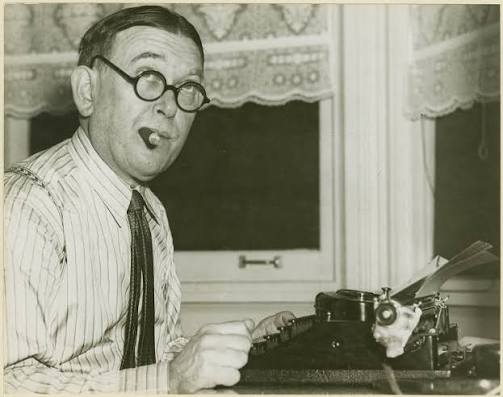
~ Mencken: The American Iconoclast (First Edition/Oxford University Press, 2005) by Marion Elizabeth Rodgers.
I should begin by saying that I found this book at my local Tesco community book stall, sitting there ready to catch my passing eye like a beached whale of intellectual stimulation upon a shore of literary triteness and mediocrity.
Marion Elizabeth Rodgers’s Mencken: The American Iconoclast is a big biography of an even bigger character – what book could possibly hold him? Like Whitman, he contained multitudes. A shorter biography could too easily have produced one of several convenient Menckens: the prophet of free speech, reactionary elitist, prose stylist, convention-hopping journalist, cataloguer of American speech, enemy of Puritanism, Germanophile eccentric, or simply the inexhaustible manufacturer of quotations.
Since I first read A Mencken Chrestomathy as a teenager, he has come to epitomise the smoky breath of America that echoes, ripples and buzzes with all its confidence and enthusiasm, both haughty and electric. If America be a man, then that is Mencken. There is something irresistibly entertaining about him. The wit, verbal extravagance and sheer pleasure he took in putting a pin through the pretensions of politicians, preachers, reformers and literary frauds remain infectious long after many of the controversies that provoked him have been forgotten.
In an age when we seem more interested in – nay, busily engaged in – dramatic takedowns of historical figures than in understanding them and the world they lived in, this book is written with great sympathy for the prejudices and contradictions we are all able to hold within ourselves, like pictures that hang uneasily in a gallery yet somehow produce a sense of beauty.
Mencken could be courageous in defence of civil liberty and contemptuous of racial persecution, while privately harbouring racial and ethnic prejudices of his own. He despised coercion but had little faith in democracy; mocked patriotism while retaining an intensely sentimental attachment to Germany; ridiculed romantic convention yet proved capable of remarkable devotion to the people he loved.
That man was rooted much more firmly in Baltimore than the title might initially suggest. Mencken travelled, edited nationally important magazines, cultivated writers across the country and eventually became one of the most recognisable literary personalities in the United States, but Baltimore remained the fixed point in a turning world from which he regarded the Republic. Thus, the Mencken we get is not just a cigar-chomping dispenser of celebrated insults but a product of the German-American bourgeois world into which he was born in 1880: prosperous, industrious, musical, beer-drinking and suspicious of moral earnestness. The destruction of much of that culture during the anti-German hysteria surrounding the First World War helps make intelligible both his hostility towards American nationalism and the sentimental indulgence with which he subsequently regarded Germany.
The development from Baltimore newspaperman into national scourge is particularly well handled. Journalism suited Mencken because it kept him close to events, personalities and the absurdities of public life. Rodgers follows his progress through the Baltimore Herald and Sun, his criticism of drama and literature, his association with George Jean Nathan, the Smart Set and eventually the American Mercury. At his height in the 1920s he was far more than a columnist with a talent for abuse. Walter Lippmann described him as the most powerful personal influence upon a generation of educated Americans, while Mencken used that influence to attack the genteel tradition, promote writers neglected by the literary establishment and assault what he regarded as the national addiction to political cant, censorship and moral improvement.
Rodgers is especially good at showing that there was substance beneath the clowning. Mencken’s distrust of censorship was not merely another occasion for a joke at the expense of Puritans. He regarded constitutional protections against government power with great seriousness. The two principles he later identified as underlying his work were being “strongly in favor of liberty” and hating fraud. Those commitments explain much of the otherwise bewildering range of his targets. Prohibition, wartime censorship, religious fundamentalism, literary gentility, political rhetoric and official moralism all appeared to him as attempts either to impose the convictions of one class upon another or to conceal self-interested behaviour beneath sanctimonious language.
It is here that Mencken becomes, to use that awful modernism, ‘problematic’ – all my heroes are blighters, bounders, cads and scoundrels. His defence of liberty was accompanied by an almost comic contempt for the political judgement of ordinary people and an absolute disdain for democracy. He opposed the persecution of minorities while continuing to write about racial and ethnic groups in a vocabulary that was already conspicuously outmoded in his own time. His Nietzscheanism fostered a belief that civilisation depended upon an intelligent and creative minority, stoking his hostility to do-gooders and the coercive reforms they proposed in the name of moral uprightness and social progress: the booboisie might deserve liberty, but Mencken saw no reason to credit them with wisdom, taste or political judgement.
At times I found myself wincing when confronted with his uncouth comments on Jews, African Americans and other groups, tutting in incredulity at his saccharine sentimentalism towards Germany, and shaking my head at his tin-eared and blinkered response to developments in Nazi Germany. Yet he also attacked lynching, defended black civil rights, later denounced the persecution of German Jews, argued that Jewish refugees should be admitted to the United States and privately assisted refugee families.
Mencken’s friendships, feuds, affairs and eventual marriage reveal qualities difficult to reconcile with the public caricature of the sneering misanthrope. His relationship with Sara Haardt, whom he married at fifty despite her serious ill health, provides the most affecting example. Rodgers handles it without turning Mencken unexpectedly sentimental. The point is rather that a man who constructed much of his public personality around scepticism could nevertheless form deep attachments and accept obligations which cannot be explained as performances of the Mencken persona.
This attention to the private Mencken also prevents the familiar story from ending conveniently with the 1920s. His decline in influence during the Depression is important precisely because it exposes how historically situated his iconoclasm was. The America against which Mencken had rebelled was changing, as a generation that had welcomed his assault upon Victorian respectability encountered mass unemployment, fascism and political crisis with rather different priorities. Mencken’s relentless hostility towards FDR left him increasingly isolated, while the American Mercury ceased to occupy the position it once had. Rodgers devotes substantial attention to these later decades and thereby resists the temptation to preserve Mencken permanently at the Scopes Trial, mercilessly mocking a whimsical fan-waving William Jennings Bryan beneath the Tennessee sun. At one point we find him stopping in the middle of a busy street and wailing in grief for his beloved Sara, dead nearly a decade.
Many of Mencken’s judgements were wrong: he misread Roosevelt’s political abilities and electoral appeal; backed the hapless Alf Landon against him in 1936; and continued to champion writers such as James Branch Cabell, with his gaudy dragon-chasing heroes, while overlooking the likes of John Steinbeck, John Dos Passos and James T. Farrell. Yet he changed the possibilities of American prose and helped make irreverence intellectually respectable. More importantly, he understood how readily respectable language could become a disguise for coercion, appetite and self-interest. His friend Sinclair Lewis dedicated Elmer Gantry to him, appropriately enough: Mencken shared Lewis’s keen eye for smoking out the seedy salesman lurking behind the preacher of promise. Mencken: The American Iconoclast succeeds because the iconoclast eventually becomes a man again: funny, loyal, vain, industrious, prejudiced, courageous, sentimental, cruel, and extraordinarily alive.
 The Beginning of Terror