
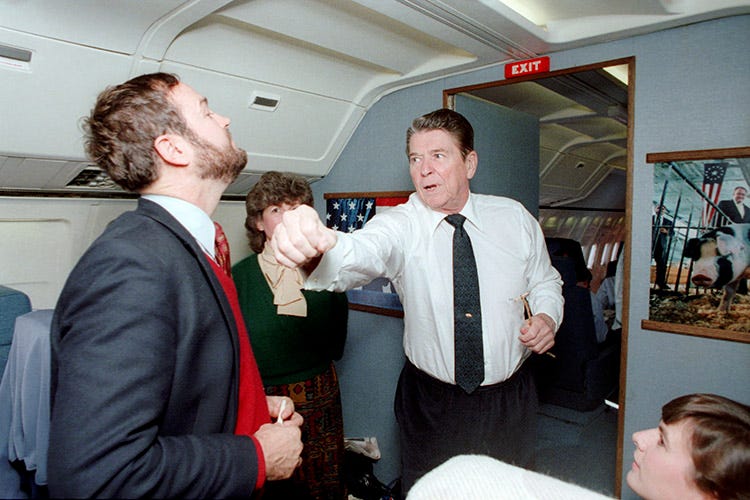
~ Reagan: His Life and Legend (Liveright, 2024) by Max Boot.
Max Boot’s Reagan: His Life and Legend is not simply another cradle-to-grave biography of Ronald Reagan but rather an attempt to suture a split personality: its real subject is the relationship between the historical Reagan and the Reagan constructed afterwards by the American conservative movement. Boot is interested in the way Reagan became a political symbol: the tax-cutter, Cold Warrior, scourge of big government, champion of free enterprise, and embodiment of national optimism. The biography therefore has two simultaneous tasks: to reconstruct Reagan’s actual life and presidency, and to test the mythology that accumulated around him.
In my review of Marion Elizabeth Rogers’ Mencken: The American Iconoclast, I vented anger at the increasingly prosecutorial character of modern biography, with its presentist hermeneutics in which a historical figure is arraigned before the moral tribunal of current mores and opinion; there is something immediately refreshing about Boot’s approach. He takes what I am going to call the Whitmanesque approach, accepting and allowing his subject to contain multitudes that may or may not be reconcilable, because human beings are not systems of thought but accumulations of impulse, conviction, prejudice, compromise, affection, and contradiction set in motion. Boot does not treat these contradictions as clues to some hidden fraudulence that must be exposed. Nor does he construct the book around the now-familiar promise that a supposedly radical reassessment will overturn everything previously believed about its subject. He mostly does the older and harder thing expected of biography: reconstructing a life with tender care, so that judgement emerges from understanding rather than being imposed upon it. Reagan consequently emerges neither rehabilitated nor demolished, but complicated — a reminder that biography need not end in either vindication or indictment. Too many biographers are Hegelians of the life, determined to make every contradiction resolve itself within some total interpretation of the whole. Understanding ought instead to move in a more Kierkegaardian direction: towards the irreducible individual, whose inconsistencies need not be rendered intelligible, merely recognised as belonging to the irreducibility of the individual, perpetually becoming himself in the anxious thrownness of existence.
The central paradox in Boot’s Reagan is that he was both more ideological and more pragmatic than he had expected. Those two qualities look contradictory only if ideology is understood as rigid adherence to a detailed programme. But Reagan’s convictions were broad and deeply held: he denounced Medicare as a step towards socialism, treated high taxation and expanding government as threats to liberty, and regarded Soviet communism in explicitly moral terms. Yet in office he repeatedly accommodated himself to circumstances. As governor of California, he signed tax increases, accepted gun-control legislation, and liberalised abortion law; as president, he followed the great tax cuts of 1981 with subsequent revenue increases, preserved rather than dismantled the principal entitlement programmes, and, having called the Soviet Union an “evil empire,” entered into negotiations with Gorbachev that culminated in the INF Treaty and the elimination of an entire class of nuclear missiles. Boot gives us a Reagan who was not merely an actor reciting conservative platitudes, but a politician whose convictions supplied a consistent and earnest ideological framework while leaving considerable practical latitude; much of the interest of the portrait lies in the ease with which he could make accommodations that later Reaganites would have regarded as ideological surrender. His ideology supplied the direction, while his pragmatism determined the form those convictions could take in practice. Here Reagan bears an uncanny resemblance to my hero William James, for whom belief was never merely a proposition entertained by the mind, but a disposition carried into experience, acquiring its fuller meaning through the courses of action it licensed, the compromises it permitted, and the consequences by which it was tested.
Reagan began as a New Deal Democrat and never entirely lost his admiration for FDR, but his movement towards conservatism was gradual and cumulative — a Whiteheadian accretion of concrete experience. From his mother Nelle, a devout Disciple of Christ, he inherited a providential Christianity in which moral agency rested heavily upon the individual and public questions could readily assume the shape of good set against evil.
His film career never quite justified the confidence with which he carried himself through it. He was handsome, dependable, and often effective within narrow limits, but rarely subtle; Warner Bros. used him largely as an agreeable leading man in second-rank pictures, and by the late 1940s the career was flatlining. His real gift was not Stanislavskian transformation but something closer to Diderotian projection: he did not disappear into the role so much as bend the role around an already recognisable self. He learned to make a limited emotional range read clearly, to trust pace and conviction over ambiguity, and to reduce a scene to the moral relation between recognisable types. None of that made him a great actor, but it proved extraordinarily transferable. Politics rewarded precisely what serious acting did not: clarity of role, confidence in delivery, repetition, and the ability to make a rehearsed line feel spontaneous.
Reagan’s years as president of the Screen Actors Guild placed him inside Hollywood’s labour wars, factional quarrels, and anti-communist investigations, where questions of loyalty, infiltration, and institutional control ceased to be abstractions. He testified before HUAC, worked with the FBI as an informant, and came to believe that Communist organisers were using respectable institutions for purposes their members did not fully understand. That experience whetted an already moralistic cast of mind, and what had once been a general hostility to Soviet communism became something much more personal, even existential.
By the time the film work had thinned out and Reagan began touring for General Electric, he was already carrying much of the emotional structure of his later politics with him. GE exposed him repeatedly to arguments about taxation, regulation, organised labour, and the growth of federal power, while eight years spent travelling between the company’s 135 plants, walking factory floors, answering questions, and speaking to workers, managers, and local civic groups steadily pared his politics into ‘The Speech’ he could eventually deliver almost by heart. Reagan consumed Human Events, National Review, Reader’s Digest, newspapers, and the business press far more readily than sustained works of political theory such as Mises, Hayek, and Friedman, and came to think through amusing jokes, folksy sentiments, memorable anecdotes, and recurring moral contrasts. By the early 1960s, these elements had cohered into a recognisable creed in which communism abroad and bureaucracy at home appeared as related threats to individual liberty.
The later mythology sometimes reads the whole presidency backwards, as though Reagan entered office with a coherent revolutionary programme and then carried it out. Such backreading has something of Lukács’s Marx about it: the later system is made to supply a unity the historical record never quite possessed — Reaganism has done the same to Reagan. The president who signed the 1982 TEFRA tax increase after the great tax cut of 1981, accepted the bipartisan rescue of Social Security in 1983, worked with Democrats on tax reform and immigration in 1986, and signed the INF Treaty with Gorbachev in 1987 was subsequently remembered as the pure embodiment of tax cutting, small government, and implacable anti-communism. Boot demonstrates that Reagan and Reaganism are two very different things by a kind of Heideggerian Destruktion, stripping away the inherited conceptual structure of Reaganism to recover the more contingent and contradictory historical figure beneath it.
Boot’s more interesting question is not whether Reagan was intelligent, but what kind of intelligence he possessed. He could be astonishingly incurious about the machinery of government: Treasury Secretary Don Regan recalled serving four years without once discussing economic philosophy or fiscal policy with the president alone, while aides found that Reagan would accept briefing-book conclusions, sometimes doze through presentations, and leave the “fellas” to settle questions on which he offered little instruction. Yet this administrative passivity sat beside an acute instinct for political effect. Reagan could seize upon a statistic, a joke, or an anecdote, pare it down until it carried a moral argument, and repeat it long after its factual foundations had begun to crumble. Boot’s examples are often damning: dubious quotations, inflated welfare stories, and claims borrowed from fringe conservative literature survived correction because Reagan regarded the larger point as truer than the particulars. What looks at first like intellectual deficiency was therefore bound up with a real faculty. Reagan grasped the emotional and symbolic structure of an argument very quickly, often more quickly than its empirical content, and could make that structure legible to millions. He had little time for epistemology. Once he had found a story that rendered events morally intelligible, contrary evidence could be slugged away like a homer into the crowd if it got in the way of the larger truth he believed himself to be expressing.
Boot circles, in Rilke’s widening rings, around Reagan the performer. He did not don conviction like an actor in costume. Rather, performance was one of the forms his convictions took. There is a long lineage here, from Lincoln’s Scripture-sprinkled speeches with their King James cadences, through the bared teeth and press-courting of Bull Moose Teddy Roosevelt, to the pipe-smoking Stanley Baldwin, delivering plain-dealing yeoman rusticisms over the wireless as his wife knitted beside him for teapot intimacy; from FDR’s fireside chats, explaining abstract economics within the confines of the 500 most commonly used words in English during the Depression, to the Homeric grandeur of Churchill’s defiant rhetoric, steeped in Gibbon, honed on Macaulay, and tinged with Kipling, and to Kennedy’s glib smile and coolness beneath the lights beside a pale, sweating, milkshake-glugging Nixon. Reagan belongs among these masters and manipulators of political performance — as, unfortunately, does Donald Trump, with the shithousery of his WrestleMania presidency.
The 1964 “A Time for Choosing” speech did more than introduce Reagan nationally; it overshadowed a lame Goldwater: Reagan was fluid, funny, and self-assured, while Goldwater seemed stiff, dour, and soporific — flatter than a Coke in the Arizona sun. Reagan gathered years of GE stumpwork into one performance — statistics, jokes, moral alarm, and the closing “rendezvous with destiny” — sounding more visionary, energetic, and in tune with his audience than the doomed candidate he was ostensibly supporting. Even when the joke was on him, he understood that surrendering himself to it could strengthen the performance: at his 1973 Dean Martin roast, Don Rickles mocked him as the politician who laughed at everything, even “My brother died!”, while Reagan howled, teary-eyed and bent double in his chair. In 1980, a peevish Carter’s attack on his Medicare record was brushed aside with “there you go again,” before Reagan reduced the election to “Are you better off than you were four years ago?” Four years later, “Morning in America” made recovery from the economic basketcasery of the 1970s and rabid-rabbit assaults on presidents visible through fishing boats rolling on the dawn tide and paperboys cycling through suburban twilight, while the age question that had wounded him in the first debate with Walter Mondale disappeared in the second when Reagan promised not to exploit his opponent’s “youth and inexperience.” Mondale laughed with everyone else, knowing the game was up.
Perhaps it began with Reagan’s religious upbringing, with its near-Manichaean contrast between good and evil, or with Hollywood, where the complexities of life were repeatedly smoothed into Production Code scripts of temptation, conflict, and moral resolution. Either way, Boot shows how much Reagan’s failings revealed the limits of the moral world through which he understood America: suffering that could be fitted into this world elicited sympathy readily enough, but what fell outside it was harder for him to recognise in full.
Reagan had opposed the Civil Rights Act of 1964, later admitted that he had opposed the Voting Rights Act “from the beginning” because he thought it “humiliating to the South,” and campaigned against California’s Rumford Fair Housing Act; yet in 1982 he signed a twenty-five-year extension of the Voting Rights Act and spoke of the ballot as the “crown jewel” of American liberty. The contradiction was not necessarily cynical, as Reagan’s instinctive moral unit was the sovereign individual, which made racial discrimination repellent to him but also made federal remedies, quotas, and group claims look like new infringements upon individual liberty. That framework could be sincerely held and still leave him obtuse to the historical weight borne by words such as “states’ rights,” “law and order,” or “welfare queen.” AIDS exposed the limits of the same moral imagination more brutally: the first cases were reported in 1981; Reagan did not address the epidemic publicly in sustained fashion until 1987, by which spring more than 33,000 American cases had been reported, roughly 58 per cent of them already fatal, while the Public Health Service estimated that perhaps 1.5 million people carried HIV. Thus, an administration capable of finding moral urgency in communism, taxation, or welfare dependency proved painfully slow to find language for an epidemic associated in the public mind with gay men and drug users.
Likewise, his economic record was far from the Friedmanite wet dream later projected onto it. The 1981 programme cut individual income-tax rates by 25 per cent over three years, but Reagan signed TEFRA in 1982 and then the bipartisan Social Security settlement of 1983, which accelerated payroll-tax increases, taxed part of Social Security benefits for higher earners, and brought new groups into the system. Nor did the federal leviathan wither: gross federal debt rose from about $995 billion in fiscal 1981 to $2.87 trillion in 1989. Boot is right, therefore, to puncture the nursery version of Reaganomics in which tax cuts themselves vanquished stagflation. Paul Volcker’s Federal Reserve inflicted the necessary pain: unemployment peaked at 10.8 per cent in late 1982, while inflation fell to 3.7 per cent the following year. Yet Boot can push the correction too far. Volcker himself later recalled that Reagan never publicly attacked him, despite staff pressure to do so and every political incentive supplied by recession and nine- or ten-per-cent unemployment; Volcker called that restraint “very important.”
Reagan did something very similar to Margaret Thatcher in the UK: neither actually dismantled the post-war state to anything like the extent suggested by their rhetoric, but both changed the political assumptions within which their successors had to operate. Thatcher left the NHS and much of the welfare state intact, yet Blair governed inside a political economy she had helped remake; Reagan left Social Security, Medicare, and a large federal apparatus standing, yet Clinton could only reach the White House by accommodating himself to a political language suspicious of taxation, welfare dependency, and “big government.” It was less an institutional revolution than a rhetorical one.
Consider, too, the Cold War. He had spent decades treating Soviet communism as a moral evil, yet once Gorbachev appeared he proved willing to revise the practical meaning of that belief, much to the alarm of conservatives who had taken his rhetoric more literally than he did. The INF Treaty signed in December 1987 ultimately eliminated 2,692 American and Soviet missiles — an entire class of weapons — something scarcely imaginable from the man of the “evil empire” only four years earlier. Reagan’s preference was to settle on an objective, entrust it to men he trusted, and leave them room to move. In the Iran initiative, that looseness produced arms-for-hostages dealings contrary to his own stated policy and a clandestine Contra operation run through the NSC. The Tower Commission found that normal national-security procedures had been “largely ignored,” and that Reagan and his senior advisers had met collectively on Iran only two or three times in seventeen months, often without agendas, papers, minutes, or even a common understanding of what had been decided. Reagan later conceded that his management style had failed him. The same habit that left Volcker free to break inflation and Shultz room to negotiate with Moscow could, in less capable or less scrupulous hands, shade into presidential absence.
Boot’s emotionally distant Reagan makes more sense when set against the boy who, at eleven, came home to find his alcoholic father sprawled unconscious on the porch and had to drag him inside, while Nelle Reagan held the household together through her abiding faith and irrepressible sunny-side-up optimism. Reagan remembered the poverty of the Depression — his father losing work, the family moving from town to town — but habitually recast childhood in cheerful terms, later burnishing it as a “Huck Finn–Tom Sawyer idyll.”
This pattern was repeated throughout his life: he could save seventy-seven swimmers as a teenage lifeguard, send personal cheques to strangers who wrote to him in distress, and yet leave his own children feeling that access to him was rationed. Michael, his adopted son with Jane Wyman, later disclosed that he had been sexually abused at seven by a camp counsellor he had come to regard as a substitute father — Reagan knew nothing of it until Michael told him decades later. Patti Davis, his daughter with Nancy, remembered a household in which everybody seemed somehow separate from everybody else, and when she challenged her father’s recollection of their supposedly happy family life, Reagan appealed almost helplessly to the camera: “We were happy, just look at the home movies.” Nancy alone appears to have broken through the reserve completely. Reagan could be generous to strangers, genial with almost everyone, and intimate with remarkably few.
Here I recognise something of myself in him. Growing up with an alcoholic father teaches you early that personality can become an instrument of coping: humour, composure, withdrawal, whatever keeps the emotional situation manageable. Being bookish in a working-class environment can teach another version of the same lesson, because eccentricity has to be made companionable if it is not to become isolating. I know too the loner’s odd ability to care deeply for someone while they are present and then allow them almost to fall out of consciousness when they leave the room. None of this excuses Reagan’s failures as a husband, father, or friend, but it makes Boot’s paradox less mysterious. The genial public Reagan need not have been a fraudulent mask concealing the “real” cold man beneath; the warmth and the remoteness may have grown from the same practised habit of keeping life bearable by controlling the terms on which it entered him. This is the power of good biography: you can see your faults and foibles present in a life greater than your own and reflected back at you.
Finally, there is the question of the supposed Perlsteinian “golden thread” running from Goldwater through Reagan to Trump. My answer is no, and I will tell you why.
In his guts he may have been nuts, but Barry Goldwater ended his career attacking the religious right, defending abortion rights, and supporting the right of gay Americans to serve openly in the military. Reagan signed the 1986 immigration reform that legalised millions of undocumented migrants, pursued free trade with Canada, treated NATO as central to American power, and negotiated the INF Treaty with Gorbachev. These are not incidental details but substantive commitments. A politics organised around tariffs, immigration restriction, suspicion of alliances, executive aggrandisement, and grievance therefore cannot be treated as the straightforward consummation of Goldwater–Reagan conservatism without evacuating that conservatism of much of its actual content.
Here I find myself agreeing with what Boot laid out in The Corrosion of Conservatism. His argument there was not that Trump descended upon an innocent movement from nowhere. Looking back more sceptically at the conservatism in which he had spent his adult life, Boot admits that racism, xenophobia, conspiracy-mongering, and irrationalism have been present from the movement’s beginnings. What matters, however, is the attempt by figures such as Bill Buckley, George Will, and Reagan to keep those tendencies at the fringe and to make conservatism governable. Boot points, for instance, to Buckley’s willingness to confront George Wallace and the segregationist right, while Reagan’s own politics remained recognisably internationalist, pro-trade, and comparatively open on immigration. Trump’s achievement, in Boot’s formulation, has been to reverse that hierarchy: taking the fringe and making it mainstream.
That is the part of Boot’s argument I find persuasive. Trump did not demonically invent the dark materials of the American right, but neither did their presence make him the inevitable culmination of Goldwater or Reagan. Boot’s earlier description of Trumpism as “completely antithetical” to the Reagan conservatism he had championed — limited government, free trade, immigration, and American leadership abroad — is more discriminating than a Butterfieldian linearity in which all those differences are collapsed into one continuous march towards 2016.

