
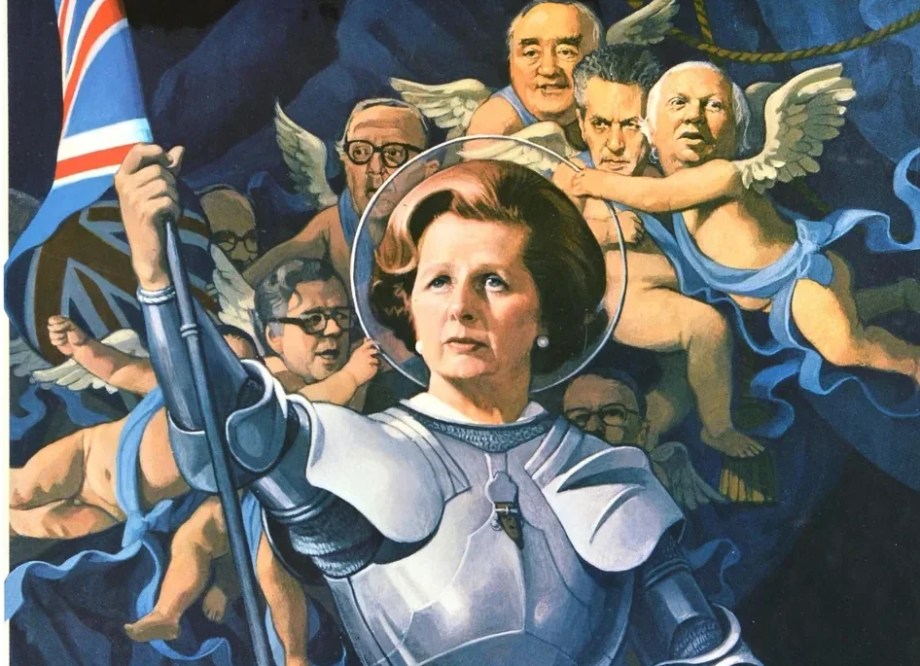
~ Margaret Thatcher: The Authorised Biography, Volume One: Not for Turning (Allen Lane, 2013) by Charles Moore.
~ Margaret Thatcher: The Authorised Biography, Volume Two: Everything She Wants (Allen Lane, 2015) by Charles Moore.
~ Margaret Thatcher: The Authorised Biography, Volume Three: Herself Alone (Allen Lane, 2019) by Charles Moore.
Margaret Thatcher was not, by all accounts, an especially amusing woman. She possessed little patience for jokes, less for irony, and almost none for the possibility that she might herself be ridiculous. It is therefore one of the considerable achievements of Charles Moore’s monumental three-volume biography that its subject should emerge as such an extraordinarily entertaining character. There is something inherently comic about a woman who approached nearly every human interaction as an examination in which she alone possessed the correct answers. Yet the comedy is frequently quite inadvertent, and the woman who emerges from Moore’s account is considerably more peculiar, contradictory, and human than either her admirers or her detractors have generally been prepared to acknowledge.
Commissioned in 1997, with publication postponed until after Thatcher’s death, Moore’s biography occupied more than two decades of research and eventually expanded from two volumes into three. He received exceptional access to her private papers, government documents, family and political associates, and Thatcher herself. The resulting work is immense, exhaustive, sometimes maddening, frequently fascinating, and perhaps the closest anyone is likely to come to a definitive account of her personal and political life.
Moore is an admirer of his subject, which is hardly a secret, but his admiration seldom descends into hagiography. I am rather glad of this. There is something intolerably tiresome about the modern fashion for prosecutorial biography, in which the historical subject is arraigned before a tribunal of contemporary opinion and every contradiction becomes evidence of some previously concealed moral deficiency. Moore does something considerably more valuable: he reconstructs a life with sufficient sympathy to make its contradictions intelligible, without requiring that they be resolved. Thatcher consequently emerges neither as the saint of Conservative mythology nor the great she-devil of the British Left, but as a singularly determined woman possessed of an almost limitless capacity to astonish and exasperate those around her.
The Margaret Thatcher of popular memory was an almost Cartesian automaton of ideological certainty, marching through political life with an unshakable immunity to doubt. Moore’s Thatcher is considerably less straightforward. She was extraordinarily industrious, frequently insecure, remarkably adaptable when circumstances required it, and often incapable of understanding why others did not appreciate the wisdom she so generously dispensed. Interviewed by Lynda Lee Potter, she wondered why people resented her knowing the answers. That other people might possess answers of their own evidently failed to occur to her.
Her encounters with other people frequently possess the quality of scenes from an unusually implausible social comedy. During a 1968 Any Questions? broadcast, Malcolm Muggeridge suggested that everyone was intrinsically ridiculous. Thatcher objected that Muggeridge himself had appeared to take the pre-programme dinner rather seriously. When he questioned whether she imagined herself a serious person, she replied, “Well I do. You may not.” The exchange is marvellous. Thatcher appears impervious to the possibility that Muggeridge was teasing her, just as she was impervious to the notion that seriousness might be demonstrated by anything other than an unwavering insistence upon it.
Nor did becoming prime minister entirely cure these peculiarities. During her audiences with Elizabeth II, Thatcher would perch nervously upon the edge of her chair, extract an agenda from her handbag, and commence lecturing the sovereign. The Queen privately complained that she received little encouragement to contribute. Thatcher could be simultaneously reverential towards authority and spectacularly disrespectful towards those exercising it.
One of Moore’s considerable strengths is his recovery of the young Margaret Roberts, the ambitious daughter of a Grantham grocer whose subsequent transformation into an almost mythological political personality has tended to obscure the particularities of her earlier existence. More than 150 private letters to her sister Muriel reveal someone preoccupied with clothes, romances, social advancement, and the ordinary pleasures of a young woman determined to make something of herself. In one delightful episode, Margaret borrows a royal-blue velvet cloak for an outing with her boyfriend Tony Bray and revels in the attention it attracts. Decades later, when Bray approached her with a proposal concerning the sale of council houses, she gave little acknowledgement to their former acquaintance before turning immediately to the policy.
Moore also demonstrates how profoundly Thatcher’s ascent disturbed the established social arrangements of the Conservative Party. She was a grammar-school girl entering a political world still dominated by inherited privilege, public schools, and the assumptions of an established governing class. Her first employer paid her £50 a year less than male colleagues, while her parliamentary ambitions encountered repeated objections to the prospect of a woman pursuing such an unnatural career. Yet she possessed little sympathy for organised feminism. When invited to address the Conservative Political Centre in 1968, she rejected a suggestion that she speak on women in politics, preferring a lecture upon government itself. Having fought the prejudices of her society, she was remarkably unwilling to identify herself with others experiencing them. She was determined to succeed within the established order, rather than organise its discontents into a movement for its alteration.
The same attention to contradiction serves Moore’s political narrative. Thatcher’s reputation for unbending ideological consistency is repeatedly complicated by the practical compromises of government. In 1981, her government retreated over threatened pit closures rather than confront the miners before it was prepared for a prolonged strike. During the Irish republican hunger strikes, she privately acknowledged the prisoners’ courage while her government pursued confidential contacts despite its public refusal to negotiate.
Even the Falklands War, subsequently celebrated as the great vindication of her determination, reveals an uncomfortable discrepancy between conviction and circumstance. In May 1982, Thatcher reluctantly supported proposals for a negotiated settlement which did not provide the islanders with the explicit right to self-determination she considered essential. Moore’s reconstruction of the Cabinet discussions exposes a concession subsequently obscured in her own recollections. This does not diminish the political courage required by the eventual military campaign. Rather, it makes the actual course of decision-making more interesting than the patriotic nursery version in which Thatcher never entertained anything resembling compromise.
Her relationship with Ronald Reagan likewise demonstrates the limitations of ideological solidarity. In October 1983, the United States invaded Grenada, a Commonwealth country, despite her objections and without adequate consultation. Moore devotes considerable attention to an incident which reveals how little the supposedly indispensable Anglo-American partnership guaranteed British influence over American decisions. The Iron Lady discovered that the leader of the free world was not invariably inclined to seek her permission.
Here Thatcher bears some resemblance to Reagan himself, whose subsequent mythology has similarly obscured the pragmatic politician beneath the ideological monument. Her convictions supplied the direction of government without always determining its particular course. The difficulty for any biographer is to distinguish those occasions when her stubbornness preserved her government from error from those when it merely created difficulties of her own making. Her resistance to the European Exchange Rate Mechanism, for instance, appears considerably more prescient in light of the sterling crisis of September 1992 than did the assurances of those colleagues who had insisted upon British participation.
It is here that Moore is at his best as a historian. His reconstruction of the Westland affair is particularly revealing. During the struggle over the future of the helicopter manufacturer, a confidential legal letter damaging to Michael Heseltine was improperly leaked. Moore’s interviews with Colette Bowe, the civil servant centrally involved, helped establish the extent of Downing Street’s involvement in an operation whose full circumstances had remained concealed for decades. Bowe had retained her records in a bank vault. Thatcher’s determination to defeat an increasingly troublesome colleague had brought her government within uncomfortable distance of a constitutional scandal capable of destroying it.
Nevertheless, the experience of reading Moore is not uniformly pleasurable. His prose can be wonderfully dry, precise, and understated, but it is frequently interrupted by his own High Tory preoccupations. Already in the acknowledgements to the second volume, we are introduced to his horse Tommy and treated to a maxim upon the similarities between hunting and writing a biography. Anyone familiar with his Spectator columns, in which he can scarcely resist pontificating upon the virtues of foxhunting, will recognise the intrusion. It is not so much Moore’s politics that grate as his occasional inability to resist making himself part of the story.
Moore is an exceptionally conscientious High Tory, for whom the educational pedigree of a minor official can appear almost as significant as the office he holds. His footnotes habitually establish where his protagonists attended school, which college they entered, and how they came to occupy their particular rung upon the British social ladder. Much of this is undoubtedly useful, but its accumulation becomes wearisome. The endless cataloguing of respectable backgrounds and institutional affiliations occasionally gives the impression that one has wandered into an early Evelyn Waugh novel (much as I love Waugh), though without the satirical intention that made such social distinctions worth recording in the first place.
There is also something peculiarly irritating about the occasional intrusion of the author’s social and intellectual superiority. His editorial insertion of [sic] after a grammatical lapse in Thatcher’s youthful correspondence is a particularly revealing instance. One can almost see the Old Etonian schoolmaster reaching for his red pen. Equally trying is Moore’s conviction that nearly every complication of parliamentary business deserves minute examination. In the second volume, the problems of selecting a Speaker and determining MPs’ salaries become two of the significant difficulties confronting Thatcher in 1983. No doubt these matters exercised Westminster considerably, but one occasionally wishes Moore possessed a rather less comprehensive understanding of what constitutes historical significance.
Moore’s writing betrays something about the world through which he understands political history. It is a world overwhelmingly populated by politicians, officials, advisers, diplomats, and journalists, whose rivalries and anxieties he reconstructs with almost novelistic intimacy. The difficulty is that the people outside this comparatively narrow circle occasionally appear as little more than the population upon whom its decisions are inflicted.
The contrast becomes particularly apparent when Moore turns to the economic and social transformations of the Thatcher years. The miners’ strike of 1984–85 is reconstructed through the decisions of ministers, the calculations of the National Coal Board, and the confrontation with Arthur Scargill. These matters are indispensable to understanding the dispute, but they cannot by themselves explain its consequences for mining communities. Nor can the difficulties of monetary policy be understood entirely through the disagreements of the Treasury and Cabinet. According to the Office for National Statistics, unemployment rose from an annual average of 5.4 per cent in 1979 to 11.8 per cent in 1984. These figures conceal enormous geographical disparities, with the industrial districts of Scotland, Wales, and northern England bearing a disproportionate share of the dislocation. Moore can tell us almost everything about how the government arrived at its decisions, but rather less about how those decisions were experienced beyond Westminster.
The consequences of Right to Buy provide an equally revealing example. Moore is sufficiently independent to acknowledge the housing shortage which developed following the sale of council properties. The policy undoubtedly enabled large numbers of tenants to acquire homes, an achievement which its critics should not dismiss. Yet it also removed substantial numbers of properties from local-authority ownership without ensuring their replacement. A 2017 investigation by Inside Housing, drawing upon information obtained from 111 English councils, found that approximately 40 per cent of the former council homes identified in its returns were being privately rented. A policy intended to create a property-owning democracy had, in these cases, eventually transferred public housing into the hands of private landlords. The subsequent concentration of former council properties among landlords is hardly what one imagines Thatcher had in mind when she spoke so enthusiastically of extending ownership.
Thatcherism was, of course, more than a programme of privatisation, monetary restraint, trade-union reform, and reduced state ownership. It sought to alter the relationship between property, independence, and personal responsibility. In her 1987 interview with Woman’s Own, Thatcher argued that the wider ownership of property encouraged individuals to exercise responsibility towards others. Her much-quoted denial of society’s existence was accompanied by an insistence upon obligations to families and neighbours. The familiar caricature of an entirely atomistic Thatcherism therefore requires qualification. Indeed, there is much to admire in the belief that individuals should exercise responsibility rather than surrender it to government.
The more interesting question is whether the political and economic arrangements through which Thatcher pursued that ambition consistently supported it. Right to Buy could enlarge the independence of the purchaser while leaving subsequent tenants increasingly dependent upon private landlords. The weakening of established industrial organisations might liberate workers from coercive union practices while simultaneously depriving them of institutions through which they could exercise economic power collectively. These are not necessarily arguments for retaining the existing arrangements, many of which had become thoroughly indefensible, but they are arguments against assuming that their destruction automatically produced freedom in their place. Moore’s Westminster-centred account is less well equipped to investigate these consequences than to explain the political intentions from which they arose.
Indeed, his own evidence repeatedly demonstrates that Thatcher’s achievements were inseparable from institutions she neither created nor controlled. Her early political apprenticeship was conducted through Conservative associations, public meetings, and constituency campaigning. In Colchester she learned to confront hecklers while campaigning for the local Conservative candidate. The party provided her with political education, a network of acquaintances, and even an introduction to Denis. By the time she reached Westminster, her career had been sustained by forms of organised association without which individual determination, however prodigious, would have accomplished comparatively little.
This becomes particularly apparent in Moore’s account of Thatcher’s downfall. By the late 1980s Thatcher’s confidence in her own judgment had increasingly impaired her ability to maintain the relationships upon which her position depended. Moore records her repeated humiliation of Geoffrey Howe, her deteriorating relationship with Nigel Lawson, and her extraordinary suspicions of Norman Tebbit. During the 1987 election campaign, the episode remembered as Wobbly Thursday saw her lose control of her temper so spectacularly that senior colleagues struggled to calm her. David Young, meanwhile, reportedly seized Tebbit by the lapels in a furious argument over the campaign’s direction. There is something wonderfully absurd about a government on the verge of winning its third consecutive election behaving as though the entire enterprise were about to collapse around it.
The resulting political collapse three years later is narrated with tremendous dramatic skill. Geoffrey Howe’s resignation speech in November 1990 finally supplied the occasion for Thatcher’s enemies to move against her. Moore’s account of the manoeuvres which culminated in her removal is among the most compelling sections of the trilogy. It is also peculiarly sad. On her final morning in Downing Street, her hairdresser arrived having forgotten his comb. The prime minister was too distraught for him to ask for one, and he was reduced to searching discreetly through the private rooms. Even the smallest domestic arrangements seem to dissolve amid the destruction of her political world.
The concluding volume’s title, Herself Alone, thus acquires a significance beyond the immediate circumstances of her departure. In 1991, the Conservative conference greeted her with six minutes of sustained applause, but the enthusiasm of the membership could not restore the premiership withdrawn by her parliamentary colleagues. She was soon reduced to offering advice which John Major increasingly resented. Moore describes a woman who left Downing Street without a settled domestic organisation and who struggled to construct a life beyond politics. The death of Denis in 2003 and her subsequent cognitive decline complete a portrait whose final chapters are considerably more affecting than one might have anticipated.
Here Moore’s affection is invaluable. He does not attempt to rescue Thatcher from the indignities of ageing by manufacturing some final political triumph, nor does he treat her decline as a providential judgment upon her career. He records the diminishing capacities of a woman whose political existence had once seemed inexhaustible. The result is all the more affecting for its restraint.
It is, in the end, difficult not to admire the sheer achievement of these books. Moore has assembled an extraordinary body of evidence, recovered innumerable details previously unknown or neglected, and produced a portrait far more persuasive than the competing political caricatures which continue to dominate Thatcher’s reputation. His narrative is sometimes overburdened, his writing occasionally insufferable, and his sympathies more apparent than he might wish. But his subject remains endlessly fascinating, and his capacity to bring her peculiarities vividly to life is undeniable.
There is, however, a further significance to Moore’s undertaking which emerges almost in spite of his biographical method. Thatcher understood political achievement principally through the exercise of individual judgment and responsibility, and Moore has devoted three immense volumes to the most formidable individual in modern British politics. Yet the history he recounts continually demonstrates that the exercise of individual agency depends upon forms of cooperation which cannot be reduced to the characteristics of the individual himself.
This is not a refutation of individualism, properly understood. It is a distinction between the individual as the author of his actions and the individual imagined as sufficient to their accomplishment. Thatcher’s determination was indispensable to her career, but it did not create the Conservative associations which nurtured her, the parliamentary institutions through which she governed, the civil servants who implemented her decisions, or the Cabinet colleagues upon whose confidence her authority depended. The point is not to diminish Thatcher’s individual achievements, but to recognise that even someone of her extraordinary determination could neither attain nor exercise power through force of personality alone.
This is perhaps most evident in the circumstances of her downfall. The Conservative Party which had enabled the young Margaret Roberts to become prime minister was the same party which eventually removed Margaret Thatcher from office. Her determination had not diminished, nor had her conviction that she was right. What had changed was the willingness of her colleagues to support her. However formidable her personality, she could neither govern without their cooperation nor remain in office once that cooperation was withdrawn.
Much as I find him an unbearable, self-satisfied snob and his writing style grating, Moore has written a magnificent biography of an extraordinary woman.

