
Introduction.
The aim of this is essay is to bring the theology of St. Basil the Great and the process philosophy of A.N. Whitehead into some sort of conversation, focusing on their respective accounts of time, divine nature, and creation. I want to explore how both thinkers reject simplistic linear or mechanistic conceptions of temporality, instead articulating layered models in which time emerges as a meaningful, contingent structure shaped by divine intention. The result is a vision of temporality that is neither static nor chaotic, but structured, participatory, and oriented toward fulfillment in God.
Divine Temporality and the Ontology of Time.
For both St. Basil the Great and Alfred North Whitehead, time is not simply a backdrop against which divine or creaturely activity unfolds. Rather, it is a metaphysical threshold – a liminal structure through which being is disclosed, ordered, or resisted. Yet while both thinkers reject crude temporalization of God, neither leaves time untouched by the divine. Their respective visions offer distinct, but potentially reconcilable, understandings of time’s origin, structure, and relationship to God.
In Against Eunomius, St. Basil develops a nuanced theology of time in polemic response to the Neo-Arian claim that the generation of the Son implies a temporal priority of the Father. Against this, St. Basil draws on Aristotelian and Stoic resources to assert a non-temporal causality: the Father’s priority is not temporal but ontological, and thus free of the (diastima) extended interval or space characteristic of created time. He distinguishes sharply between divine causality, which is eternal and without sequence, and created temporality, which emerges only with the created cosmos. Time, for St. Basil, is not an eternal substrate but a condition coextensive with Creation. This is a finite and contingent reality, absent in God and inaugurated by His will.
In Whitehead’s metaphysical cosmology, temporality is likewise a relational structure, though not reducible to Aristotelian motion nor Stoic extension. Instead, time is an expression of processual becoming – an emergent pattern of actual occasions each prehending the past and aiming toward a future. Whitehead divides God’s nature into two poles: the primordial nature, which is non-temporal, and the consequent nature, which is temporal insofar as it responds to the unfolding of the world. Temporal experience, for Whitehead, is not a passive dimension but the very form of creative concrescence. Time is relational, durational, and extensive not because it proceeds from a prior fixed measure, but because it is the living tissue of interrelated actualities.
Where St. Basil and Whitehead differ is in their sense of divine participation. For St. Basil, the divine is absolutely outside time – its non-temporality is what secures the Son’s eternal generation. For Whitehead, by contrast, God is not temporally prior to the world but is its supreme instance of actuality – pure process in his consequent nature, yet untouched by temporal sequence in his primordial nature. What both agree on, however, is that temporality cannot be imposed upon God without compromising either His unity (St. Basil) or His metaphysical role as the lure for feeling (Whitehead).
One of St. Basil’s most significant contributions to the metaphysics of time is his distinction between temporal succession (before and after) and ontological priority. In rebutting Against Eunomius, St. Basil uses the analogy of fire and light to illustrate a causality that is not mediated by temporal delay (see AE, p121 – 1.19-21). The cause is prior to the effect only in the order of reason (logos), not in time. Hence, the Son’s generation from the Father is instantaneous, eternal, and devoid of diastima as an extended interval or space. This is reinforced by St. Basil’s emphasis on the logical or natural order (physiki taxis) over the deliberative or artificial order of human constructions. In this sense, divine order is atemporal even when it grounds temporal realities.
Whitehead, too, rejects the idea that causality must be temporal. For him, causal efficacy often proceeds by final causation, not efficient succession. The primordial nature of God provides the eternal ordering of eternal objects as ideal forms of possibility, which lure actual occasions toward their own fulfillment. This is not a push from behind, but a pull from ahead: divine causality works not as an initiator of movement but as a teleological ground. The world becomes through a dialectic of inheritance and novelty. The order in God, like St. Basil’s natural order, is prior without being earlier. Indeed, in Whitehead’s metaphysics, even time itself is constituted by the ordering of actual entities – a structure of becoming that includes but is not reducible to clock-time.
This shared emphasis on non-temporal order opens a significant conceptual pathway. St. Basil’s fire-light analogy and Whitehead’s final causation both imply that the highest forms of causality are not those most subject to time but those that transcend it. Yet they do not evacuate time of meaning. Rather, they articulate an understanding of time as derivative: an echo or extension of divine intention that acquires sequence only in the domain of Creation.
If St. Basil guards divine transcendence through the denial of an interval or space in God, and Whitehead upholds divine immanence through the inclusion of process in God, then a synthesis must locate time as a structure within Creation that remains anchored in the eternal. We can thus distinguish three ontological registers:
- Atemporal Causality: The divine Logos (in St. Basil) or primordial nature of God (in Whitehead) as the ground of intelligibility and order, operating without sequence.
- Emergent Temporality: The ordered series of created phenomena, measured by motion and succession, yet always dependent on non-temporal foundations.
- Participated Eternity: In both thinkers, especially through Basil’s one day (hemera mia) and Whitehead’s consequent nature, Creation is drawn toward participation in a timeless or trans-temporal unity that redeems mere succession.
This trifold vision allows us to conceive time not as a container but as a tension—a field between origin and end, Logos and cosmos, lure and concrescence. God, in this model, is neither prisoner of chronology nor absent from duration. Time itself becomes the arena in which God’s non-temporal reality is echoed, refracted, and invited into relation.
Theological Implications: Divine Nature, Creation, and the Logic of Process
The metaphysical framework outlined above sets the stage for a deeper theological exploration of the nature of God, the doctrine of creation, and the implications of temporal structure for divine action. St. Basil and Whitehead arrive at their visions of divine temporality in response to distinct theological challenges – St. Basil to defend the eternal divinity of the Son, Whitehead to rescue theology from metaphysical stasis. Yet both thinkers converge on a central insight: the being of God must not be conceived as inert or extrinsic to the world. Rather, God’s being is dynamic, even if not in the same way as temporal beings are dynamic. This section explores the implications of that insight along three axes: divine nature, creation, and the relation between eternity and becoming.
For Basil, divine simplicity and transcendence necessitate that God is without diastima – without extension, division, or succession. The divine essence is unbegotten, immutable, and without temporal intervals. Yet in defending the Son’s divinity, St. Basil carefully avoids collapsing this unity into indistinction. The Son is begotten, but not temporally so; His generation is eternal and without change. The distinction of hypostases does not compromise the unity of essence, because the order between Father and Son is logical, not temporal. The Son is light from light, not after light. St. Basil thus articulates a model of divine life that includes distinction, procession, and relation, without resorting to sequence or development.
Whitehead, beginning from entirely different premises, reaches an analogous insight through the notion of a dipolar God. God’s primordial nature is eternal, conceptual, and non-temporal—it envisages all possibilities and orders the potentiality of the cosmos. But God also has a consequent nature, through which God prehends the actual world, feels its joys and tragedies, and incorporates all experience into divine life. Here, Whitehead ventures beyond the unmoved mover of classical theism: God is not merely the ground of being but is also the fellow sufferer who understands. As he writes in Process and Reality, “the consequent nature of God is conscious; the realization of the actual world in the unity of His nature” (PR, p524).
What emerges from the comparison is a complementary vision. St. Basil’s emphasis on divine immutability safeguards the unbounded plenitude of God. Whitehead’s process theology opens space for divine responsiveness, pathos, and growth in relation. Together, they gesture toward a God who is both eternal and living: not subject to change but not void of relationship; not enclosed in pure identity, but neither swept along by external flux. Divine perfection, in this view, is not static but plenary – it includes receptivity without passivity, otherness without diminution.
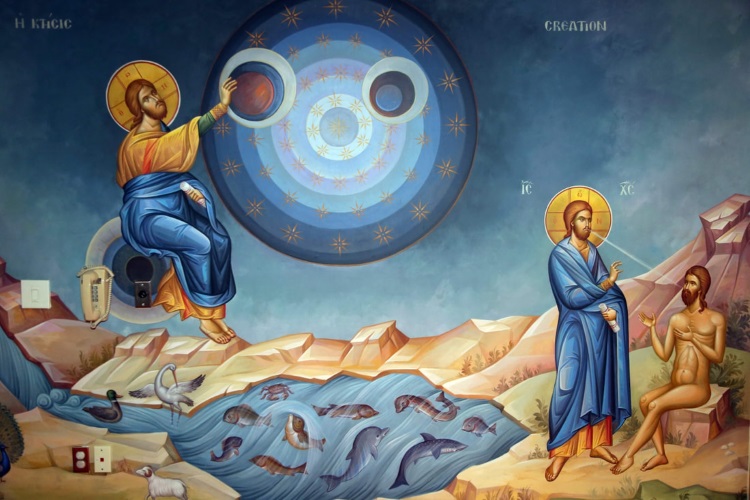
In St. Basil’s Hexaemeron, we encounter a shift in tone from the anti-Arian polemic of the Against Eunomius to a more contemplative meditation on the nature of the created world. Here, St. Basil develops the idea that creation was not accomplished through temporal stages but by an instantaneous divine act. The six days of Genesis are not temporal intervals but logical distinctions within a single creative command. St. Basil speaks of the creation as occurring achronos – outside of time – and insists that “the beginning, in effect, is indivisible and instantaneous. The beginning of the road is not yet a road” (Hex, 1.6). Time itself is a creature, a measure stretched out alongside the cosmos, inaugurated not as an external frame but as an internal rhythm of created becoming.
Whitehead, too, affirms a kind of creation – but of a metaphysical sort. In his system, every actual entity comes into being through a process of concrescence: a self-unification of inherited data and subjective aim. God, in His primordial nature, provides the ordering of potentialities; the world, through its network of actual occasions, actualizes this order through decisions, feelings, and relations. Creation is not a one-time event, nor a finished artifact, but a ceaseless becoming. God does not simply create the world but lures it into self-creative participation. Time is not imposed; it emerges from the web of related becomings.
The Basilian and Whiteheadian visions might seem at odds – one instantaneous and hierarchical, the other unfolding and democratic. But they can be reconciled by distinguishing between the ontological act of creation and the modal unfolding of creation. St. Basil’s instantaneous creation may be seen as the divine letting-be of the world, a timeless initiation of all possibility. Whitehead’s concrescence then maps the inner logic of how creation unfolds once it has been given its freedom and structure. The two views are not contradictory but perspectivally different: St. Basil gives us the divine initiative; Whitehead, the creaturely response.
A further theological implication lies in the nature of time itself. For St. Basil, time is not an illusion, but neither is it ultimate. Its measure is subordinated to the eschatological promise of the “eighth day”—a day beyond all succession, a foretaste of eternal rest. The present is fleeting, the past irretrievable, and the future unknown. Created time is marked by change, decay, and hope. Yet through the Incarnation, for Basil, time becomes a locus of redemption. Eternity touches time not through cosmic cycles but through divine condescension.
In Whitehead’s theology, time is not the enemy of God but the mode of God’s presence. The consequent nature of God is the divine integration of all temporality—not as a clockmaker standing outside time, but as a fellow participant in every moment’s becoming. There is no eternal realm of detached Forms; there are only actual occasions in dynamic interrelation, with God as their ultimate harmonizer. Eternity, in this sense, is not above time but within it—not as a durationless point, but as the fullness of integration. Time, in its deepest sense, is the becoming of God with the world.
A synthesis of these views offers a profound theological vision: time is not abolished by eternity, but fulfilled in it. Creation is not dragged along a timeline, but drawn into the eternal act of divine meaning. God’s eternity is not the negation of becoming but the infinite capacity to hold and perfect it. Thus, to be temporal is not to be separated from God, but to be invited into His life—a life that includes, embraces, and transfigures time itself.
Temporal Structures: Layered Time and the Architecture of Becoming
Having examined the metaphysical distinctions between temporality and eternity, and explored their theological implications, we turn now to a structural analysis of time itself. For both St. Basil and Whitehead, time is neither reducible to motion nor confined to a simple linearity. Each constructs a layered account of temporality: St. Basil distinguishing between one day and the succession of days, Whitehead differentiating between physical time, genetic time, and durations within actual occasions. What emerges is a vision of time not as a uniform river, but as a stratified field – structured by rhythm, relation, and purpose. Time, in this view, is a meaningful architecture in which divine action and creaturely response are coordinated, without dissolving into determinism or disjunction.
In his Hexaemeron, St. Basil famously highlights the seemingly minor but profound fact that Scripture calls the first day not the first but one day (hemera mia). He interprets this not as a mere ordinal detail, but as a metaphysical signal. One day stands apart from the numbered sequence of the following days. It represents a unique, indivisible, and unrepeatable measure – a kind of eternal archetype of time rather than a member of temporal succession. This is, for St. Basil, the measure given by God to Creation: a paradigmatic day that perfectly mimics eternity, not in being static, but in being without successor, encompassing completeness in itself.
The six days that follow, while still within the scope of God’s unified creative act, represent a logical sequence within created temporality – a divine accommodation to human understanding. Yet even here, St. Basil insists, we must not confuse the sequence of days with a temporal process in God. Creation unfolds in logical rather than chronological order. Motion and time are not absent from the created world, but they are measured against this initial divine calibration: one day. In effect, Basil establishes a double temporality: (1) a cosmic time that flows and is measured diastima as an interval, space, or distance, and (2) an eternal day that frames and transcends this flow. Time is thus both a measure and a mystery – both fleeting and, in its origin, held within the stillness of divine will.
Whitehead approaches the problem of temporal structure from a radically different angle, shaped by process metaphysics and modern science. In place of a singular beginning, he offers a world composed of countless actual occasions, each of which arises through a process of concrescence – integrating the past and aiming at satisfaction. Time, for Whitehead, is not a container but a pattern of relations among events. Every occasion is durative, not instantaneous; it extends through a finite but irreducible becoming. Thus, a moment, for Whitehead, is not a temporal atom but a limit approached within a duration. “There is no such thing as nature at an instant,” he writes; “What sense-awareness delivers over to knowledge is nature through a period” (CN, p57)
Whitehead distinguishes between:
- Genetic time: the internal unfolding of an occasion, involving successive phases of concrescence.
- Physical time: the order of completed occasions, prehended by others and forming the apparent flow of history.
- Presentational immediacy: our lived sense of the now, which is itself a fringe of memory and anticipation, not an isolated point.
This tripartite structure allows Whitehead to hold together the continuity of experience and the novelty of becoming. Time is not a line, but a fabric woven from relational threads. Crucially, God’s primordial nature is not subject to this temporal field, but God’s consequent nature incorporates it. Thus, while actual occasions come and go, God retains and integrates them into the divine life—giving time both a metaphysical integrity and an eschatological direction.
The synthesis of St. Basil and Whitehead suggests a complex, three-tiered model of temporality:
- Eternal Time (One Day): St. Basil’s non-successive archetypal time, which functions analogously to Whitehead’s primordial ordering of eternal objects. This level grounds all measure but is itself unmeasured.
- Measured Time (Cosmic Diastemic Time): St. Basil’s diastima – time coextensive with the cosmos – parallels Whitehead’s physical time, in which events are related by succession, causality, and prehension. This is the field of creaturely becoming.
- Event-Time (Genetic/Experiential Time): The inner rhythm of actual occasions, or the lived process of concrescence. Here time is not a sequence but an unfolding of intensity, valuation, and decision. St. Basil does not explicitly describe this level, but it may be implicit in his liturgical and eschatological imagination, especially in the participatory character of theosis.
This model accommodates the theological need for a God who is not subject to time, while also affirming a cosmos in which time is real, structured, and suffused with divine intention. It also opens a space for a richer understanding of liturgical and eschatological time: time not merely as measure or decay, but as invitation – an open field in which eternity touches finitude not by interruption but by participation.
Finally, both St. Basil and Whitehead contest the view of time as an absolute container. St. Basil challenges any identification of time with the motion of the stars; time, he insists, exists even when the celestial bodies are still – as in the miracle of Joshua, or the first three days of creation before the sun and moon (see AE, p122 – 1.19.21). Whitehead echoes this by rejecting the Newtonian view of absolute time and space. For him, temporal and spatial metrics emerge from the relations between actual entities. A point in time is not a thing but a set of relations; durations and rhythms arise from the overlapping of concrescent processes.
Thus, in both systems, time is real but relative. It is shaped by motion, order, and consciousness, but not reducible to any one of them. Time is not an idol but a grammar: a divinely-inflected structure through which being is disclosed, creatures become, and God is revealed.
Soteriology and Eschatology: Redemption through Participation in Divine Becoming
The metaphysical and temporal frameworks articulated by St. Basil and Whitehead are not merely speculative. They culminate in a vision of salvation that is both cosmic and participatory. In both thinkers, temporality is not a mere backdrop to redemption; it is the very medium through which creatures are drawn into divine life. Yet their respective eschatologies differ in tone and emphasis. For Basil, the narrative arc moves from the one day of Creation to the eighth day of resurrection and transfiguration. For Whitehead, the world moves not toward a predetermined end but toward increasing intensification, harmony, and integration in the consequent nature of God. Together, they offer a model of salvation as the transformation of time itself – not its erasure, but its elevation.
St. Basil’s soteriology is deeply shaped by the opposition between the temporal and the eternal. The created world, subject to decay, is characterized by motion, flux, and contingency. Yet time is not itself evil. Rather, it is the condition of possibility for movement toward God. The created order is not to be escaped but transfigured.
Central to St. Basil’s vision is the image of the eighth day – the day beyond the sevenfold structure of Creation. This is the eschatological horizon, the day that transcends the rhythm of labor and rest, flux and order. In it, all things are restored and gathered into divine stillness. It is not merely a future event but a mode of being into which the Church already enters liturgically and mystically. The rhythm of time is thus reoriented toward a telos: not absorption into timelessness, but participation in divine stability without stasis. The one day of Creation finds its fulfillment in the eighth day of resurrection, when all temporal becoming is gathered into eternal rest.
Whitehead’s eschatology is not framed by a cosmic narrative of fall and redemption, but by a metaphysical commitment to the preservation and intensification of value. For Whitehead, God is not the eschaton as final judgment or cessation, but as ultimate receptacle, harmonizer, and transmuter of all becoming. The consequent nature of God prehends every actual occasion, with its sorrows, triumphs, and failures, and weaves them into the divine life. Nothing is lost; every moment contributes to the richness of the divine experience. This is Whitehead’s radical alternative to metaphysical nihilism is God as the great companion and fellow sufferer who understands.
Salvation, then, is not rescue from time, but redemption within it. It is the intensification of experience, the elevation of value, and the movement toward greater harmony and novelty. God does not override the freedom of actual entities but lures them toward self-transcendence. Evil and suffering are not erased but taken up, integrated without being annulled. In this sense, eschatology is not future-oriented in a linear sense, but vertical: it is the growing depth of reality’s participation in God.
The theological synthesis of St. Basil and Whitehead allows us to construct a soteriology that is both apocalyptic and processive. From St. Basil, we inherit the vision of a world destined for transfiguration – where temporality gives way to participation in eternal life. From Whitehead, we inherit the view that every moment already participates in this divine process, that salvation is a becoming-with-God, not merely an arrival at God.
In this model, redemption is the transformation of temporality through its relation to divine life:
- Time is not abolished, but fulfilled. Just as Christ enters time without being subject to its corruption, so too does redeemed creation retain its structure while being drawn into the eternal.
- Eschatology is not simply an end, but a reorientation. St. Basil’s eighth day and Whitehead’s divine integration both mark a horizon in which history is taken up into meaning.
- Creatures are not saved by escaping time, but by conforming to its highest possibility: relation, motion, and self-giving participation in God.
This vision resonates deeply with the Christian understanding of the Incarnation and Resurrection: the eternal Word enters time to redeem it from within; the risen Christ does not abolish temporality but transfigures it, inaugurating a new rhythm – the sabbath beyond sabbath, time saturated with eternity.
In both Basilian and Whiteheadian frameworks, the liturgical imagination becomes central. For St. Basil, the liturgy is the sacramental entrance into eschatological time – the re-presentation of “one day and a foretaste of the eighth. The (One, Holy, Catholic, and Apostolic) Church, in its worship, anticipates the transformation of all time. Similarly, Whitehead’s concept of the present as a fringe of memory and anticipation gives theological weight to the liturgical now. Worship becomes the site where temporal occasions are most fully drawn toward their divine satisfaction. Memory, thanksgiving (eucharistia), and anticipation are not psychological phenomena alone, but ontological movements – concrescences aimed at God.
Thus, liturgy can be understood as a particular ordering of time rather than an escape from it. Ordinary time is experienced as a succession of moments that pass and disappear. In liturgy, however, that succession is gathered into a meaningful pattern. Repetition, rhythm, and ritual structure give temporal movement a direction. Time is still passing, but it is no longer experienced merely as loss or decay; it becomes oriented toward communion with God.
In this sense liturgy reflects, within temporal life, the relation between time and eternity described earlier. Eternity does not abolish time but gives it intelligibility and purpose. The liturgical cycle therefore functions as a kind of mediation between the two. It allows temporal actions: prayer, memory, thanksgiving, anticipation—to participate in a reality that exceeds temporal succession.
This also clarifies the meaning of eschatology. The end of time should not be understood simply as the final moment in a sequence, as if history were merely running out. Rather, the end is the fulfillment toward which temporal life is directed. St. Basil’s remark that God “determined to bring into being time which had no being” (Hex. 2.2) expresses the starting point of this structure: time exists because God wills it into existence. If time originates in that divine intention, then its completion must also lie in relation to that same source. The movement of time therefore has a direction: it proceeds from God and ultimately returns to Him. Liturgy anticipates this return by ordering the passing of time toward its ultimate fulfillment in divine life.
Sources and References.
~ (AE) Against Eunomius by St. Basil the Great (CUAP, 2011).
~ (Hex) The Hexameron by St. Basil the Great (From Nicene and Post-Nicene Fathers, Second Series, Volume 8 (CLP, 1895).
~ (PR) Process and Reality: An Essay in Cosmology by A.N. Whitehead (Macmillan, 1929).
~ (CN) Concept of Nature by A.N. Whitehead (CUP, 1920).
 The Beginning of Terror