
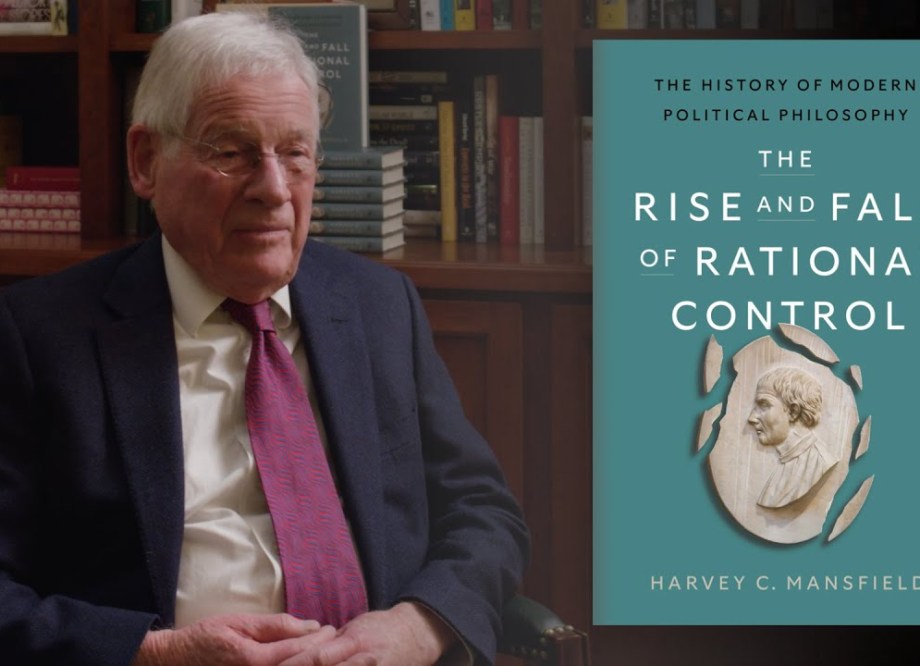
~ The Rise and Fall of Rational Control: The History of Modern Political Philosophy (Belknap Press of Harvard University Press, 2026) by Harvey C. Mansfield.
Harvey Mansfield taught Harvard’s History of Modern Political Philosophy for more than half a century, from 1968 until 2022. The Rise and Fall of Rational Control distils those lectures into eight studies running from Machiavelli through Hobbes, Locke, Rousseau, Kant, Hegel and Marx to Nietzsche. Modern political philosophy, he proposes, can be understood as the history of a single ambition: to replace dependence upon nature, providence, inherited authority, and ultimately chance itself with the deliberate government of human affairs by human reason. The moderns did not merely want to understand the world – they wanted knowledge capable of mastering it.
The startling part of the argument is that this revolution begins not with Bacon, Descartes or Hobbes but with Machiavelli. Ancient political philosophy had asked how political life might accord with justice and the human good; Christianity placed human affairs beneath a providential order whose ultimate end exceeded politics. Machiavelli instead announced “new modes and orders” and directed attention towards the effectual truth: what men actually do, what necessity requires and what political action can accomplish. Mansfield gives considerable weight to Machiavelli’s seemingly casual description of Christianity as “the present religion”. The phrase makes Christianity historical and therefore replaceable. Fortuna, similarly, ceases to be something prudent men accommodate and becomes something virtù should beat into submission – politics is thereby detached from providence and placed in human hands.
Decades spent reading Machiavelli have made Mansefild extraordinarily alert to apparently minor choices of words, jokes, omissions and rearrangements. His discussion of Mandragola, in which adultery, deception, and corruption produce a comic rather than tragic conclusion, gives the abstract proposition of “rational control” an immediately political expression. The question is no longer whether the means are intrinsically good but whether they work. Even Machiavelli’s retelling of David and Goliath becomes evidence, as Mansfield notices that his David finishes Goliath with his own knife rather than, as in the biblical narrative, Goliath’s sword. Mansfield reads the alteration as another small displacement of providence: David succeeds through his own resourcefulness rather than through divine favour.
Hobbes systematised this political audacity by treating fear, competition, and insecurity not as vices to be overcome through civic virtue but as permanent features of human conduct to be contained by an artificial sovereign capable of preventing their descent into civil war. The state becomes an artefact built from a science of human behaviour. Locke makes the project less terrifying and considerably more successful by shifting the burden from political command to institutions that protect individual independence, secure property, restrain rulers, and allow commerce to make peaceable conduct more advantageous than heroic virtue. Mansfield’s decision to begin the Locke chapter with Robinson Crusoe catches something important about the resulting anthropology, as Crusoe finds himself stripped of society and proceeds by labour, calculation, and ingenuity to reconstruct a habitable world. For Mansfield, Crusoe is recognisably Lockean because his independence is achieved through labour: he survives by working upon the world around him rather than simply accepting it as given.
By treating Hobbes and Locke as successive expressions of Machiavellian “rational control”, Mansfield risks flattening important differences between them and making their political philosophies appear as refinements of a programme already latent in The Prince. Locke’s natural rights, consent, and limitation of political authority can then appear less as a distinct political argument than as instruments for making the modern project safer and more durable. Mansfield does not collapse Locke into Machiavelli, but his genealogy repeatedly encourages that reading. Modern political philosophy begins to look less like a field of competing arguments than a succession of attempts to answer problems first posed by Machiavelli.
Rousseau becomes the decisive figure because he breaks the machinery while attempting to repair it. Mansfield calls the Second Discourse the hinge of the book. Early modern rationalism had assumed something sufficiently stable called human nature whose passions and necessities political science could understand and manage. Rousseau historicises the creature being managed. Civilised man is not simply natural man placed under government; his desires, comparisons, dependencies, and even his conception of himself have been produced through social development. Rousseau complicates the project of rational control by showing that human beings do not stand outside society as fixed creatures who can simply redesign it; society has already helped make them what they are.
Once human beings become historical, emancipation can no longer mean merely arranging institutions around a fixed nature. Freedom begins to require some form of collective self-creation. Kant attempted to rescue autonomy through a rational morality that the subject gives to itself. While Hegel made history intelligible as the process through which freedom becomes conscious of itself. Marx radicalised this claim by insisting that humanity can cease merely suffering historical forces and bring its material conditions under common direction. Rational control has moved from conquering Fortuna to humanity becoming, in some sense, the author of its own world.
At this point, “rational control” begins to cover such different projects that its explanatory force weakens. Hegel’s philosophy is not easily described as a doctrine of conscious mastery. The cunning of reason works precisely because historical actors do not comprehend the larger significance of what they are doing; modern freedom appears through institutions that no individual has designed from first principles. Marx likewise insists that men make their own history under inherited circumstances they did not choose. His capitalism is a system in which apparently free actors collectively generate economic powers that dominate them behind their backs. There is certainly a promise of conscious social regulation in communism, but it arises from an analysis of how little rational control individuals actually possess within a market society. Mansfield’s formula captures the emancipatory aspiration while partially obscuring the critique of mastery built into the argument.
Rousseau presents a related difficulty, as Mansfield needs him to mark the moment at which nature yields to history, but Rousseau never simply abandons nature. Natural pity, self-preservation, freedom and the contrast between amour de soi and socially generated amour-propre continue to provide standards from which civilisation can be criticised. Rousseau’s historical anthropology demonstrates that human beings are transformed by society without establishing that nothing about them precedes it.
Nietzsche finally turns the modern project against itself. The civilisation constructed to liberate human beings from necessity has generated the Last Man: safe, comfortable, healthy, and devoid of anything worth suffering for. Rational control has succeeded sufficiently to expose the poverty of its own objective. Reason can calculate means but cannot tell humanity why one end deserves sacrifice rather than another. Nietzsche answers with creativity, self-overcoming, and the will to power, only to make freedom available principally to exceptional individuals capable of imposing form upon themselves and perhaps others. Mansfield therefore treats Nietzsche’s revolt against bourgeois complacency as politically compromised, since recovering greatness on Nietzsche’s terms threatens the ordinary freedom that liberalism had been designed to protect.
At times, reading the book feels like watching Mansfield play intellectual solitaire with himself, arranging his thinkers into a sequence whose conclusion has largely been determined in advance. Renaissance humanism, the Reformation, confessional conflict, commercial expansion, state formation, and experimental science recede behind a succession of canonical texts made to answer one another across centuries. Machiavelli consequently appears less as a Florentine thinker working within several competing political traditions than as the originator of a project that Hobbes, Locke, Rousseau, Hegel, Marx, and Nietzsche successively develop, revise, or overturn. The result is a history in which the cards fall with suspicious neatness. Mansfield’s category of rational control certainly reveals real continuities, but it also risks manufacturing them by treating alternative traditions, historical contingencies, and genuine disagreements as secondary to the pattern he wants the history to form.
Montesquieu, Hume, Tocqueville, Spinoza, and Mill all sit uneasily with Mansfield’s genealogy because each points towards forms of modern politics less readily described as projects of comprehensive mastery. Institutional balance, commercial society, association, scepticism, experimentation, and the management of unavoidable imperfection complicate the movement from Machiavellian control to Nietzschean revolt. Tocqueville creates the sharpest problem because Mansfield eventually turns to Democracy in America as part of his answer to modernity, even though Tocqueville remained thoroughly modern in his commitment to political liberty and his acceptance of democratic equality as an irreversible historical condition – Mansfield therefore ends up drawing part of his remedy from within the very modernity his genealogy has taught the reader to distrust.
That problem reaches the book’s concluding pages, as Mansfield directs his reader towards Aristotle’s Nicomachean Ethics, The Federalist Papers, and Tocqueville, hoping to recover a conception of politics in which citizens possess souls as well as interests and freedom demands participation rather than merely protection. Political life requires judgement about justice, nobility, and common purposes; it cannot be reduced to techniques for securing survival. There is considerable potency in this, particularly when set against the succession of modern programmes that sought to narrow political conflict through rational administration: Saint-Simonian industrialism, fascist corporatism, Rooseveltian New Dealism, French dirigisme, Soviet economic planning, and the technocratic corporatism associated with Ted Heath all placed unusual confidence in the capacity of experts, planners, administrators, or organised economic interests to bring social conflict under conscious direction. They differed radically in institutions and ends, but each treated some part of politics as a problem that better organisation could master. Mansfield’s insistence that questions of authority, justice, obligation, and collective purpose cannot finally be engineered out of political life is therefore among the book’s strongest claims.
The Federalist Papers complicate the title’s verdict because liberal constitutionalism has never depended entirely upon rational control. The Federalist assumes ambition, faction, institutional conflict, miscalculation and imperfect human beings; its constitutional machinery works by preventing any single will from acquiring control. Tocqueville values associations, local government and political participation precisely because liberty cannot be manufactured administratively on behalf of passive citizens. These are not remnants of an ancient world accidentally surviving inside modernity. They are modern discoveries about the limits of mastery. The most persuasive conclusion to Mansfield’s story may therefore be not that rational control rose and fell, but that modern political thought has always contained an argument between mastery and self-limitation.
The irony is that Mansfield’s history of the failure of rational control is itself weakened by an excess of intellectual control over its materials. Machiavelli, Hobbes, Locke, Rousseau, Kant, Hegel, Marx, and Nietzsche fall into an extraordinarily satisfying sequence partly because Mansfield reads them through a Straussian method in which omissions, contradictions, peculiar formulations, and departures from received sources can disclose an argument more important than the one stated openly. Such reading can be extraordinarily acute, but it also gives the interpreter considerable power over what the text is permitted to mean: evidence that resists the governing interpretation can itself be converted into evidence of concealment or esoteric intention. His readings are consequently compressed and tendentious, with inconvenient distinctions repeatedly absorbed into a sequence that the method itself helps to produce.
Mansfield is closest to the truth when rational control begins to fail, but he misunderstands what that failure reveals. The problem is not simply that political reason occasionally exceeds its competence, or that modern states have placed too much faith in planners, administrators, and experts. Human beings never occupy the position from which complete mastery would be possible in the first place. They inherit languages, institutions, histories, obligations, and worlds they did not choose; they act with partial knowledge among other centres of agency, and discover the meaning of what they have done only after consequences have begun to escape them. Politics therefore belongs less to the logic of control than to that of judgement, experiment, correction, and response. Its characteristic condition is not knowledge followed by execution but action amid uncertainty, where purposes collide with circumstances and every settlement creates possibilities that its authors could not foresee. Mansfield tries to organise modern political philosophy around the dream of escaping that condition. A more radical history would begin from the impossibility of the escape itself: not the rise and fall of rational control, but the repeated discovery that neither the world nor the human beings within it ever become sufficiently finished to be mastered.

