
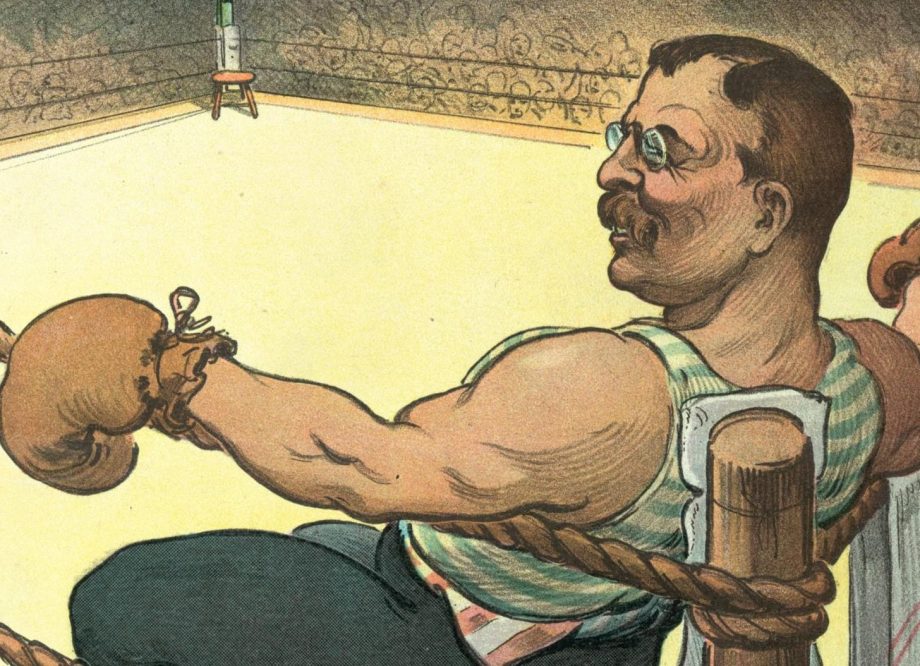
~ The Bully Pulpit: Theodore Roosevelt, William Howard Taft, and the Golden Age of Journalism (Simon & Schuster, 2013) by Doris Kearns Goodwin.
~ Unreasonable Men: Theodore Roosevelt and the Republican Rebels Who Created Progressive Politics (St. Martin’s Press, 2014) by Michael Wolraich.
~ America’s Bank: The Epic Struggle to Create the Federal Reserve (Penguin Press, 2015) by Roger Lowenstein.
On 22 October 1907, after depositors had withdrawn nearly $8 million in little more than a day, the Knickerbocker Trust Company closed its doors. The Wall Street financier J. P. Morgan had declined to save it. Benjamin Strong of Bankers Trust, later the first governor of the Federal Reserve Bank of New York, had been sent to inspect the trust’s books but could not establish whether it was solvent, and Morgan was unwilling to put his money behind an institution he could not value. The decision did not contain the damage. Runs spread through New York’s trust companies, institutions that had grown large while keeping cash reserves of only about 5 per cent of deposits, against roughly 25 per cent at national banks. Credit at the Stock Exchange almost disappeared. The call-money rate, 9.5 per cent before Knickerbocker suspended, touched 70 per cent that day and 100 per cent two days later. Morgan now found himself doing something stranger than rescuing a bank. He was deciding where liquidity should go, extracting money from other financiers, and having cash carried directly to the Exchange so that brokers could continue lending. The United States possessed thousands of banks, one of the world’s largest industrial economies, and no institution charged with doing what Morgan was improvising from his library.
Doris Kearns Goodwin’s The Bully Pulpit, Michael Wolraich’s Unreasonable Men, and Roger Lowenstein’s America’s Bank approach the political transformation that followed from different directions. Goodwin gives us President Theodore Roosevelt, his successor William Howard Taft, and the muckraking journalists who exposed how corporations, party machines, and industrial conflict actually worked to a national readership. Wolraich follows Wisconsin senator Robert La Follette, Nebraska congressman George Norris and other Republican insurgents as they challenged the party establishment led by House Speaker Joseph Cannon and Rhode Island senator Nelson Aldrich, chairman of the Senate Finance Committee, weakening Cannon’s control of the House and pushing tariff, electoral, and regulatory reform into the Republican mainstream. Lowenstein traces the effort after the Panic of 1907 to replace reliance on J. P. Morgan and private financiers with a permanent system for pooling reserves, supplying emergency credit, and stabilising the banks, culminating in the Federal Reserve Act of 1913.
Goodwin devotes substantial attention to the writers around McClure’s Magazine, whose investigations supplied Roosevelt-era reform with much of its factual ammunition. Ida Tarbell showed how Standard Oil used railroad rebates and preferential freight rates to undercut independent refiners; Lincoln Steffens found St. Louis aldermen taking cash for franchises and Minneapolis police collecting protection money from saloons, gambling houses, and brothels; Ray Stannard Baker reported from the anthracite coalfields and later investigated the accusations surrounding the Atlanta race riot. Strikingly, Tarbell, Steffens and Baker all appeared in the January 1903 issue of McClure’s: monopoly, municipal graft, and industrial conflict were placed before the same national readership as parts of the same political world. The magazine was doing more than exposing scandals; it was teaching Americans to connect abuses previously encountered as local or private affairs with the larger distribution of economic and political power.
Goodwin’s Roosevelt is above all a politician who understood that the presidency could be used to create national pressure for reform. He cultivated journalists, gave them access, read their investigations, and used the publicity generated by McClure’s and other magazines to turn corporate abuses and labour disputes into questions the federal government could no longer ignore.
Her clearest example is the anthracite strike of 1902, when Roosevelt brought mine owners and union leaders to Washington, pressed for arbitration, and considered federal intervention when the owners refused to compromise. Goodwin treats this as a departure from the older presidential posture of standing aside from labour disputes, with the feverishly energetic Roosevelt claiming a public interest separate from both capital and labour.
She follows the same instinct into his treatment of corporations. Invoking what he called a West African proverb — “Speak softly and carry a big stick; you will go far” — Roosevelt prosecuted Northern Securities, strengthened railroad regulation through the Hepburn Act, backed federal food and meat inspection, and used antitrust law selectively. Goodwin is careful that he was not hostile to corporate size in itself. Rather, Roosevelt accepted the large corporation as a permanent feature of modern America; what he rejected was the idea that its size placed it beyond public control.
She also stresses his use of the media as a form of political power. Roosevelt could not always compel Congress directly, but he could make an issue national, force opponents to defend themselves publicly, and use popular opinion against party leaders and corporate interests. This was the bully pulpit that gives Goodwin’s book its name. Roosevelt was helping to pioneer a new kind of presidency in which publicity itself became an instrument of government: cultivating reporters, managing access and, when Congress resisted him, appealing over its leaders directly to the voters who elected them. During the fight for the Hepburn Act he did exactly that, taking railroad regulation to the country rather than leaving it to congressional bargaining. Public opinion could now supply the president with power that the Constitution had never formally given him.
Goodwin’s biographical method gives this development unusual intimacy, but it also bends the argument towards Roosevelt. Taft too readily becomes the foil: cautious where Roosevelt is energetic, legalistic where Roosevelt is imaginative, temperamentally unsuited to the political age his predecessor had helped create. His record is less obliging. Taft’s administration initiated more antitrust suits than Roosevelt’s, including actions against U.S. Steel and International Harvester. Congress during his presidency strengthened federal railway regulation and submitted the income-tax and direct-election amendments to the states.
The disagreement between the two men was therefore more serious than a contrast between the hyperenergetic Progressive and a conservative plodder. Roosevelt claimed an expansive conception of executive responsibility: the president might act wherever the Constitution did not expressly forbid him. Taft, meanwhile, wanted authority grounded in statute and constitutional precedent before the executive used it. Both accepted an enlarged national government but disagreed over what would legitimate its enlargement.
Goodwin’s preference for Roosevelt can make this enlargement of presidential power look like the natural accompaniment of modern government. Roosevelt himself stated the principle more starkly. Under his “stewardship” theory, the president was bound to do whatever the needs of the nation required unless the Constitution or Congress specifically forbade it; power therefore began with national necessity rather than with an enumerated grant. Taft thought the doctrine “unsafe,” objecting that it threatened to turn the president into a kind of “Universal Providence” empowered to set things right whenever he judged the public interest demanded it. For Taft, executive power had to be traced back to the Constitution or an act of Congress. Their quarrel was consequently over more than political temperament. Roosevelt was helping create the modern presidency by treating popular mandate and public necessity as sources of executive initiative; Taft saw in the same innovation the possibility that necessity might become its own warrant for power.
Wolraich’s Unreasonable Men puts the fight inside Congress, where House Speaker Joseph Cannon appointed committees, chaired the Rules Committee, and could decide which bills reached the floor; in the Senate, Aldrich used the Finance Committee to defend the protective tariff and the manufacturers and financial interests that benefited from it. The Payne-Aldrich fight of 1909 showed what the insurgents were up against. La Follette and other western Republicans joined Democrats in trying to lower duties and attach an income tax to a bill Aldrich had constructed to preserve high protection. Their quarrel with the party leadership was therefore not simply ideological. Cannon and Aldrich occupied the points through which legislation had to pass.
Nebraska Republican George W. Norris, one of the House insurgents challenging Cannon’s leadership, broke the Speaker’s hold over the chamber by turning one of Cannon’s own rulings against him. Cannon had allowed a census bill to bypass the normal calendar because the Constitution required the census; Norris seized on the same logic, arguing that the House’s constitutional power to make its own rules entitled him to force a vote on changing the Rules Committee. Cannon delayed for nearly two days while supporters were summoned back to Washington, then ruled Norris out of order. The House overruled him. More than forty Republicans joined the Democrats, and the resolution passed 191–156. Cannon remained Speaker, but he lost his place on the Rules Committee and with it much of his ability to decide which legislation ever reached the floor.
La Follette’s method was less theatrical and more corrosive. He repeatedly introduced measures that party leaders considered impossible, refused to bargain them down into harmlessness, and waited for political opinion to move towards him: railroad regulation, direct election of senators, workers’ protection, and progressive taxation had all formed part of his politics before they became respectable national positions. Roosevelt’s own movement after leaving office shows how far those ideas had travelled. By 1910 his New Nationalism had embraced progressive taxation, stronger labour protections, and a much larger federal role in regulating business; two years later, much of that programme formed the platform of his Progressive Party. Direct election of senators, workmen’s compensation, restrictions on child labour, minimum wages for women, an eight-hour day in continuous industries, graduated inheritance taxation, and disclosure of campaign expenditure all appeared there. Many of the “unreasonable” demands had survived by making everyone else move.
Wolraich complicates Goodwin’s Roosevelt, because the reform programme did not simply radiate outward from the bully pulpit. Roosevelt had tolerated Cannon when breaking with him threatened his own legislation and remained wary of La Follette’s insurgency; by 1912 he was campaigning on proposals the insurgents had spent years forcing into national politics.
There is also something harder in Wolraich than a story of heroic rebels defeating reactionaries — the insurgents discovered that changing policy required changing the institutions that decided what counted as possible policy in the first place. Norris weakened the Speaker because the Speaker could prevent reform from reaching a vote, while La Follette persisted with proposals whose apparent extremity depended partly on the political arrangements excluding them. By 1912, direct election, income taxation, and federal labour regulation were no longer safely outside respectable politics. The rebels had not merely won arguments but had helped alter the terms on which an argument could be called reasonable at all.
Aldrich himself provides the hinge between Wolraich and Lowenstein. In Unreasonable Men he is one of the principal guardians of the Republican establishment, using the Senate Finance Committee and the protective tariff to resist insurgent reform; after the Panic of 1907, however, the same Aldrich chaired the National Monetary Commission, studied European central banks, and became convinced that the American banking system required reconstruction. The figure La Follette treated as an embodiment of the old order thus helped design one of the institutions that would define the new one. America’s Bank begins with that complication: Progressive reform did not advance simply by sweeping men like Aldrich aside, but by taking over parts of the expertise and institutional machinery they had already begun to assemble.
Lowenstein begins with a banking system whose weakness was built into its structure. Thousands of mostly single-office banks held reserves that could not readily be mobilised when trouble moved from one city to another, while national banknotes could expand only against holdings of federal bonds. In ordinary times, excess reserves flowed towards New York and into call loans on the stock exchange; during a panic, banks tried to pull the same money home. The Panic of 1907 exposed the additional danger created by institutions outside the existing safety arrangements. New York trust companies held cash reserves of roughly 5 per cent of deposits, against about 25 per cent at national banks, yet most stood outside the Clearing House that pooled reserves and supplied emergency credit to its members. When Knickerbocker Trust failed, the machinery available to stop a run ended at an institutional boundary the panic itself ignored.
Congress answered first with the Aldrich-Vreeland Act of 1908, which authorised emergency currency and created Aldrich’s National Monetary Commission. Two years later Aldrich, Paul Warburg and four others disappeared to Jekyll Island under the pretence of a hunting trip. Their secrecy followed directly from the politics of the problem: Warburg was a partner at the New York investment bank Kuhn, Loeb & Co., Henry Davison a senior partner at J. P. Morgan, and Frank Vanderlip president of National City Bank. The National Reserve Association they devised could pool reserves and issue an elastic currency, but its governing structure left control overwhelmingly with bankers; of forty-six directors, only six would have been government appointees. A plan intended to prevent another Morgan rescue therefore looked uncomfortably like a permanent transfer of monetary authority to Morgan’s world.
The Aldrich plan died after the Democratic victory of 1912, but much of its technical machinery survived. Virginia congressman Carter Glass, chairman of the House Banking and Currency Committee, and Oklahoma senator Robert Owen, chairman of the Senate Banking and Currency Committee, continued to draw on Warburg’s ideas as they recast the proposal with President Woodrow Wilson, and Warburg later pointed to passages of the Federal Reserve Act that closely resembled his earlier schemes. What changed was the distribution of authority. Aldrich’s banker-dominated National Reserve Association gave way to a system in which regional reserve banks operated under a federal board appointed from Washington. The problem remained the same; the political terms on which it could be solved did not.
Glass wanted autonomous regional reserve banks and initially resisted a powerful central authority in Washington. Wilson insisted otherwise. The eventual Act placed twelve Reserve Banks around the country under a Federal Reserve Board whose members were appointed through the federal government, while commercial banks remained woven into the regional system. The arrangement answered several fears at once. Reserves need no longer remain scattered among thousands of banks; emergency credit could be created when cash demand surged; New York would not possess a single national central bank; nor would bankers receive the largely private governing structure Aldrich had proposed. The Fed’s famous decentralisation was therefore less an elegant application of banking theory than a record of the interests that had to be defeated, accommodated, or reassured before a central bank could exist in the United States.
This gives Lowenstein’s story a more interesting political conclusion than the simple triumph of modern central banking. Progressive reformers had spent years attacking the conversion of private wealth into public power, yet monetary reform required them to preserve a large place for private financial expertise. Warburg’s knowledge survived the political destruction of Aldrich’s plan because the Democrats could reject Wall Street’s control without dispensing with what Wall Street knew. The Federal Reserve Act left banking overwhelmingly in private hands while making the coordination of reserves and emergency credit a national responsibility. Rather than abolishing financial power, the Progressive state built institutions through which it could work upon it.
Lowenstein is less convincing when that 1913 settlement begins to resemble the modern Federal Reserve too closely. The original system did not conduct monetary policy in the present sense: the gold standard constrained inflation and the exchange rate, the Federal Open Market Committee did not yet exist, and the Banking Act of 1935 later shifted substantial authority from the regional Reserve Banks towards Washington. Central banking itself was not the only reform contemporary Americans discussed; branch banking and various schemes for asset-backed currency offered alternative responses to the weaknesses of the National Banking System. The institution that survived can make its own birth look more inevitable than it was.
The achievement of 1913 was narrower, and in some ways more revealing. The federal government did not take command of American finance. It accepted responsibility for failures that could no longer plausibly be treated as the private misfortunes of individual banks. Morgan’s improvised authority in 1907 had demonstrated the cost of leaving national coordination to private discretion; the Federal Reserve made that coordinating capacity permanent, while deliberately dividing it between Washington, the regions, and the banking system itself. The resulting institution carried the Progressive contradiction inside its own structure: greater public power over capitalism was obtained not by separating the state from concentrated economic power, but by constructing a permanent relationship between them.
Read together, the three books describe not a simple victory of Progressivism over the shibboleths of the Gilded Age, but the political consolidation of the economy that age had created. Roosevelt accepted the large corporation and sought a federal power capable of mastering it, while Norris and La Follette attacked the congressional arrangements that allowed entrenched interests to choke off reform before it reached a vote. Lowenstein ends with bankers, legislators, and reformers constructing a reserve system capable of stabilising finance without displacing private banking. The regulatory state did not emerge from outside corporate capitalism to subdue it — the two grew together.
What looked like a series of victories over concentrated power was, in practice, a reorganisation of it. Standard Oil was broken apart, but the large corporation survived and soon ceased to appear an aberration. Cannon lost the machinery through which he had dominated the House, but congressional government itself became more organised rather than less. Morgan would no longer be expected to rescue the financial system from his library, yet the Federal Reserve did not drive bankers out of monetary government. It placed them inside a permanent institution created by federal law. Again and again, Progressivism attacked a concentration of power while preserving the function that concentration had come to perform.
Seen from this angle, Morgan’s library in 1907 was not merely filling a vacuum left by a weak state. Something resembling government was already taking place there, as bankers brought him intelligence, Morgan decided which institutions could be saved, and private capital was marshalled behind those decisions. The Federal Reserve did not so much invent those functions as make them permanent, national, and partly public. The movement from Morgan to the Fed was therefore less a clean transfer of authority from private hands to public ones than the conversion of improvised private sovereignty into a durable public-private regime.
The radical Progressive achievement was not the destruction of the Gilded Age order but its constitutionalisation. Corporate power would remain, but increasingly within rules written, administered, and enforced by a national state strong enough to confront it on its own scale. This enlarged democratic control over capitalism while changing the meaning of democratic control itself. Decisions once made by Morgan, Cannon, or corporate boards increasingly passed to presidents, commissions, regulators, and central bankers whose authority rested less directly on elections.
By 1913 the important question was no longer whether the national government should govern a national economy. The harder problem was already visible through the glass darkly: whether democracy could acquire the power necessary to govern capitalism without surrendering too much of that power to institutions beyond the immediate reach of democratic life.
Seen from the history that followed, I am inclined to be less sanguine about the Progressive settlement than any of these books, because the familiar opposition between corporate power and federal regulation is too simple. National regulation could restrain large firms while also supplying what fragmented markets and private agreements often could not: uniform rules, administrative coordination and systemic stability. Wilson’s New Freedom had been framed against monopoly, yet his administration created the Federal Reserve and Federal Trade Commission and strengthened antitrust law through the Clayton Act; wartime agencies then coordinated production, transport, prices and finance on an unprecedented scale. The New Deal carried this tendency further, multiplying regulatory bodies and centralising economic management, while the Banking Act of 1935 tightened Washington’s control over the Federal Reserve. Corporate concentration and federal regulation did not merely advance together; increasingly, the state helped organise the conditions under which large-scale capitalism could endure.

