
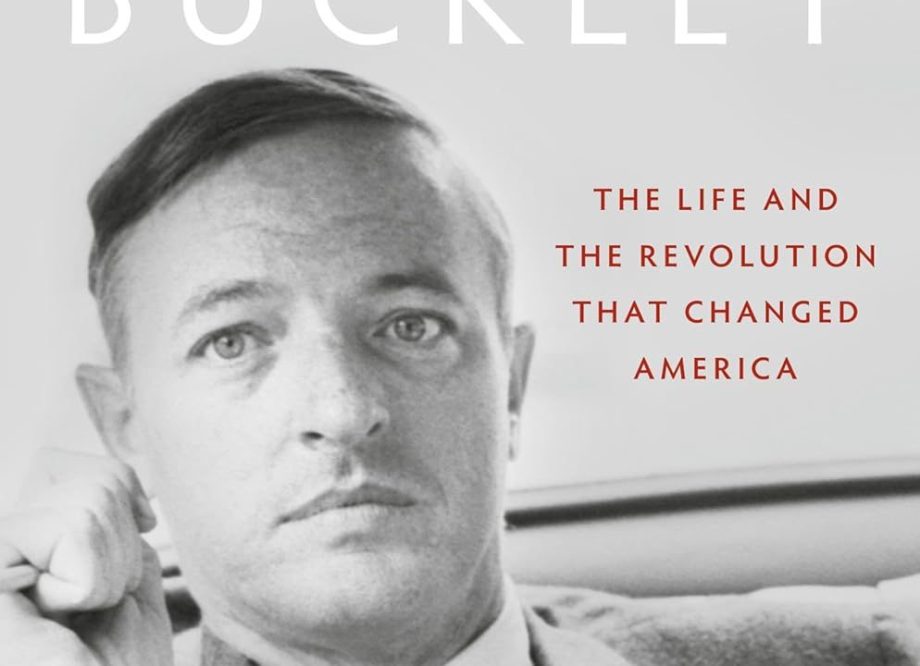
Buckley: The Life and the Revolution That Changed America by Sam Tanenhaus, Random House, 2025.
Bill Buckley was one of those people I had always wanted to know more about but was starved of information on. I knew that he had founded National Review, hosted Firing Line, lost his temper with Gore Vidal during the 1968 Democratic Convention, enjoyed sailing, remained a devout Catholic and spoke with an indiscernible mid-Atlantic drawl containing something of the King’s English mixed with Southern plantation moonlight. Beyond these fragments, little else.
Sam Tanenhaus has filled that gap with an enormous biography, more than a quarter of a century in the making. Buckley selected him for the task in 1998, submitting to extensive interviews and granting access to his private papers. The finished work runs to 1,040 pages and reconstructs not merely an unusual life but the formation of the American conservative movement from its marginal position after the Second World War to its apparent triumph under Ronald Reagan. Despite its scale, the book rarely feels inert. Tanenhaus writes with authority, controls an intimidating quantity of material and gives Buckley the one thing he spent his life demanding: sustained attention.
What emerges is a Buckley who made American conservatism respectable through what, in modern British parlance, might be called shithousery. He pioneered the art of high-brow trolling, using performative vocabulary, dripping irony, deliberate interruption and theatrical condescension to unravel an opponent’s composure while maintaining a smirk of innocent detachment. Yet trolling understates the seriousness of what he accomplished. The accent, vocabulary, humour and visible enjoyment of combat translated ideas associated with the political fringe into the language of metropolitan sophistication. Buckley did not merely irritate liberal opponents. By debating them, charming them and often befriending them, he established that conservatism belonged inside serious public conversation.
His performance on Firing Line was not publicity attached to the real political work but was a part of it. Beginning in 1966, the programme placed socialists, civil-rights leaders, feminists, libertarians, Black nationalists, writers and politicians opposite a conservative host who treated ideological disagreement as theatre without entirely reducing it to entertainment. Norman Mailer, Germaine Greer, Muhammad Ali, Jesse Jackson and Christopher Hitchens could appear as adversaries rather than enemies unworthy of engagement. Even those who disliked Buckley’s politics could enjoy the spectacle of his face rearranging itself around a particularly recherché adjective. Tanenhaus calls him a “performing ideologue”. That performance kept conservatism visible throughout a decade in which its electoral and cultural position often appeared hopeless.
The public manner was partly the product of an extraordinary childhood. William F. Buckley Jr. was the sixth of ten children born into a wealthy, intensely Catholic and politically reactionary family. Spanish came before English; French followed during a childhood residence in Paris; a British school supplied another layer of pronunciation; long visits to the family property in Camden, South Carolina, added the Southern cadence. What sounded like an affectation was largely the audible record of an eccentric upbringing that moved between Mexico, Europe, New England and the Jim Crow South.
Political certainty arrived through the same inheritance, with William F. Buckley Sr., an oilman of commanding personality, teaching his children to regard Franklin Roosevelt, secular liberalism, collectivism and international communism as connected assaults upon religion, property and paternal authority. The son learned not simply a collection of opinions but a posture towards the world. Liberalism was seldom encountered as an argument whose strongest version required patient reconstruction but appeared as an occupying ideology spread through universities, government departments, newspapers and Protestant clerisy. The young Buckley’s conservatism began as filial loyalty raised to the level of counter-revolution.
That formation made him a creature of Whitmanite multitudes: a patrician and a populist, a Catholic aristocrat in a Protestant republic, a cosmopolitan nationalist, an anti-elitist formed by Yale, preparatory schools, inherited wealth and old-world domestic arrangements. The contradictions were not incidental embarrassments. They generated his peculiar political authority. Buckley could mobilise resentment against the American establishment because he appeared to know it from within, bolstered by his education and social position. Here was a man who spoke the language of the ruling class announcing that the ruling class had betrayed the country.
For example, Buckley grasped that McCarthyism was more significant than Joseph McCarthy himself. Beneath the senator’s fabrications and brutality lay a potential social movement animated by suspicion of diplomats, professors, officials, journalists and specialist expertise. God and Man at Yale attacked liberal elites from above, using the standing of an alumnus to accuse the university of violating the religious and economic convictions of those who funded it. McCarthy’s followers supplied the corresponding pressure from below: voters convinced that credentialled authorities had concealed treachery behind professional decorum. Buckley recognised that these constituencies could be made to serve a new movement calling itself conservatism.
Such political intelligence, however, did not make him a profound political philosopher. Buckley possessed formidable quickness, wide reading, a prodigious memory and an unusual capacity to formulate arguments under pressure. But none of these gifts produced a systematic statement of conservative principles. His projected major work, The Revolt Against the Masses, was abandoned after approximately ten thousand words. Once the immediate controversy disappeared, so did much of his intellectual appetite. Columns, debates, lectures, television appearances, holidays, social engagements, spy novels and sailing offered a succession of concrete excitements that sustained reflection could not match.
As someone with frustrated literary ambitions, I sympathise with his desire to be accepted as a serious thinker rather than merely a brilliant polemicist. No number of defeated opponents could satisfy the wish to stand in the line of Burke and Tocqueville as an enduring interpreter of political life. Buckley published dozens of books, but few readers now consult them for systematic illumination. His most important creation was not a philosophical text. It was the public identity called William F. Buckley Jr.
Nevertheless, denying Buckley philosophical greatness does not diminish his historical importance. His real achievement was institutional. Through National Review, he gathered anti-communists, Catholic traditionalists, free-market liberals, Southern reactionaries, anti-New Deal businessmen, social conservatives, former leftists and young activists into a movement whose members gradually learned to recognise one another as allies.
These groups did not share a coherent political philosophy. Libertarians treated coercive government as the chief danger to freedom. Traditionalists feared that unrestricted individualism and commercial appetite would destroy the moral inheritance upon which liberty depended. Cold Warriors accepted immense state power when directed against the Soviet Union. Southern conservatives defended racial and constitutional arrangements that other contributors regarded as either disreputable or politically ruinous. Catholics wanted public recognition of truths that secular free-marketeers considered private matters. Buckley never resolved these disputes. Rather, he made them politically viable.
Anti-communism supplied an external enemy capable of postponing internal conflict. Editorial authority performed the rest. Different writers could govern separate intellectual territories, provided that none destroyed the common enterprise. James Burnham supplied geopolitical severity; Frank Meyer attempted to reconcile liberty with inherited virtue; Russell Kirk recovered the moral imagination of traditional conservatism; Friedrich Hayek and Milton Friedman furnished the economic indictment of planning; Whittaker Chambers transformed anti-communism from a dispute over government administration into an existential struggle over the spiritual character of the West.
Fusionism was therefore less a philosophical endeavour and more than an editorial stance. Buckley selected the combatants, regulated their quarrels, established a recognisable tone and decided which disagreements could be tolerated without dissolving the coalition. National Review did not prove that libertarianism, traditionalism, Catholicism, Southern constitutionalism and Cold War militarism arose from common principles. It gave their adherents common enemies, a shared publication and the experience of belonging to a cause.
His role as gatekeeper has subsequently become the most flattering part of the Buckley legend. According to this account, he entered a conservative wilderness inhabited by anti-Semites, conspiracy theorists and political cranks, then expelled the John Birch Society, rejected Ayn Rand’s atheistic movement and denied George Wallace admission to respectable conservatism. Like a discerning diamond dealer, he took a raw and chaotic political subculture, cut away its worst impurities and presented the remainder as a high-value intellectual product.
Buckley did police the movement’s boundaries, but the boundaries were adjusted according to political necessity. He understood the organisational power of the John Birch Society, cultivated its founder Robert Welch and hesitated before making a decisive break. Extremists were often tolerated while they supplied subscribers, activists or electoral energy; excommunication followed when their reputational cost exceeded their usefulness. Buckley’s function was not simply to cleanse conservatism of radicalism. He tried to exploit radical energy while preserving the authority to determine its legitimate public expression.
Race gives this tactical flexibility its most serious moral consequence. Tanenhaus establishes that the Buckley family helped finance the Camden News, a South Carolina newspaper created because the existing local publication was considered insufficiently committed to segregation.
The gravest test of Buckley’s claim to have disciplined the conservative movement concerns race. Tanenhaus reveals that his family helped finance the Camden News, a South Carolina newspaper founded to defend segregation more aggressively than the town’s existing press. William Buckley Sr. assured Strom Thurmond that his son supported segregation and that National Review maintained the appropriate line. The magazine’s notorious 1957 editorial, “Why the South Must Prevail”, defended white political supremacy on the grounds that the white population remained, for the time being, the “advanced race”.
Later articles opposed integration by claiming that racial separation served Black children themselves, while appeals to states’ rights converted segregation into constitutional principle and left Southern governments free to enforce it through law, intimidation and administrative obstruction. Buckley later repudiated segregation, acknowledged Jim Crow as a monstrosity and accepted that federal intervention had been necessary to destroy it. His change was real and should not be treated as fraudulent. Yet later correction cannot make the earlier position peripheral to his political formation. The man celebrated for removing disreputable elements from conservatism had himself given racial domination an urbane and intellectually respectable defence.
McCarthy presents a similar difficulty. Buckley and his brother-in-law, L. Brent Bozell, did not defend every accusation made by the Wisconsin senator. Their 1954 book defended McCarthyism as a legitimate movement around which morally serious anti-communists might rally. The distinction allowed Buckley to distance himself from the man’s lies while preserving the politics those falsehoods had mobilised. Even after McCarthy’s disgrace, Buckley refused the full repudiation demanded by his critics. He saw that the senator’s methods expressed a wider revolt against institutional authority and remained unwilling to surrender that insurgent constituency to liberal interpretation.
The Edgar Smith episode exposes the same failing at a more intimate level. Smith had been convicted of murdering fifteen-year-old Victoria Zielinski. After corresponding with him, Buckley became convinced of his innocence and spent years campaigning for his release. The supposed knowledge upon which this judgement rested came largely from letters written in an arch, cultivated style resembling Buckley’s own. Once freed, Smith attacked another woman, stabbing her in the chest, and eventually returned to prison. Buckley had mistaken verbal fluency for moral character and stylistic affinity for knowledge.
That mistake illuminates more than one catastrophic lapse in judgement. Buckley was attracted to brilliant, embattled or socially magnetic men because they made life interesting. Personal loyalty then reinforced the original fascination, allowing confidence to survive evidence that should have destroyed it. His susceptibility to Smith was the private counterpart of his political willingness to excuse allies whose conduct could be absorbed into a larger cause. Certainty supplied the initial judgement; loyalty protected it from correction.
Tanenhaus nevertheless gives us a man who was charming and droll, loyal to friends, generous to younger writers and capable of maintaining genuine affection across ideological divisions. Liberals who opposed almost everything he advocated still accepted his hospitality, travelled with him, appeared on his programme and enjoyed his company. Buckley wanted to do things for people, arrange their marriages, advance their careers and draw them into the family circle. Such generosity could become possessive. Garry Wills’s wife warned that Buckley “absorbs people”; several protégés discovered that affection could turn severe once independence became ideological rebellion.
Sociability also performed a public function. By treating political adversaries as interesting companions, Buckley encouraged the liberal establishment to recognise conservatism as a legitimate part of intellectual life. His warmth did not cancel the severity of his positions. It made them easier to receive. The charming host opened the room in which the reactionary argument could be heard.
My mind therefore turns to Kierkegaard’s Either/Or. Kierkegaard’s aesthete is a person who has lost the absolute and consequently lives through the interesting: wit, irony, novelty, variation, performance and detachment, all mobilised against boredom. Buckley appears at first to invert that figure. As a Catholic, conservative moralist and anti-relativist, he was not lacking in absolutes. Religious faith, anti-communism and familial loyalty supplied stable commitments that he never treated as temporary amusements.
His aestheticism lay elsewhere. Buckley did not sacrifice commitment to pleasure. He aestheticised commitment itself.
Catholicism furnished the permanent allegiance; controversy supplied endless variation. Political conviction became a succession of debates, columns, campaigns, television encounters, parties, voyages and personal dramas through which the same basic commitments could be experienced anew. Buckley’s thought remained most alive when directed at an immediate opponent because opposition converted belief into performance.
The institutional labour behind National Review prevents the analogy from becoming a simple accusation of frivolity. He worked prodigiously, created organisations, raised money, cultivated writers and sustained enterprises that seldom paid for themselves. Yet the appetite for the interesting shaped the use to which this discipline was put. Movement conservatism became a theatre of permanent antagonism in which doctrine mattered, but never so much that the performance could end.
The rise of Reagan was, like the coming of Christ, not the force that destroyed this arrangement but its electoral consummation. Reagan read National Review, sought Buckley’s support and formed a genuine friendship with him. Their association was also mutually useful. An erudite East Coast Catholic could reassure Republican grandees about a former actor, while Reagan offered Buckley the presidential victory for which the conservative movement had worked since the 1950s. The biography does not invent that relationship, though it sometimes allows Buckley’s proximity to Reagan to imply more political authorship than the evidence warrants.
The rupture came only after Reagan, whose populism still operated through the institutions Buckley had helped to build. Magazines, think tanks, party organisations and intellectual gatekeepers continued to translate popular anger into a disciplined conservative programme. Donald Trump has preserved these grievances while overthrowing those mediators. Buckley had believed that educated leaders could summon hostility towards elites, exploit popular anger and still retain the authority to decide which expressions of that anger were permissible. Trumpism demonstrates how the grassroots can seize control of a coalition, reject its former custodians and dispense with the elaborate ideological vocabulary through which resentment is presented as principle.
Yet, Buckley’s Catholicism, Atlanticism, intellectual curiosity, personal generosity and willingness to debate serious opponents distinguish him from Trump. Nevertheless, he helped create the political technique through which an elite spokesman could mobilise anti-elitism; racial resentment could be translated into arguments about crime, disorder and federal overreach; provocation could be offered as evidence of courage; and political combat could become an end in itself. The later Right kept the performance and discarded the patrician disciplines of virtue and courtesy.
Here Tanenhaus’s decision to hurry through the final decades becomes especially damaging. More than eight hundred pages carry Buckley into Reagan’s first term, after which approximately twenty-five years receive only a few dozen. The end of the Cold War, the rise of talk radio, Pat Buchanan’s insurgencies, the emergence of the neoconservatives, the Clinton presidency, immigration, the Iraq War and the growing estrangement between Buckley’s conservatism and the movement bearing his name are treated too briefly or omitted. It’s like a Dicken’s serial with the final part missing.
Such an imbalance prevents Tanenhaus from testing his own subtitle. The biography explains how Buckley constructed a conservative instrument but not how that instrument escaped his control. Reagan’s victory appears as the revolution’s culmination; the subsequent dissolution of fusionism becomes an epilogue. Yet the collapse of Buckley’s authority may reveal more about the nature of his achievement than its moment of triumph. A coalition held together by anti-communism, editorial command and shared hostility towards liberalism faced a crisis once the Soviet enemy disappeared. Conflicts over foreign intervention, immigration, trade, religion and national identity could no longer be postponed indefinitely.
Tanenhaus has consequently produced the definitive archival life without offering the final interpretation of Buckley’s revolution. His command of the formative decades is formidable. Family, money, religion, race, journalism, friendship and political strategy are joined within a narrative that remains readable despite its immense scale. No future historian of American conservatism will be able to ignore the evidence he has assembled. The portrait combines affection with moral seriousness and avoids both conservative hagiography and liberal caricature.
Still, the book never defines with sufficient precision what Buckley revolutionised. He did not invent the component ideas of post-war conservatism, nor did he reconcile them philosophically. His greatness lay in turning conservatism into a public culture: a magazine, a television personality, a network of friendships, a style of argument, an institutional counter-establishment and a coalition whose incompatible members learned to understand themselves as participants in the same historical cause.
Buckley did not bring the American Right beneath a God-like yoke. He stood at the centre of its contradictions and made them productive. Libertarianism could coexist with moral authority, patrician leadership with popular rebellion, political absolutism with social charm, and intellectual seriousness with the pleasures of scandal because his personality held the arrangement together. Once that authority disappeared, the conflicts remained but the discipline weakened.
Kierkegaard’s aesthete ultimately answers to his appetite. While Buckley answered to convictions more substantial than appetite, but he taught conservatism to experience conviction through provocation, denunciation and theatrical combat. His successors inherited the form without always preserving the faith, intellect or manners that had restrained it.
That is the temptation still haunting the American Right: to confuse scandal with truth, denunciation with proof, victory over an opponent with mastery of an argument, and performance with seriousness. Tanenhaus has written the richest account of the man who made those confusions politically powerful. The biography’s achievement is to show why Buckley could command the performance. Its unfinished task is to explain what happened when the players no longer required their impresario.
For all Buckley’s faults, his patrician style imposed a discipline upon political combat. He believed that opponents deserved to be answered, that ideas required articulation, and that a movement should be governed by standards higher than the appetites of its audience. The American Right does not need to recover his prejudices or social hauteur, but it badly needs something of that governing restraint: confidence without vulgarity, combativeness without contempt, and leadership willing to educate its constituency rather than merely imitate its anger. Basically, the difference between being Cicero or a shit-flinging baboon.
 The Beginning of Terror