
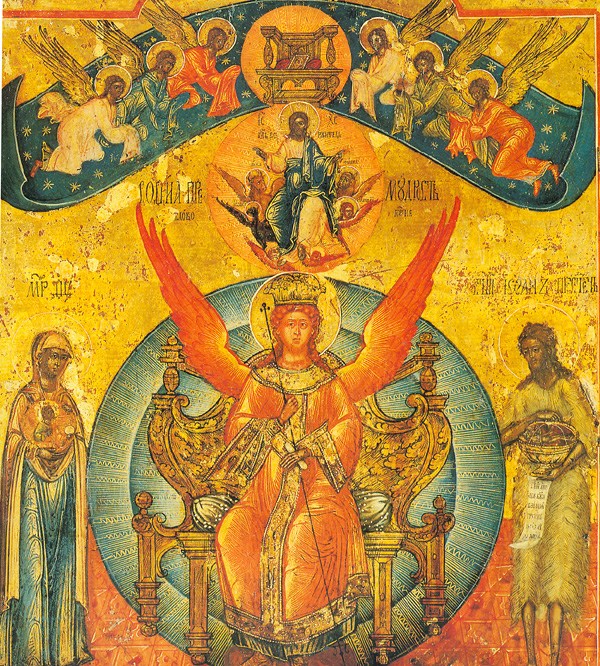
Introduction
The modern Sophiological tradition emerged from the Russian religious renaissance of the late nineteenth and early twentieth centuries, chiefly through Vladimir Solovyov, Pavel Florensky, and Sergius Bulgakov. Its central question was how Creation could remain wholly distinct from God while still being capable of receiving and manifesting divine life. Sergius Bulgakov developed this notion most fully by distinguishing Divine Sophia, God’s eternal Wisdom, from creaturely Sophia, Creation participating in that Wisdom through time, freedom, and grace. The language was controversial from the beginning, since Sophia could appear to blur the distinction between Creator and creature or introduce something resembling a fourth divine hypostasis.
What interests me in Sophiology is that Creation is not spiritually neutral matter upon which salvation is later imposed. Instead, it is made through Wisdom and therefore possesses, within its own creaturely limits, a capacity for sanctification and transfiguration. I use Sophia in this sense: not as a divine feminine person or world-soul, but as Creation ordered towards God and capable of receiving divine life without ceasing to be Creation.
I first came to this problem as teenager through poetry of William Blake, Robert Graves, and his protégé Ted Huges. Blake’s emanations made relation and sexual contrariety central to the divided human person, Graves gave the feminine mythic and erotic force through the Goddess and the Muse, while Hughes carried the same questions into animal life, landscape, and historical violence. Their poetry also exposed the weakness of such symbolism, with the feminine becoming subordinate to masculine action in one writer and swollen into sovereign Goddess-power in another. What remained difficult was to explain receptivity without turning it into either passivity or possession.
That question became theological for me during a pilgrimage to Russia in 2014. Entering the Church of the Holy Sophia in Novgorod, I encountered in the icon something the poetry had only suggested: matter bearing a presence it did not originate. Together with Dostoevsky and Berdyaev, that experience contributed to my conversion from atheism to Eastern Orthodoxy soon afterwards.
At the Annunciation, Mary received what she could neither originate nor control, yet her assent was indispensable to what followed. Her affirmative (genoitos) is neither passive submission nor an assertion of autonomous will. She receives what she cannot originate, but her reception becomes consent, pregnancy, motherhood, and a life continually shaped by what she had received. The feminine, understood in this sense, identifies a condition shared by all created life: existence is received before it can be acted upon, and freedom begins in the response made to that calling.
Sergius Bulgakov and William James on the Becoming of Truth
Sergius Bulgakov describes “becoming, emergence, development, fulfillment” as the “fundamental mark of the created world” (S-WG, p. 74). Creation is complete in the elementary sense that God has truly created it, yet a created thing is not thereby finished. Bulgakov reaches for a plant analogy: “the seed remains only a seed, and not the plant itself” (S-WG, p. 75). An acorn already possesses the nature from which an oak can grow, but the mature tree does not secretly stand complete inside it. Growth requires weather, soil, time, and the continuing activity of the organism. Disease can deform it; drought can arrest it; a tree that survives will carry in its final shape the history through which it grew. Bulgakov wants Creation to possess this kind of reality. Its form is given, but its history is not superfluous.
William James offers a useful language for the temporal side of the argument when he writes that “truth happens to an idea. It becomes true, is made true by events” (P, p. 97). A truth may have an objective ground and still require events in which its relation to reality becomes actual. James later compares truth with health and wealth, both of which are also “made” in experience (P, p. 104). Health is not whatever a doctor decides to call healthy, and wealth is not created simply by declaring oneself rich. In each case there are real conditions that precede our judgement, but those conditions have to become actual. A body has to function, recover and sustain itself as healthy. Resources have to be produced, accumulated or exchanged before they amount to wealth. Neither health nor wealth is invented by the activity that realises it, yet neither exists merely as an abstract possibility. James treats truth in the same way: it becomes true through the relations and consequences by which an idea proves itself in experience.
Bulgakov describes Creation in much the same way. Its form is given in Wisdom, but what is given must still be realised in time. The eye is formed and possesses the capacity for sight before it sees anything, language permits truthfulness and deceit before an honest word or cunning lie is told, and freedom is given before a person has done anything worthy or vicious with it. Bulgakov can consequently say that the world both “is, and at the same time is not, the creaturely likeness of divine Sophia,” since that likeness is approached “in the course of the world process” (S-WG, p. 75). Creation already bears Wisdom in its capacities and history records what those capacities become.
This also gives evil a clearer place as falsehood has no language of its own and must borrow the human power of speech. Cruelty requires agency, domination requires social power, and exploitation requires a value or property to be extracted. Evil does not produce a rival set of created forms. Rather, it bends existing capacities away from the good that made them possible. To this extent, the intelligence used to understand another person can become the intelligence used to manipulate them, sexual attraction can become attention to another body or the wish to possess it, and political authority can protect a common life or treat citizens as expendable material for a programme. The corruption is parasitic: each distorted act still depends upon the good capacity it has turned against its proper end.
Freedom is consequently unlike the modern fantasy of self-origination and social contract. Nobody begins by choosing a body, ancestry, language, or world and only afterwards enters relations voluntarily. We find ourselves already implicated in them, with the self that later claims independence has been fed, spoken to, named, and taught before it possesses the intellectual resources with which to imagine itself autonomous. Creaturely freedom begins inside a received life.
The feminine can be recovered here without reducing the female to metaphysical receptacles for masculine action. Receptivity is older than that division and belongs to everything created because Creation receives its existence. Bulgakov inherited from the Russian Religious Renaissance an essentialist tendency to associate the feminine with receptivity, but his later Mariology pushes beyond the simple allocation of feminine and masculine functions. Mary’s significance eventually extends beyond women because Bulgakov can speak of all Christians as called to become Spirit-Bearers or even Divine Mothers, giving Christ form in thought and action. Femininity begins to describe a vocation of creaturehood rather than a religious duty imposed upon one sex.
The Feminine in William Blake and Robert Graves
In his poetry, William Blake rejects the notion of self-sufficient individuality. For, as he writes in Jerusalem: “Man is adjoined to Man by his Emanative portion” (J, 39:38). The emanation belongs to the person rather than arriving as an optional companion from outside, and the self discovers that part of its own wholeness exists in relation. Blake’s mythology is full of the damage done when reason tries to stand alone, treating imagination, affection, and embodied life as subordinate regions to be controlled.
His sexual symbolism does not always escape the hierarchy it attacks. In Milton the weary are taken into shelter “Like Women & Children” while “every Man” continues forward (M, 31:1–5). The feminine is associated with protection and care, but the movement of the poem still belongs to men. Woman may be necessary to the restoration of the masculine self, yet she remains too easily cast as the one who receives, shelters, consoles, and completes him rather than as an equal centre of action.
In Blake’s later poetry, especially Jerusalem, this division begins to break down as he makes the dependence of masculine and feminine even stronger: “Man cannot unite with man but by their Emanations” (J, 88:10). The emanation is no longer simply the feminine part that shelters or restores an acting male. It becomes the means through which divided human beings can enter relation at all. Jerusalem herself carries maternal and affective qualities, but she also represents a consciousness in which thought and feeling have been brought back into relation. Blake is therefore moving beyond the idea that men think while women feel. The division of those powers is itself part of the fallen condition, and their recovery has to occur in both sexes.
Robert Graves answers the problem of passive femininity by giving his Goddess overwhelming agency. In Mammon and the Black Goddess, the poet reaches a “Goddess of Wisdom” only after passing through the “passionate ordeals” of her White aspect (MBG, p. 162). Wisdom is no longer sterile intellect. It is encountered through sexual love, betrayal, ageing, suffering, and poetry. Graves’s Goddess emerged from the attempt to recover a mythic and non-rational wholeness after the psychic destruction of the Great War, with the White Goddess gradually darkening into a figure of Wisdom, Night, and Death whose attraction lies partly in her refusal of the rational civilisation Graves distrusted.
Graves brings wisdom back into embodied life. Desire, sexual love, suffering, ageing and death are not obstacles to knowledge but part of the experience through which it is gained. Both desire and mortality must enter the account, yet his woman readily becomes the bearer of a symbolic office constructed around the poet’s needs. Muse, lover, destroyer, and initiatrix are enormous roles, but their grandeur can obscure the person expected to perform them. Graves’ poetry transforms landscape, woman, and myth into a psychological country through which the poet recovers what modernity has taken from him. He gives the feminine immense symbolic power, but the individual woman can still be reduced to the role she plays in the poet’s spiritual and erotic drama.
In both Blake and Graves, the difficulty is that the female can still be defined by a role assigned in advance. In Blake she often receives, shelters or restores. While in Graves she becomes Muse or Goddess, the source of ordeal and revelation – leaving actual women orbiting the poet’s ordeal. One diminishes the feminine, the other magnifies it, but both risk turning the woman into a function within a drama centred on male transformation.
Marian Affirmation and the Openness to Receive
Moving into Scripture, Luke’s account of the Annunciation does not make Mary a passive instrument of the Incarnation. Gabriel brings the message, but Mary listens, questions and finally consents: “Behold the handmaid of the Lord; be it unto me according to thy word” (Lk 1:38). God initiates the event, yet Mary’s assent remains a genuinely human act, freely given rather than supplied for her.
Mary’s genoito does not end with the words spoken at the Annunciation. Her consent has to be lived. She carries the child, gives birth, flees with him from Herod, raises him, and finally watches him die. Bulgakov therefore treats Mary’s deification as a process extending from the Annunciation to the Dormition, and her response becomes the pattern of an entire life rather than a single moment of assent. Mary as the Theotokos receives Christ once, but what that reception demands of her continues to unfold through history.
Bulgakov can therefore describe her genoito as continual. What she receives once has to be received again under conditions she did not choose. There is nothing passive about enduring the consequences of a gift whose shape changes as it grows. Her agency lies neither in originating Christ nor in controlling what Christ becomes. She gives the Incarnation the human conditions that only she can give: her flesh, consent, care, and continued relation to a son whose identity always exceeds her maternity.
For Bulgakov, Sophia does not become another person inside Mary. Created Wisdom becomes personal in the way a human life is actually lived. Mary is the fullest human expression of creaturely Sophia and Bulgakov understands her not as an incarnation of the Holy Spirit but as a human hypostasis wholly penetrated by the Spirit. The distinction preserves her humanity – Mary does not become less created as she becomes more holy.
“She is created Wisdom, for she is creation glorified,” Bulgakov writes (S-WG, p. 126). The sentence could easily become dangerous if detached from that distinction. But Mary is not Sophia because femininity conceals a divine nature underneath creaturely existence. She is Sophia because creaturely existence in her becomes extraordinarily open to what it was made to receive. The human answer remains human even when it bears God.
Pregnancy is irreducibly female; there is no need to dissolve its bodily particularity into an abstract symbol available equally to everyone. Yet what happens through that female body reveals something every creature shares. We all begin by receiving a life we did not originate. Mary’s distinction is that receptivity reaches a unique perfection in her without cancelling initiative, intelligence or courage. Bulgakov’s Mariology both inherits sexual essentialism and eventually opens discipleship to a universal divine motherhood, in which men as well as women are called to receive the Spirit and give that reception form in the world.
The Theotokos does not prove that woman is naturally passive. Rather, she makes the active-passive opposition itself look inadequate. Her receptivity is not inactivity, since assent commits her to a course of action whose consequences she must continue to bear. Nor does her freedom consist in mastering what she has received. Christ remains other to her even as He takes flesh from her, and His life cannot be reduced to an extension of her own will. Reception therefore demands a different kind of freedom from possession: the capacity to accept what comes from beyond the self, to give it room to become what it is, and to remain answerable to it without trying either to absorb it or control its outcome. Mary’s genoito is active precisely because what she receives is never simply hers to command.
Bulgakov on Answerability
Bulgakov finds the same discipline of freedom in the making of an icon. The iconographer does not begin with passive material upon which an image can simply be imposed. He works within forms already received through the tradition of the Church, attends to the character of the materials before him, and submits his own invention to the person he is trying to represent. Bulgakov therefore describes the icon as a work that “knows and loves its own forms and colors, understands their revelation, governs them, and is obedient to them” (I, p. 40). The contradiction here is deliberate, as the artist must govern because an icon will not make itself, but he must also obey because neither the material nor the sacred image begins with his will. His freedom lies in bringing something into form while remaining answerable to what he has received.
The same relation between creative freedom and attention to what resists it appears in other forms of making: an idea that feels complete in the mind can unravel when forced into a sentence, a carpenter has to work with the grain of the wood, and stone can split along a fault when the sculptor forces it too hard. Artistic freedom survives each correction; indeed, the work becomes more fully the artist’s because he has allowed something besides his first intention to affect what he makes. As I have argued elsewhere in my essay on art, a work becomes more truthful when the subject or material is allowed to revise the maker rather than merely supply evidence for a conception already settled in advance.
Visiting Niagara, Bulgakov watched “the mist and spray, the chaos, the seething” and yet saw within it “the lucid form of the flowing power of the water” (QT, p. 51ff.). He imagined the Falls as something like the primordial waters of Genesis, with form and formlessness already struggling together, and wrote that light “delicately and persuasively penetrates the tohu va-bohu” (ibid.), not abolishing the tumult but making its form visible from within. Beauty was not imposed upon matter once disorder had been overcome. Rather, it appeared through the very forces that seemed to resist it, as divine light entered Creation without battering it into submission.
In Unfading Light, Bulgakov described the contrary impulse as magism, a desire for power severed from love. Art succumbs to this same temptation whenever it seeks “to become magical” by “acquiring power over the world” (UL, p. 324). The danger is not creative power itself, but the attempt to make reality answer only to the artist’s will. The iconographer must both govern and obey – magism does the first and discards the second.
Mary’s genoito can be understood in the same terms, as she did not originate the Incarnation, but her assent and her body gave it its human form. The iconographer likewise works with an image, a tradition, and materials that preceded him, yet the icon still depends upon his skill and judgement. Receptivity in either case was not passivity. What had been received became actual through a freedom that answered to it rather than claiming it as its own.
Tolkien and Sub-Creation
In “On Fairy-Stories” J.R.R. Tolkien wrote that “we make in our measure and in our derivative mode, because we are made” (OFS, p. 80). The artist does not create ex nihilo. He receives a world already possessing forms, materials and meanings, then makes something genuinely new from what has been given. Sub-creation therefore depends upon the very limitation that distinguishes the creature from the Creator. Human making remains real without having to pretend that it begins from itself.
The Lord of the Rings gives the opposite temptation to Galadriel. When Frodo offers her the Ring, she imagines what her existing powers might become if they were freed from every limit: “In place of the Dark Lord you will set up a Queen,” until finally “All shall love me and despair!” (LR, pp. 365–66). The temptation is not simply to become evil. Rather, Galadriel imagines herself beautiful, wise and terrible, using overwhelming power for what she could still regard as good. The Ring corrupts more deeply by allowing the creature to imagine that the good can be secured through possession, with every other will finally brought beneath her own.
Her refusal is therefore more than an act of restraint. “I will diminish, and go into the West, and remain Galadriel” (ibid.). This scene can be read against Galadriel’s earlier pride and how the immense Queen of her temptation gives way again to Galadriel herself. To “remain Galadriel” is to refuse an apotheosis that would actually destroy the person it appeared to exalt. She accepts limitation, mortality within the history of the Elves, and the loss of the power by which Lothlórien has been preserved. Diminution is not her defeat. Instead, it is the price of remaining a creature rather than turning her gifts into a claim upon everything around her.
Galadriel’s refusal also involved accepting the fading of the world she had preserved. Tolkien had seen a danger within the Elves’ love of beauty itself. In Letter 154, he wrote that they desired the “peace and bliss and perfect memory of ‘The West’” while remaining in Middle-earth, became increasingly preoccupied with fading, and allowed their art to become “antiquarian,” their efforts finally “a kind of embalming” (TL, L.154, p. 196). The temptation is subtle because the Elves do not wish to destroy what they love, but to save it from change. Yet a world held permanently in its most beautiful moment has been denied the becoming that belongs to created life. Nenya allows Galadriel to preserve Lórien against the movement of time; the One Ring would make that desire absolute, giving her the power to keep what she loves by bringing it wholly beneath her will. Her decision to “diminish” therefore accepts more than personal limitation. Lórien will fade, the Elves will depart, and Middle-earth will pass into another age. To “remain Galadriel” is also to relinquish the claim that what she loves must remain forever as she wishes it to be.
Bulgakov’s magism and Tolkien’s Ring then approach the same corruption from different directions. Creative power becomes destructive when it can no longer receive any limit from what lies beyond itself. The Ring promises mastery, while Galadriel’s refusal preserves relation. What she already possesses remains gift rather than entitlement, and her greatness survives because she does not need to make herself its source.
Ted Hughes and Historical Disorder
The poetry of Ted Hughes brought the argument into a landscape already marked by violence, labour, and memory. Nature in Hughes is never simply passive scenery. It had its own force and history, and human use does not leave it unchanged. Growing up beneath Scout Rock in the Calder Valley, Hughes later called the rock his “memento mundi,” his “spiritual midwife” and his “godfather,” adding that “from my first day, it watched” (W-SMP, p. 122) In Remains of Elmet, that sense of an independent natural presence remained, but it had become inseparable from quarrying, mills, and industrial decline. The landscape did not stand outside history but carried what human violence had done to it.
In Remains of Elmet, that independent natural presence survives, but no longer outside human use. “Hill-Stone Was Content” follows the stone from the hillside into the mills, where it “let itself be conscripted” and remains “Defending this slavery against all” (RE, p. 37). To say conscripted gives quarrying the language of forced service. The stone’s strength and endurance, once properties of the hill, are commandeered to support the industrial order imposed upon it. In defending this slavery, the irony is brutal: with stone that has been subjected to industrial use becoming the very material that sustains the system imposed upon it. The mill, however, is built from the very stone quarried from the hill. Industry has not replaced nature with something alien but forced the existing material into a historical form that now bears the marks of its own subjection.
Once the hill-stone has been quarried, built into mills, and blackened by their use, its natural and human histories can no longer be cleanly separated. The stone remains what it was, but it also bears what has happened to it. Any recovery of its created form therefore has to include that history rather than imagine an untouched nature hidden beneath it. Bulgakov had approached the same problem at Niagara, where he saw form emerging from within the turbulence rather than appearing only after disorder had been subdued. Form does not depend upon first removing disorder. For as Hughes demonstrates, disorder is historical: the marks of labour and exploitation enter the thing itself.
Conclusion
Returning to Scripture, the risen Christ still bore the wounds of the Crucifixion. When Thomas doubted, Christ did not offer him an untouched body but told him to put his hand into His wounded side (Jn 20:27). Resurrection had overcome death without erasing what had happened to the body that died. The wounds remained, no longer as signs of defeat but of victory over death – the body was glorified as the same body that had suffered.
Thus, Sophia can finally be separated from the fantasy of perfectibility that so often accompanies talk of divine form. Creation does not become holy by having everything recalcitrant, painful, and historical stripped away until the divine design shines through uncontaminated. If the created thing is to be redeemed, the thing that actually lived must reach fulfilment. Mary as the Theotokos remains the woman who consented, bore, fled, endured, and grieved; the icon remains wood and pigment; Hughes’s stone remains the stone that was quarried and built into a mill; and the risen body of Christ remains the body that was scourged and crucified.
Received existence leaves marks because it is exposed to what it receives. That vulnerability is not peculiar to women and cannot safely be imposed upon them as a spiritual destiny but belongs to relationality itself. A being that cannot be affected by anything outside itself may be impregnable, but it cannot love, learn, create or bear another life. Creaturehood is not a lesser form of divine self-sufficiency. Rather, its dignity lies elsewhere: in being capable of receiving what it did not create without losing the freedom to answer it.
What Mary as the Theotokos reveals is not a quality naturally belonging to women and absent from men, but a truth about created existence itself. No creature begins from itself. We receive a body, a world, and capacities whose origins precede our freedom, and freedom begins in what we make of them. The attempt to escape this condition by becoming self-sufficient does not perfect creaturehood but refuses it. Autonomy, when pushed as far as self-origination, becomes a fantasy of being uncreated.
Mary offers a different model because reception, in her, became creative rather than passive – what she received became fruitful through her. She did not merely accept something already complete and preserve it unchanged. What she received became flesh through her, entered into history, and demanded a response that continued long after the Annunciation. Her freedom consisted neither in originating the vocational calling nor in surrendering herself before it, but in giving what she alone could give to something whose source remained beyond her. This is why the feminine in Sophiology cannot finally be reduced to passivity. Reception is capable of producing forms that did not exist before the encounter.
The deeper consequence is that Creation reaches fulfilment not by overcoming its dependence upon what gave it being, but by becoming capable of receiving that gift without distortion and returning it freely. The created world does not become divine by ceasing to be creaturely. Its perfection lies in becoming completely what only a creature can be: a being whose existence is received, whose freedom is real, and whose answer to what has been given is genuinely its own.
Sources and References
~ (S-WG) Sophia: The Wisdom of God – An Outline of Sophiology (Lindisfarne Press, 1993) by Sergius Bulgakov.
~ (P) Pragmatism: A New Name for Some Old Ways of Thinking (Longmans, Green, and Co., 1907) by William James.
~ (J) Jerusalem: The Emanation of the Giant Albion (University of California Press, 2008) by William Blake.
~ (M) Milton: A Poem in Two Books (University of California Press, 2008) by William Blake.
~ (MBG) Mammon and the Black Goddess (Cassell, 1965) by Robert Graves.
~ (Lk) The Gospel According to St Luke (Authorized Version) from The Holy Bible.
~ (I) Icons and the Name of God (William B. Eerdmans Publishing Company, 2012) by Sergius Bulgakov.
~ (QT) Quiet Thoughts: Ethics, Culture, Sophiology (Oleg Abyshko, 2008) by Sergius Bulgakov.
~ (UL) Unfading Light: Contemplations and Speculations (William B. Eerdmans Publishing Company, 2012) by Sergius Bulgakov.
~ (OFS) Tolkien On Fairy-stories (HarperCollins, 2008) by J. R. R. Tolkien.
~ (LR) The Lord of the Rings (Houghton Mifflin Company, 2004) by J. R. R. Tolkien.
~ (TL) The Letters of J. R. R. Tolkien (Houghton Mifflin Company, 1981) by J. R. R. Tolkien.
~ (W-SMP) “The Rock,” in Worlds: Seven Modern Poets (Faber and Faber, 1974) by Ted Hughes.
~ (RE) Remains of Elmet (Faber and Faber, 1979) by Ted Hughes.
 The Beginning of Terror