
Introduction
The idea for this essay arose from a conversation with a work colleague over the diabolical claim that beauty lies in the eye of the beholder. The glib phrase reduces aesthetic judgement to private feeling and passing fancy, collapsing beauty into private appetite and reflex emotion. Whatever pleases, agitates, or flatters the observer is declared beautiful merely because it has produced a response. Walking through the gardens of Floors Castle in the Scottish Borders, I began to consider a different account. Beauty may depend upon perception, but not upon preference alone. It emerges when attention is disciplined enough to let a subject resist the meanings we first impose upon it, and when art gives that corrected vision a form through which something real becomes newly visible.
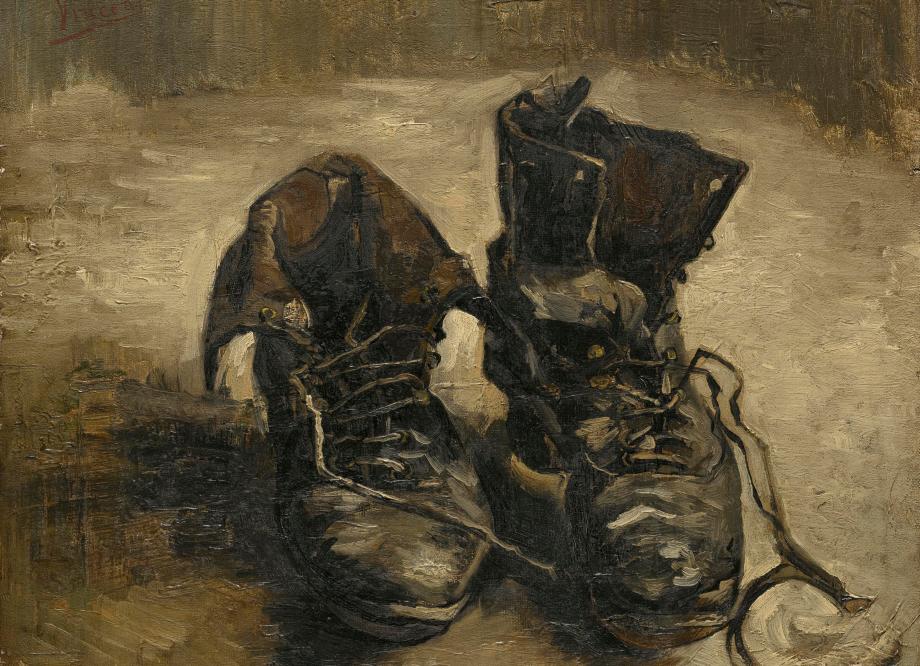
In Poetry, Language, Thought, Martin Heidegger argues that an artwork does more than reproduce something already available to ordinary sight. In art, “the truth of beings” is “setting itself to work” (PLT, p. 38): the work allows a thing to appear within relations that habitual recognition or practical use normally passes over. His discussion of Van Gogh’s shoes begins with an object whose purpose seems obvious. As equipment, shoes are noticed chiefly when they are needed or when they cease to function; when they serve the user well, they largely disappear into their use. The painting interrupts this familiarity, with the worn shoes disclosing something of the world to which they belong – their wear and tear, clods of mud, threadbare laces, etc. Heidegger is therefore interested less in what the shoes resemble than in what becomes perceptible through their representation, as the painting brings into view a way of being that the ordinary recognition of a mere pair of shoes leaves concealed.
His Greek temple example extends the argument beyond an individual object. The temple “sets up a world” (PLT, p. 43) because it gathers into one place the relations through which a historical people understands itself: the presence of the divine, communal worship, birth and death, victory and disgrace, blessing and disaster. These things do not merely occur beside the temple, but through the order it establishes they acquire a shared significance. Yet the same work that opens this human world also makes more conspicuous what Heidegger calls earth. Standing upon the rock and exposed to the weather, the temple brings forward the working and shape of the stone, the brightness of daylight upon its surface, and the force of the elements against it. Earth does not mean simply raw matter buried beneath cultural meaning, but hints at a dimension of things which comes into appearance while never becoming completely transparent or exhaustible. Hence the artwork “lets the earth be an earth” (PLT, p. 45). Stone can be measured and cut, but such knowledge does not use up the experience of its heaviness and resistance, and sunlight can be described physically without exhausting the way it shines. The artwork thus discloses a world without reducing everything it contains to that world’s meanings. What appears through art retains an independence from the interpretation that has brought it into view.
Such resistance provides a way into the act of making itself. An artist seldom begins with the full apprehension that the completed work will contain. A novelist may initially understand a character as cowardly and find, through the pressure of composition, that the judgement no longer explains their actions. What began as a stable moral description becomes unstable because the imagined life has acquired relations that the description cannot contain. The same corrective process may occur to a painter during a portrait sitting. The subject may at first appear haughty and pride will dominate the painter’s perception, only for lines around the eyes, twitching of the mouth, and shaking of the hands to change the expression from secure superiority into something defended and precarious.
Artistic seriousness begins when such discoveries are allowed to alter the work. A novelist who has decided that a character is cowardly can continue arranging events so that every action confirms the judgement. A painter who first sees pride in a sitter can exaggerate the features that support it and suppress whatever complicates the impression. In both cases the artist remains in control only because nothing encountered is permitted to revise the original conception.
A stronger work develops when observation carries consequences. If the novelist discovers that fear is entangled with responsibility, shame, or loyalty, the character must begin to act differently on the page; if the painter notices exhaustion beneath the sitter’s composure, the portrait must somehow make room for both. The discovery cannot remain an interesting thought outside the work. It has to change what is selected, emphasised, omitted, or given form. Otherwise the artist has seen more without allowing the work itself to become more truthful.
Creation therefore involves a tension between control and correction. The artist still chooses, arranges, invents, and excludes, but those choices are no longer made in complete freedom from the subject. They are tested against what has been noticed and revised when they cease to fit. Art is neither the passive copying of a ready-made reality nor the imposition of a private design upon inert material. It is a process in which the artist gives form to something only after accepting that the thing represented may resist the first meaning imposed upon it.
Ego and the Reduction of the Subject
Iris Murdoch gives this problem a moral and psychological dimension of sorts when she describes “the fat relentless ego” as an enemy of truthful vision (SG, p. 51). Ego here means more than vanity. What she has in mind is the way consciousness bends what it sees towards its own habits of judgement, desire, fear, and explanation. Once that process has begun, the world becomes easier to read because less and less is allowed to contradict the interpretation already in place.
Fiction makes the danger particularly clear. For if a novelist decides too early that a character is contemptible, every action can be made to confirm the judgement. Hesitation becomes cowardice, courtesy calculation, compromise duplicity, etc. None of these readings is impossible in itself, but together they create a closed system in which the character can no longer surprise the author. In Lord of the Rings, J.R.R. Tolkien avoids precisely this mistake with Gollum. He remains deceitful, dangerous, and finally treacherous, but these qualities never become a complete explanation of him. His attachment to Frodo, his fear of Sauron, his dependence upon the Ring, and the intermittent return of Sméagol in his cleaved personality continually disturb the easier judgement that he is simply a villain. The reader is not prevented from judging Gollum. Rather, the judgement becomes harder to settle because Tolkien allows the character to retain a life beyond it. I will add, too, that biography can also fall into the same trap and become either hagiography or a hatchet job. An example of the first could be Andrew Roberts’ Churchill: Walking with Destiny, and of the latter, Tariq Ali’s Winston Churchill: His Times, His Crimes. In both cases, the conclusion has determined the evidence.
Murdoch’s distinction between fantasy and imagination explains why this produces bad art. Fantasy is “mechanical, egoistic, untruthful,” whereas imagination is “truthful and free” (MM, p. 321). Fantasy is mechanical because the work no longer discovers anything. Details are admitted only after their meaning has been settled, so apparent richness merely supplies further confirmation of what the artist already believed. The work may still be technically accomplished and internally coherent, but its coherence has been achieved by excluding whatever might have forced the artist to think again.
Good intentions do not prevent the same reduction. To provide an example, take the politically charged issue of private renting in the UK. A documentary about rentier landlords may begin from a perfectly legitimate concern with exploitation and still narrow the reality it claims to expose. If every dispute is organised around greed and indifference, the landlord’s conduct becomes self-explanatory before the circumstances of the tenancy have been considered. A refusal to carry out further repairs may be negligent, but it may also follow repeated damage to the property, persistent arrears, or behaviour that has made the tenancy difficult to manage. None of this cancels the landlord’s obligations, still less excuses exploitation where it exists. It does, however, alter the moral shape of the case. Once such facts are excluded because they complicate the intended judgement, the documentary has ceased to investigate a relationship and begun arranging one party as evidence against the other.
The answer is not to balance every judgement with an opposite trait. Giving the villain a tender moment or the victim a flaw simply produces a more elaborate formula. But Murdoch’s demand is stricter – the artist must remain willing to discover that the first judgement was incomplete, and to let that discovery alter the work. Attention becomes truthful when the subject retains enough independence to resist the role assigned to it.
Attention and Particularity
Murdoch calls attention “a just and loving gaze directed upon an individual reality” (SG, p. 33). Justice here belongs to the accuracy with which different aspects of a life are allowed to bear upon one another. A drunken father remains responsible for the fear and harm he causes, but his conduct becomes more intelligible if drink has become the habitual answer to humiliation, poverty, or a life he experiences as failure. None of this excuses the cruelty that follows. Rather, it places that cruelty within the shape of a particular life, where explanation can deepen judgement without dissolving it.
The superior work of art is one that learns to preserve this double movement. Artistic judgement thus gains force from limits placed upon its own claims. The artist relinquishes the satisfaction of possessing a complete explanation in order to make a more precise one.
Murdoch puts the point most clearly in her account of love: “Love is the perception of individuals. Love is the extremely difficult realization that something other than oneself is real” (EM, p. 215). The difficulty begins once a useful description starts to feel complete. Someone may indeed be a victim, a tyrant, a criminal, a coward, or a saint, but none of those designations can contain the whole person. Attention becomes false when the category starts deciding in advance what can be seen. Murdoch’s loving gaze does not ask one to abandon judgement but requires that enough room is permitted for the person judged to remain more than the judgement.
Murdoch’s emphasis on the individual also explains why particular detail matters in art. Simply adding more description does not necessarily make a character more real. A writer can tell us the colour of a man’s coat, the shape of his face, and the furniture in his room without revealing much about him. A single action may do more. An elderly man who refuses help with his coat or pauses before a staircase tells us something about the way he is experiencing his own decline. Such details matter because they reveal a person rather than merely describing their appearance.
Attention consequently develops through revision rather than duration alone. Looking longer is valuable only insofar as what is newly perceived is allowed to reorganise what seemed obvious at first. The artist who protects the first conception can observe indefinitely and remain trapped within it, whereas the artist willing to be corrected may discover that one small contrary detail has changed the character of the whole.
Imagination Under Constraint
Attention does not require the artist merely to record what is already there – novelists invent scenes and dialogue, while painters alter colour, proportion, and perspective. Murdoch’s distinction is between invention that answers to the subject and invention that forces the subject towards a desired effect. “We use our imagination not to escape the world but to join it” (SG, p. 88).
A novelist writing an unhappy marriage, for example, may initially give husband and wife a confrontation in which both explain their grievances with perfect clarity. The scene might tell the reader everything and still feel false. After twenty years together, resentment is rarely confined to a single cause. It has accumulated through past slights, bad habits, irritating character traits, disappointments that were never quite settled, and arguments whose original subject has long since become entangled with everything that followed. By the time the couple quarrel, a remark about money, the fact they can’t have children, or some trivial domestic irritation may carry the weight of years. The writer therefore invents more truthfully by allowing that history to shape what is said, what is avoided, and why an apparently minor exchange can become charged with meanings that both characters already understand. To give three examples, from three of my favourite books, by three of my most beloved authors:
- In Graham Greene’s The Heart of the Matter, the unhappiness of Scobie’s marriage to Louise cannot be traced to a single breach or failure. The death of their daughter, Louise’s dissatisfaction, Scobie’s pity for her, and his increasing sense of duty have already altered the marriage before Helen enters it. His affair therefore does not create the crisis so much as expose tensions that have been accumulating for years.
- With his black humour and merciless social commentary, Evelyn Waugh confronts the same problem in A Handful of Dust, with Brenda’s affair with Beaver growing out of an estrangement already visible in her boredom with Hetton and the life Tony continues to value. Adultery becomes less the beginning of their separation than the point at which an existing distance between them becomes impossible to ignore.
- In The Sheltering Sky, Paul Bowles makes the estrangement of Port and Kit more diffuse still. Their marriage is worn down by sexual infidelity, habit, dependence, and an inability to understand what the other now wants from their life together. Travel does not simply cause their alienation; it strips away the routines that had allowed them to live alongside it. By the time their relationship begins to fracture openly, neither one event nor one grievance can explain what has happened between them.
Imagination therefore gives the artist considerable freedom, but that freedom is not arbitrary. A novelist can invent actions, conversations, and motives that never existed outside the work, yet each invention must remain convincing within the character and circumstances already created. The writer cannot simply make a person behave differently because the plot requires it, or give him an insight he has shown no capacity to possess. Invention becomes truthful when it develops what the work has discovered rather than forcing the subject towards an ending or effect decided in advance.
Resistance and Revision
Revision sometimes requires an artist to give up something that works beautifully on its own. A novelist may write an excellent speech and then realise that the character would never speak with such confidence or self-knowledge. Or a poet may find a striking metaphor that makes suffering sound more beautiful than it ought to. In both cases the problem is not lack of skill but too much attachment to the effect itself. The passage has succeeded as writing while failing the subject.
Murdoch captures the discipline required in Rilke’s description of Cézanne: “He did not paint ‘I like it’, he painted ‘There it is’” (SG, pp. 57–58). Cézanne’s paintings are still unmistakably his, but his style develops from looking closely at what is before him rather than forcing everything into a preferred appearance.
In Cézanne’s Doubt, the embodied phenomenologist Maurice Merleau-Ponty describes Cézanne returning to the landscape until familiar conventions of perspective and composition no longer determined what he saw. Cézanne sought the motif only after prolonged looking, trying to recover the landscape as it appeared before it had been tidied into an already-known picture. His remark, “The landscape thinks itself in me, and I am its consciousness” (CD, p. 17), gives Merleau-Ponty the relation he wants: the painter neither copies a passive object nor simply projects himself upon it. The painting develops through the encounter between the painter’s way of seeing and something in the landscape that continually resists being reduced to formula.
That becomes especially powerful with images of Mont Sainte-Victoire, which Merleau-Ponty described in Eye and Mind as being continually made and remade. Cézanne painted the mountain repeatedly, but repetition did not mean applying the same established style to the same convenient subject. Each painting was another attempt to discover how the mountain held together in perception – its mass, depth, colour, and relation to the surrounding country – without forcing it into the geometrical perspective that Cézanne believed could falsify lived sight.
A personal style therefore need not mean repeating the same effect from one work to the next. It can also be the recognisable way an artist responds when a subject demands something different. The strongest artists are not those who make everything look like themselves, but those whose manner changes enough to meet what they are trying to show.
Style as Discovery
Style becomes meaningful when it grows out of the problem the artist is trying to solve. A novelist describing an event that nobody fully understands may need several narrators because no single account can contain what happened. Their disagreements then become part of the subject itself: the reader has to reconstruct the event from partial and conflicting versions rather than being given one authoritative explanation.
The opposite problem may require a very different form. A first-person narrator who does not understand what has happened to him should not suddenly acquire the language needed to explain it perfectly. The limitations of his voice become part of the novel because the reader can see more than the narrator himself can recognise.
Style becomes mannerism when the artist stops making these decisions in response to the subject and simply repeats the same device from work to work. Multiple narrators, fragmented chronology, distorted perspective, or any other recognisable technique can become empty habits if they are used regardless of what is being represented. A genuine style is not the repetition of one effect but is the recognisable way an artist finds the form that each subject requires.
The literary critic Viktor Shklovsky argued that habit is necessary to ordinary life, but it also allows familiar things to disappear beneath the ease with which we recognise them. As he wrote in Art as Device: “Automatization swallows up things, clothing, furniture, one’s wife, and the fear of war” (AD, p. 13), until we know what something is without any longer attending closely to how it appears or what it feels like to encounter it. Art interrupts this process. Its purpose, Shklovsky argues, is “to convey the sensation of things as they are seen, not as they are recognised” and “to render the stone its stony quality” (AD, p. 13). Form therefore has a practical task. An unfamiliar point of view, an unexpected description, or a disruption of ordinary narrative can slow recognition long enough for something familiar to become perceptible again. Tolstoy does this in War and Peace when Natasha sees the opera stripped of its social prestige and theatrical conventions: scenery becomes painted boards, gestures appear artificial, and singing sounds incomprehensible. The opera has not changed, but the manner of representing it has removed the assumptions that normally tell the spectator what she is supposed to see.
For Shklovsky, estrangement works only so long as it interrupts habitual perception. He writes that the artistic device depends upon “the ‘estrangement’ (ostranenie) of objects and the complicating of forms” (AD, p. 13), but any device repeated often enough can itself become familiar and lose the power to make us see afresh. Once fragmentation, distorted perspective, narrative delay, or any other unusual device becomes familiar, it can be recognised as automatically as the convention it originally disturbed. Style must therefore remain responsive to what has become difficult to see. Shklovsky makes the point differently in The Energy of Delusion when he says that “the writer uses plot to cleanse the world” and compares it to wiping “the mirror of consciousness” (ED, pp. 146, 139). Plot does not cleanse by being unusual for its own sake but changes the relations through which familiar events are perceived. An artist who applies the same device indiscriminately eventually produces mannerism rather than estrangement, because the audience learns the device and begins looking through it. The continuity of a genuine style lies instead in the artist’s repeated ability to find a form that makes the particular subject difficult enough to be seen again.
The Proto-Image and Revelation
Sergius Bulgakov begins his account of art from the distinction between outward resemblance and fuller apprehension. Breaking habitual recognition is only the beginning. Once the familiar appearance of a thing has been disturbed, the artist still has to discover what in it is worth bringing into form. As he writes in Icons and the Name of God: “The creative act of art in the iconization of a thing consists, first, in the seeing through it (to) its proto-image and secondly in its expression by the resources of art” (I, p. 47). The proto-image is not another, more perfect object concealed behind the visible one. It is the fuller character of the thing as the artist comes to understand it through sustained attention.
A portrait makes the point clearly. The painter does not merely reproduce the sitter’s face as accurately as possible. Expression, posture, age, temperament, and the way the person inhabits the body all begin to alter what the face means. The finished portrait may depart from photographic likeness and still reveal more of the sitter than an exact copy would. Bulgakov therefore distinguishes the icon from a mere “repetition or copy” and speaks instead of expressing “the meaning of a thing, its name, its idea” (I, p. 47). Art becomes truthful when appearance is not discarded but made to disclose more than it shows at first sight.
A good example of this would be Picasso’s portrait of Gertrude Stein (1905-06). After struggling with the painting through repeated sittings, Picasso eventually painted out Stein’s head and later reconstructed it without her present, abandoning straightforward likeness for the severe, mask-like face of the finished portrait. Her friends complained that it did not look like her, although Stein herself came to regard it as a peculiarly faithful image. The departure from naturalistic resemblance had not made the portrait less attentive to its sitter. Picasso sacrificed exact likeness in order to find a form capable of conveying something more enduring about Stein’s presence and character.
Of course, Bulgakov was writing of the Eastern Orthodox iconographic tradition, where the distinction between likeness and truth is fundamental. But there is not so much separating Picasso from the iconographic method as might first appear. Take the Christ Pantocrator of Saint Catherine’s Monastery at Sinai, painted in the mid-sixth century AD. Christ is recognisably human, and the encaustic technique gives the face an unusual degree of naturalism, yet the iconographer was plainly after something more than the appearance of an individual face. The striking asymmetry between its two halves has often been read as an attempt to hold Christ’s human and divine natures together within a single countenance: one side softer and more vulnerable, the other sterner and more commanding. Whether or not that interpretation exhausts the asymmetry, the larger method is clear enough. The face has been shaped by what the painter understands Christ to be. Picasso did something surprisingly similar with Stein. But neither artist treated optical likeness as the final measure of fidelity, as each altered what the eye observed to convey something that a straightforward resemblance would leave out. The difference is that Picasso discovered his image of Stein through the act of painting her, whereas the iconographer worked from a theological understanding of Christ already received through the Church.
Form, Beauty, and the Resistance of the Medium
Bulgakov’s proto-image should not be confused with an idealised version of reality. To see something more fully does not mean stripping away everything disordered, painful, or unresolved until a hidden harmony appears. Grief, for example, would be badly represented if mourning were reduced to solemn sorrow. Bereavement can contain irritation, relief, distraction, resentment, even inappropriate laughter, and these reactions belong to the experience rather than standing outside it. A work that removes them for the sake of dignity may become more coherent while becoming less truthful.
Commenting on a visit to Niagara Falls in November 1934, Bulgakov deemed that beauty was not something that emerged after chaos had been subdued, but that beauty and chaos emerged together: amid “the mist and spray, the chaos, the seething,” “the lucid form of the flowing power of the water” appeared for a moment before closing again beneath a cloud of spray (QT, p. 51ff.). While form is present, it never finally masters the turbulence from which it appears. He compares the Falls to “the ocean before the first day of creation,” when “formlessness and forms are already contained and are fighting for existence” (ibid.). Beauty therefore does not require the artist to cudgel disorder into harmony. Bulgakov finds Sophia precisely where order is still struggling to become visible within something violent, unstable, and unfinished.
The image becomes still clearer when Bulgakov writes that “the light delicately and persuasively penetrates the tohu-wabohu” (ibid.). This phrase from Genesis 1:2, meaning without form and void, signifies that uncreated light does not destroy the primordial confusion but enters it, making form perceptible without pretending that chaos has disappeared – beauty is this ray of light.
Applied to art, this allows a work to give shape to grief, violence, broken relationships, or other disordered experiences without tidying them into a resolution they do not possess. Form makes the disorder intelligible, but it need not abolish it. A work may therefore become more truthful by retaining contradiction, incompleteness, or fracture where those things belong to the subject itself.
Bulgakov describes the icon as something that “knows and loves its own forms and colors, understands their revelation, governs them, and is obedient to them” (I, p. 40). The apparent contradiction is important. An artist must command the medium, but mastery also means recognising what the material will and will not allow. Oil paint can be worked over repeatedly, whereas fresco demands decisions before the plaster dries. Meanwhile, stone may resist a projected form through its grain or weakness. These are not merely technical inconveniences; they affect how the work develops and may force the artist to change what was first intended.
The same is true of language. An idea that seems perfectly clear in the mind may become confused once it has to be written as an actual sentence. The act of giving it form exposes weaknesses that thought alone could leave hidden. Bulgakov’s point is therefore that artistic making involves both command and obedience: the artist shapes the material, but the material also corrects the artist.
Participation and Co-Creation
Bulgakov extends this reciprocity into a broader account of human making when he writes that “Man is a being who sees images…and who also creates them” (I, p. 43). The artist receives a world already shaped by material properties, inherited conventions, bodily capacities, and histories of use, yet none of these contains the finished work. Creation occurs when one possibility is developed into a form that did not previously exist. Take the two examples of music and sculpture:
- Music: Instruments arrive with physical limits produced by construction and with possibilities developed through generations of practice. A composition cannot simply be read out of those conditions, although it could not exist independently of them either. The composer creates by finding relations within and between inherited possibilities, and the act of choosing one path necessarily abandons others.
- Sculpture: A block does not contain one predetermined statue awaiting release, yet its dimensions and grain prevent every conceivable statue from being made from it. Intention enters into a negotiation with material possibility, and the finished figure may carry evidence of that encounter in a turn or proportion that the first design did not anticipate.
When Bulgakov says that human beings “actively participate in this iconization of being” (I, p. 43), participation therefore implies neither passive discovery nor unlimited authorship. The artist genuinely makes something new, but novelty arises in response to a reality whose properties and possibilities were not created by the maker. Co-creation is this very asymmetry: human freedom is real precisely because it acts within a world capable of answering back.
Selection and Partial Truth
The finite form produced by such an encounter can never contain everything that made it possible. Form is dependent upon exclusion because nothing becomes intelligible until attention has been limited. Consider the following:
- Portraiture fixes one appearance from a life in continuous change.
- Biography gives narrative shape to decades by dwelling on some episodes and compressing others.
- Literary fiction distributes attention among a small number of consciousnesses while the larger historical world remains mostly unrepresented.
Returning to Murdoch, she writes that art “condenses and clarifies the world, directing attention upon particular things” (MM, p. 8). Condensation can reveal relations that lived experience keeps apart. A novel may place events separated by twenty years close enough for the reader to perceive an alteration that the characters could experience only gradually. Portraiture can make gesture and expression modify one another because both remain simultaneously present within the image. Artistic form therefore creates knowledge by bringing selected elements into relations that ordinary temporality or practical attention would disperse.
Selection becomes deceptive when the resulting coherence conceals the conditions of its own production. A biography may turn decisions made under radically different pressures into stages of a single stable personality, giving retrospective consistency to a life that was experienced without it. Political documentary can achieve a similar inevitability when testimony is chosen chiefly for its capacity to anticipate an outcome already known to the filmmaker. The resulting sequence may contain nothing factually false and still impose a relation among facts that historical actors could not have possessed. Respective examples of these could be the following:
- Patrice Gueniffey’s Bonaparte: 1769–1802 follows Napoleon from provincial Corsica through the Revolution, the Italian campaigns and Brumaire to the Consulate. Seen from the end of that trajectory, earlier episodes can begin to look like stages in an inevitable ascent, as though the young artillery officer at Toulon already contained the ruler who would dominate France a few years later. I will add that Gueniffey is too careful a historian simply to impose such a destiny upon the evidence, but it shows the danger inherent in biography: events that were uncertain, improvised, or contingent when they occurred can acquire a unity in retrospect that nobody living through them could yet have seen, let alone Bonaparte himself.
- Michael Moore’s Fahrenheit 9/11 moves from the disputed election of 2000 against Al Gore, through the Bush family’s Saudi connections, and September 11, to the way the administration framed terrorism, national security, and Iraq in the years that followed. Moore did not invent those events, but his selection and juxtaposition make them appear as parts of a single developing story in which the Iraq War becomes the almost inevitable outcome of the administration presented at the beginning.
Murdoch’s description of other people as “far more complicated and enigmatic and ambiguous” than languages or mathematical concepts (SG, p. 89) places an ethical limit upon such formal power. A truthful work can organise experience strongly without claiming to have consumed its subject. The severe face in a portrait may establish one dominant impression, while an uncertain hand alters how that severity is understood. Indeed, John Singer Sargent used a sitter’s hands to communicate their personality and attitude. Fiction may condemn an action as cruel while leaving visible motives and attachments that cruelty does not explain. In Shakespeare’s King Lear, the titular character’s rejection of his daughter Cordelia remains cruel, but the bard allows us to see the vanity, fear of dependence, and anxiety about old age that lie behind it. None of these details absolves Lear; rather, they prevent the cruelty of one action from becoming a complete explanation of the man.
Partial truth is therefore not a retreat from judgement. The work makes a definite structure perceptible while preserving evidence that the structure does not exhaust the reality from which it has been formed. Its limit becomes part of its honesty.
Formula, Consolation, and Artistic Justice
Bad art often decides too early what we are supposed to feel. The villain becomes steadily worse because every action has to confirm our hatred. Or the victim is denied any unpleasant or inconvenient quality because pity must remain uncomplicated. Sentimentality does this by smoothing away whatever might disturb sympathy, but cynicism can be equally mechanical. A novel in which every generous act conceals selfishness has decided what human beings are before any of them have been allowed to act. Murdoch’s criticism of “self-consoling fantasy” applies to both (SG, p. 83). Consolation need not be pleasant. It can consist simply in finding the world exactly as predictable as we expected. A more truthful work allows judgement without reducing the person to the judgement. For instance:
- A murderer may remain guilty while the novel shows his tenderness towards a child, his fear of humiliation, or the loyalties that still bind him to other people. None of this excuses the murder, but it prevents the crime from becoming the only fact about the man.
- A worker can be exploited without becoming merely an illustration of exploitation; he still has pride, bad habits, ambitions, jealousies, loyalties, and a life that continues beyond the political argument being made about him.
The naturalist writer Emile Zola gives an example of the former with the Fouans in La Terre (The Earth), where the peasant family are bound to the land by poverty, inheritance, and fear of dispossession, yet remain capable of greed, cruelty, jealousy, and betrayal. Their circumstances explain why property governs them so completely without absolving what they do in pursuit of it. Meanwhile, lefty muckracker Upton Sinclair provides an specimen of the latter in The Jungle when Jurgis and his family are plainly exploited by the stockyards and the economic system around them, but Sinclair does not make them morally spotless in order to prove the case. Exhaustion, drink, anger, bad judgement, and desperation enter the story alongside the exploitation itself.
This helps explain Murdoch’s remark that “good artists can be bad men” (EM, p. 460). Artistic attention is a particular discipline rather than proof of a virtuous life. A person may be selfish, vain, or cruel in ordinary conduct and still possess the ability, while making a work of art, to look closely enough at another person to let that person remain more complicated than the role the artist first intended for them.
Take two of my favourite writers: Gustave Flaubert and Fyodor Dostoevsky. Neither man offers much support for the comforting idea that artistic greatness must rest upon personal sweetness or moral consistency. Flaubert could be vain, contemptuous, and savage in his private judgements, yet Madame Bovary gives Emma far more than the punishment of a foolish adulteress. Dostoevsky could be volatile, obsessive, and destructive in his own life, yet his novels repeatedly enter the minds of murderers, drunkards, fanatics, and humiliated men without reducing them to a single vice. The generosity lies in the work itself: the artist may fail badly in ordinary life and still possess, while creating, the patience to let another person remain more complicated than the judgement passed upon them.
Reception, the Education of Attention, and Durable Vision
A work can be simplified by its audience just as easily as by its maker. A contemporary bane is the reader who, having decided that a novel is fundamentally Marxist, religious, feminist, or autobiographical, can soon make every detail confirm the label. The interpretation may illuminate something real, but it becomes reductive once the work is no longer allowed to contradict it. Good criticism should work in the opposite direction.
Murdoch maintains that much of ordinary perception is governed by use: we notice people and things because they attract us, obstruct us, threaten us, or offer something we want. Art can interrupt that habit. Take a still life: it asks us to attend to fruit we cannot eat. A novel can make us care about people who have no existence beyond the page and can give us nothing in return. When Murdoch writes that “Beauty is that which attracts this particular sort of unselfish attention” (SG, p. 64), she does not mean that looking at art automatically makes anyone morally better. In short, art gives us practice in attending to something for its own sake rather than immediately turning it towards our own purposes.
Once an artist has given an act of attention form, other people can encounter it long after the original moment has passed. A portrait preserves the painter’s way of seeing a particular face; a poem can preserve the shape that grief or desire assumed for someone who is no longer alive. We are still puzzled by the expression on the face of Leonardo’s Mona Lisa and still recite W.H. Auden’s Funeral Blues as a eulogy for loved ones. The work does not preserve the experience itself, but something of the attention through which that experience was understood.
Going back to Bulgakov again, he gives this a wider significance when he calls humanity the “pan-icon of the world” and describes reality as imageable “for man, in man, and through man” (I, p. 43). Human beings do not merely look at the world and then leave it unchanged. Through painting, language, music, architecture, and other forms of making, aspects of experience are given a shape that others can later enter. Art therefore adds to culture not simply by producing objects, but by preserving ways in which the world has been seen.
Conclusion
The radical conclusion to all this is that art is not primarily an act of expression. Rather, it is an encounter in which the artist discovers the limits of his own expression – art begins where mastery fails.
The artist necessarily approaches the world with intentions, judgements, habits of perception and preferred forms, but the work becomes truthful only when those are no longer sovereign. A face, a landscape, a character, a block of stone, even a sentence can resist what the artist first wanted from it. That resistance is not an obstacle to creation but the condition under which creation becomes more than self-expression. The artist makes the work but does not possess the right to decide in advance what the work will finally reveal.
Art is therefore neither imitation nor invention in the usual sense. It is the discipline of allowing reality to acquire form without first reducing it to something already understood. This is why the greatest works retain an element of difficulty even after they have become familiar: they do not merely confirm a judgement but preserve the pressure of what exceeded it. The artist’s freedom lies precisely here, not in escaping constraint, but in remaining capable of being changed by what he is trying to make. A work becomes true when the world has been allowed to leave something in it that the artist could not have put there alone.
Sources and References
~ (PLT) Poetry, Language, Thought (Harper Perennial, 2001) by Martin Heidegger.
~ (SG) The Sovereignty of Good (Routledge, 2014) by Iris Murdoch.
~ (CD) “Cézanne’s Doubt,” in Sense and Non-Sense (Northwestern University Press, 1964) by Maurice Merleau-Ponty.
~ (AD) Viktor Shklovsky, “Art as Device,” in Theory of Prose (Dalkey Archive Press, 1991 / 1916) by Viktor Shklovsky.
~ (ED) The Energy of Delusion: A Book on Plot, trans. Shushan Avagyan (Dalkey Archive Press, 2007 / 1981) by Viktor Shklovsky.
~ (HO) A Hunt for Optimism (Dalkey Archive Press, 2012 / 1931) by Viktor Shklovsky.
~ (MM) Metaphysics as a Guide to Morals (Penguin Press, 1992) by Iris Murdoch.
~ (EM) Existentialists and Mystics: Writings on Philosophy and Literature (Chatto & Windus, 1997) by Iris Murdoch.
~ (I) “The Icon,” in Icons and the Name of God (Eerdmans, 2012) by Sergius Bulgakov.
~ (BL) The Bride of the Lamb (T&T Clark, 2002) by Sergius Bulgakov.
~ (QT) Quiet Thoughts: Ethics, Culture, Sophiology (St Petersburg, 2008) by Sergius Bulgakov.
 The Beginning of Terror